Reduce Grazing Intensity
Seaweed ecosystem protection is the long-term protection from degradation of wild subtidal brown and red seaweed ecosystems. Seaweeds, also called macroalgae, are photosynthetic marine organisms that absorb CO₂ from the water and convert it into biomass. This can lower surface-water CO₂ concentrations, allowing additional CO₂ from the atmosphere to be dissolved in the ocean. Some of the fixed carbon can be sequestered through export to the deep sea or burial in the seafloor, while a portion may persist in forms that resist degradation even at the ocean surface.
Protecting seaweed ecosystems can reduce a range of human impacts (wild harvesting, coastal development, overgrazing, and poor water quality) and improve resilience to other stressors (warming), which helps preserve carbon removal by the seaweed and avoid CO₂ emissions from biomass losses.
This solution focuses on legal mechanisms of protection through the establishment of Marine Protected Areas (MPAs), which are managed with the primary goal of conserving nature. This solution does not include cultivated seaweed (see Deploy Seaweed Farming for Food).
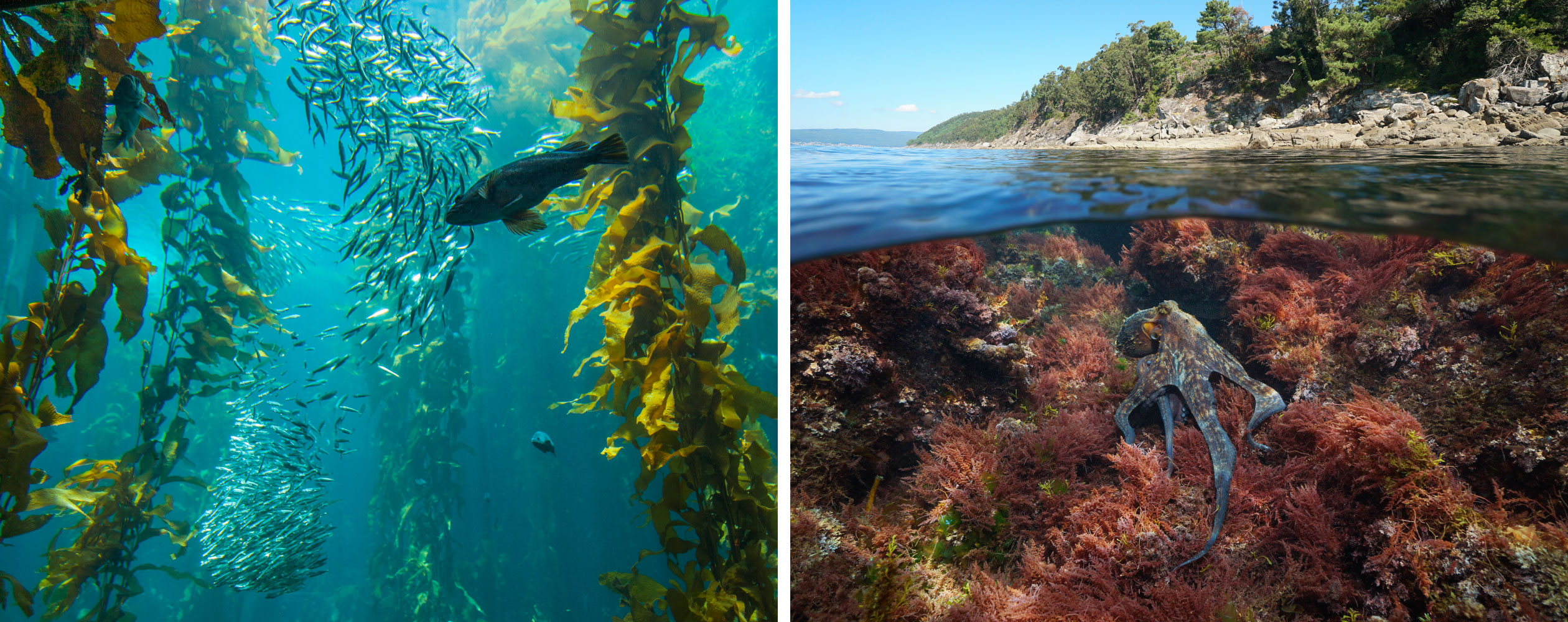
Seaweeds are diverse marine photosynthetic organisms composed of three groups: brown (Phaeophyceae), green (Chlorophyta), and red algae (Rhodophyta). They can form ecosystems, such as kelp forests, and contribute to other marine ecosystems by providing habitat and food. Seaweeds are distinguished from other algae, such as phytoplankton, based on their larger size and because most are attached to substrate rather than free-floating. Seaweeds cover an estimated 600 Mha of the ocean (Duarte et al., 2022), an area that is an order of magnitude greater than the area associated with coastal wetlands (~55 Mha, see Protect Coastal Wetlands).
This solution focuses on wild subtidal (always submerged) brown and red seaweed ecosystems, which together account for over 75% of global seaweed extent (Duarte et al., 2022) (Figure 1). We do not include green seaweeds due to their smaller extent and data limitations. We also do not include seaweeds that occur in intertidal zones, as free-floating colonies (e.g., some species of Sargassum) or are cultivated due to data limitations or coverage in other Explorer solutions (e.g., Deploy Seaweed Farming for Food).
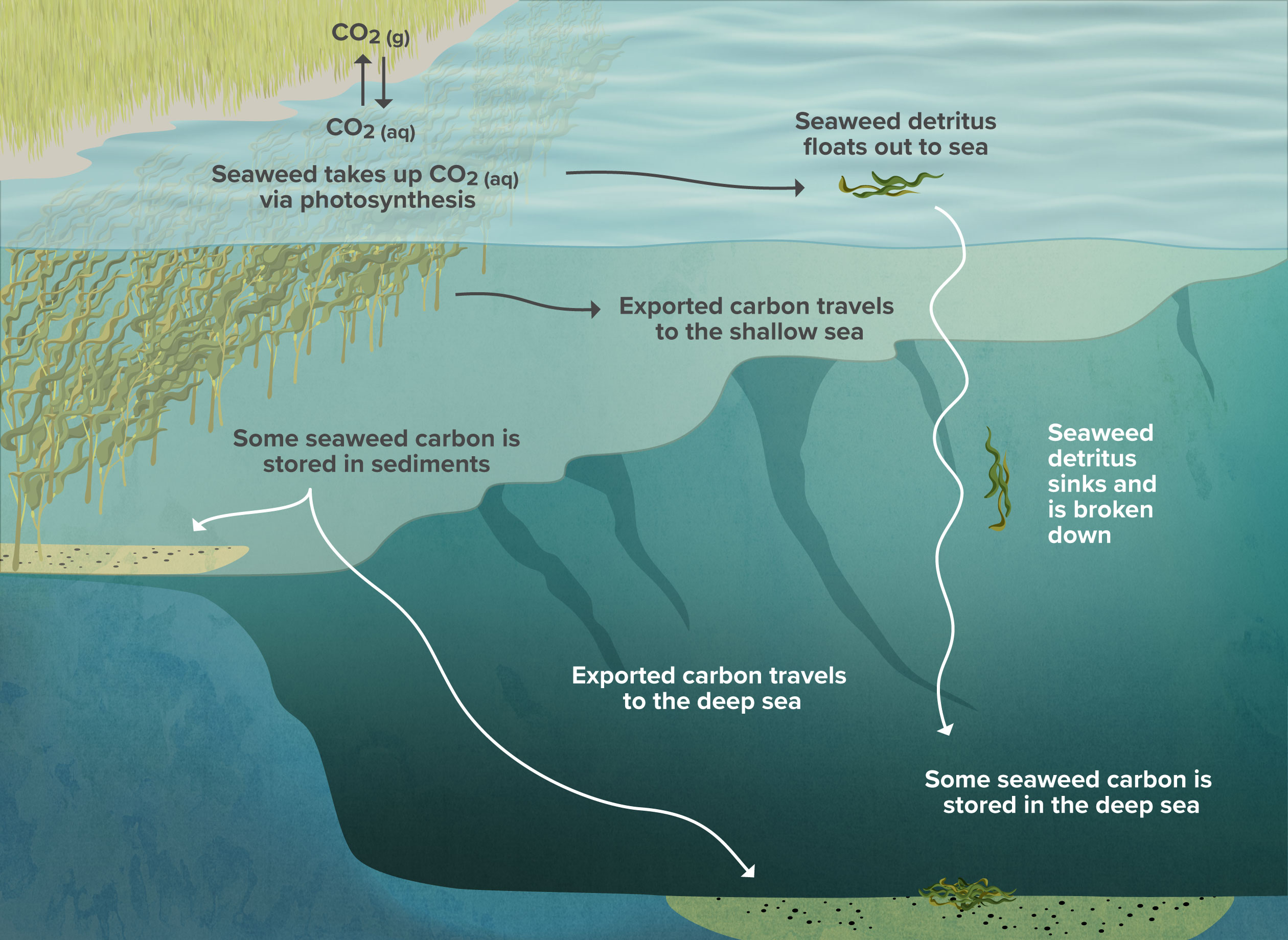
Seaweed ecosystems exhibit high net primary productivity (NPP) rates, comparable to those of terrestrial forests (Filbee-Dexter, 2020). Unlike many terrestrial ecosystems, however, nearly all carbon storage in seaweed ecosystems occurs as above-ground biomass, since seaweeds lack below-ground roots. A smaller amount can be buried on site in sediment (Krause-Jensen & Duarte, 2016). Most long-term carbon storage attributable to seaweeds occurs largely outside of seaweed ecosystems, through the export of carbon in dissolved and suspended forms (Figure 2). Some of this carbon reaches the deep sea, where it can persist for more than 100 years (Krause-Jensen & Duarte, 2016; Krause-Jensen et al., 2018; Ortega et al., 2019). Roughly 11.4% (25th quartile, 6.0%; 75th quartile, 13.7%) of NPP from global seaweed ecosystems is estimated to contribute to long-term carbon storage in the deep sea, equivalent to as much as 0.62 Gt CO₂‑eq/yr (173 Tg C/yr, Krause-Jensen & Duarte, 2016). While uncertain and requiring more research, recent modeling efforts support these estimates, suggesting that more than 12.5% of NPP may be removed on 100-yr timescales (Filbee-Dexter et al., 2024b).
Figure 2. Overview of a seaweed ecosystem showing carbon fluxes into and out of the ecosystem (g=gaseous, aq=aqueous) that can result in carbon removal. Some carbon is exported to the shallow sea, where it may be recycled or persist for longer periods depending on its form, some is exported to the deep sea (~1000 m), and some is buried in seafloor sediments.
Adapted from: Hurd, C. L., Gattuso, J.-P., & Boyd, P. W. (2024). Air-sea carbon dioxide equilibrium: Will it be possible to use seaweeds for carbon removal offsets? Journal of Phycology, 60(1), 4–14.
Seaweed ecosystems face growing threats from a range of climate change impacts (Harley et al., 2012), such as increasing sea surface temperatures, marine heat waves, ocean acidification, and extreme storm events, as well as local drivers, such as overfishing, overgrazing, pollution, disease outbreaks, invasive species, and bottom fishing (Corrigan et al., 2025; Filbee-Dexter et al., 2024a; Hanley et al., 2024). For instance, overfishing can deplete top predators in ecosystems, leading to increases in herbivores, such as sea urchins, that overgraze seaweed (Steneck et al., 2002).
In this solution, we calculate how legal protection of seaweed ecosystems via MPAs can reduce CO₂
emissions and preserve carbon removal through avoided ecosystem loss. In addition to preventing direct losses from impacts such as wild harvest, MPAs can help restore predator populations that keep herbivores in balance. For instance, many MPAs include no-take zones that allow predatory fish populations to recover, thereby lessening overgrazing impacts over time. MPAs can also increase the resilience of seaweed ecosystems against climate change stressors, such as marine heat waves (Kumagai et al., 2024; Ortiz-Villa et al., 2025). While some seaweed can release methane, offsetting CO₂
removal (Roth et al., 2023), we exclude this process from our analysis due to existing data limitations. We also do not consider nitrous oxide, though protection might provide additional climate benefits because enhanced nitrous oxide production has been tied to nutrient-polluted seaweed systems (Wong et al., 2021).
We present estimates of climate impact as likely upper bounds under several key assumptions (see Appendix and Caveats), which can be improved upon as more research unfolds. We consider subtidal brown and red seaweed to be protected if they are within designated MPAs based on global datasets from UNEP-WCMC and IUCN (2024). Importantly, protection can help reduce – but will not eliminate – ecosystem loss in MPAs relative to unprotected areas (see Effectiveness).
Akaike, S., & Mizuta, H. (2024). Optimizing the biomass balance of macroalgae and sea urchins in kelp beds by removing the urchins. European Journal of Phycology, 59(2), 218–231. Link to source: https://doi.org/10.1080/09670262.2024.2306397
Balmford, A., Gravestock, P., Hockley, N., McClean, C. J. and Roberts, C. M. (2004). The worldwide costs of marine protected areas. Proceedings of the National Academy of Sciences, 101(26), 9694–9697. Link to source: https://doi.org/10.1073/pnas.0403239101
Bauer, J., Beas-Luna, R., Malpica-Cruz, L., Abadía-Cardoso, A., Filz, P., Bonilla, J. C., & Lorda, J. (2025). Community-led management maintains higher predator biomass supporting kelp forests persistence in Baja California. Scientific Reports, 15(1), Article 23253. Link to source: https://doi.org/10.1038/s41598-025-86140-6
Best, R. J., Chaudoin, A. L., Bracken, M. E. S., Graham, M. H., & Stachowicz, J. J. (2014). Plant–animal diversity relationships in a rocky intertidal system depend on invertebrate body size and algal cover. Ecology, 95(5), 1308–1322. Link to source: https://doi.org/10.1890/13-1480.1
Corrigan, S., Cottier-Cook, E. J., Lim, P. E., & Brodie, J. (2025). The state of the world’s seaweeds 2025 [Data set]. Natural History Museum. Link to source: https://doi.org/10.5519/4ln9oqk7
Cotas, J., Gomes, L., Pacheco, D., & Pereira, L. (2023). Ecosystem services provided by seaweeds. Hydrobiology, 2(1), 75–96. Link to source: https://doi.org/10.3390/hydrobiology2010006
Cottier-Cook, E. J., Lim, P. E., Mallinson, S., Yahya, N., Poong, S. W., Wilbraham, J., Nagabhatla, N., & Brodie, J. (2023). Striking a balance: Wild stock protection and the future of our seaweed industries [Policy brief]. United Nations University Institute on Comparative Regional Integration Studies. Link to source: https://cris.unu.edu/sites/cris.unu.edu/files/UNU-CRIS_Policy-Brief_CottierCook_Et.al_23.06.pdf
Cuba, D., Guardia-Luzon, K., Cevallos, B., Ramos-Larico, S., Neira, E., Pons, A., & Avila-Peltroche, J. (2022). Ecosystem services provided by kelp forests of the Humboldt current system: A comprehensive review. Coasts, 2(4), 259–277. Link to source: https://doi.org/10.3390/coasts2040013
Duarte, C. M., Gattuso, J. P., Hancke, K., Gundersen, H., Filbee-Dexter, K., Pedersen, M. F., Middelburg, J. J., Burrows, M. T., Krumhansl, K. A., Wernberg, T., Moore P., Pessarrodona, A., Ørberg, S. B., Pinto, I. S., Assis, J., Queirós, A. M., Smale, D. A., Bekkby, T., Serrão, E. A., & Krause-Jensen, D. (2022). Global estimates of the extent and production of macroalgal forests. Global Ecology and Biogeography, 31(7), 1422–1439. Link to source: https://doi.org/10.1111/geb.13515
Earp, H. S., Smale, D. A., Almond, P. M., Catherall, H. J. N., Gouraguine, A., Wilding, C., & Moore, P. J. (2024). Temporal variation in the structure, abundance, and composition of Laminaria hyperborea forests and their associated understorey assemblages over an intense storm season. Marine Environmental Research, 200, Article 106652. Link to source: https://doi.org/10.1016/j.marenvres.2024.106652
Eger, A. M., Eddy, N., McHugh, T. A., Arafeh-Dalmau, N., Wernberg, T., Krumhansl, K., Verbeek, J., Branigan, S., Kuwae, T., Caselle, J. E., Ospina, A. G., & Vergés, A. (2024). State of the world’s kelp forests. One Earth, 7(11), 1927–1931. Link to source: https://doi.org/10.1016/j.oneear.2024.10.008
Eger, A. M., Marzinelli, E. M., Christie, H., Fagerli, C. W., Fujita, D., Gonzalez, A. P., Hong, S. W., Kim, J. H., Lee, L. C., McHugh, T. A., Nishihara, G. N., Tatsumi, M., Steinberg, P. D., & Vergés, A. (2022). Global kelp forest restoration: Past lessons, present status, and future directions. Biological Reviews, 97(4), 1449–1475. Link to source: https://doi.org/10.1111/brv.12850
Eger, A. M., Marzinelli, E. M., Beas-Luna, R., Blain, C. O., Blamey, L. K., Byrnes, J. E. K., Carnell, P. E., Choi, C. G., Hessing-Lewis, M., Kim, K. Y., Kumagai, N. H., Lorda, J., Moore, P., Nakamura, Y., Pérez-Matus, A., Pontier, O., Smale, D., Steinberg, P. D., & Vergés, A. (2023). The value of ecosystem services in global marine kelp forests. Nature Communications, 14(1), Article 1894. Link to source: https://doi.org/10.1038/s41467-023-37385-0
Elsmore, K., Nickols, K. J., Miller, L. P., Ford, T., Denny, M. W., & Gaylord, B. (2024). Wave damping by giant kelp, Macrocystis pyrifera. Annals of Botany, 133(1), 29–40. Link to source: https://doi.org/10.1093/aob/mcad094
Food and Agriculture Organization of the United Nations. (2024). The state of world fisheries and aquaculture 2024: Blue transformation in action [Report]. Link to source: https://doi.org/10.4060/cd0683en
Filbee-Dexter, K. (2020). Ocean forests hold unique solutions to our current environmental crisis. One Earth, 2(5), 398–401. Link to source: https://doi.org/10.1016/j.oneear.2020.05.004
Filbee-Dexter, K., & Wernberg, T. (2020). Substantial blue carbon in overlooked Australian kelp forests. Scientific Reports, 10, Article 12341. Link to source: https://doi.org/10.1038/s41598-020-69258-7
Filbee-Dexter, K., Feehan, C. J., Smale, D. A., Krumhansl, K. A., Augustine, S., de Bettignies, F., Burrows, M. T., Byrnes, J. E. K., Campbell, J., Davoult, D., Dunton, K. H., Franco, J. N., Garrido, I., Grace, S. P., Hancke, K., Johnson, L. E., Konar, B., Moore, P. J., Norderhaug, K. M., … Wernberg, T. (2022). Kelp carbon sink potential decreases with warming due to accelerating decomposition. PLOS Biology, 20(8), Article e3001702. Link to source: https://doi.org/10.1371/journal.pbio.3001702
Filbee‐Dexter, K., Starko, S., Pessarrodona, A., Wood, G., Norderhaug, K. M., Piñeiro‐Corbeira, C., & Wernberg, T. (2024a). Marine protected areas can be useful but are not a silver bullet for kelp conservation. Journal of Phycology, 60(2), 203–213. Link to source: https://doi.org/10.1111/jpy.13446
Filbee-Dexter, K., Pessarrodona, A., Pedersen, M. F., Wernberg, T., Duarte, C. M., Assis, J., Bekkby, T., Burrows, M. T., Carlson, D. F., Gattuso, J.-P., Gundersen, H., Hancke, K., Krumhansl, K. A., Kuwae, T., Middelburg, J. J., Moore, P. J., Queirós, A. M., Smale, D. A., Sousa-Pinto, I., … Krause-Jensen, D. (2024b). Carbon export from seaweed forests to deep ocean sinks. Nature Geoscience, 17(6), 552–559. Link to source: https://doi.org/10.1038/s41561-024-01449-7
Gao, G., Gao, L., Jiang, M., Jian, A., & He, L. (2022). The potential of seaweed cultivation to achieve carbon neutrality and mitigate deoxygenation and eutrophication. Environmental Research Letters, 17(1), Article 014018. Link to source: https://doi.org/10.1088/1748-9326/ac3fd9
Gibbons, E. G., & Quijón, P. A. (2023). Macroalgal features and their influence on associated biodiversity: Implications for conservation and restoration. Frontiers in Marine Science, 10, Article 1304000. Link to source: https://doi.org/10.3389/fmars.2023.1304000
González-Roca, F., Gelcich, S., Pérez-Ruzafa, Á., Vega, J. M. A., & Vásquez, J. A. (2021). Exploring the role of access regimes over an economically important intertidal kelp species. Ocean & Coastal Management, 212, Article 105811. Link to source: https://doi.org/10.1016/j.ocecoaman.2021.105811
Hanley, M. E., Firth, L. B., & Foggo, A. (2024). Victim of changes? Marine macroalgae in a changing world. Annals of Botany, 133(1), 1–16. Link to source: https://doi.org/10.1093/aob/mcad185
Harley, C. D. G., Anderson, K. M., Demes, K. W., Jorve, J. P., Kordas, R. L., Coyle, T. A., & Graham, M. H. (2012). Effects of climate change on global seaweed communities. Journal of Phycology, 48(5), 1064–1078. Link to source: https://doi.org/10.1111/j.1529-8817.2012.01224.x
Heckwolf, M. J., Peterson, A., Jänes, H., Horne, P., Künne, J., Liversage, K., Sajeva, M., Reusch, T. B. H., & Kotta, J. (2021). From ecosystems to socio-economic benefits: A systematic review of coastal ecosystem services in the Baltic Sea. Science of the Total Environment, 755, Article 142565. Link to source: https://doi.org/10.1016/j.scitotenv.2020.142565
Hurd, C. L., Gattuso, J.-P., & Boyd, P. W. (2024). Air-sea carbon dioxide equilibrium: Will it be possible to use seaweeds for carbon removal offsets? Journal of Phycology, 60(1), 4–14. Link to source: https://doi.org/10.1111/jpy.13405
Kelp Forest Alliance. (2024). State of the world’s kelp report [Report]. Link to source: https://kelpforestalliance.com/state-of-the-worlds-kelp-report/
Krause-Jensen, D., & Duarte, C. M. (2016). Substantial role of macroalgae in marine carbon sequestration. Nature Geoscience, 9(10), 737–742. Link to source: https://doi.org/10.1038/ngeo2790
Krause-Jensen, D., Lavery, P., Serrano, O., Marbà, N., Masque, P., & Duarte, C. M. (2018). Sequestration of macroalgal carbon: The elephant in the blue carbon room. Biology Letters, 14(6), Article 20180236. Link to source: https://doi.org/10.1098/rsbl.2018.0236
Krumhansl, K. A., Okamoto, D. K., Rassweiler, A., Novak, M., Bolton, J. J., Cavanaugh, K. C., Connell, S. D., Johnson, C. R., Konar, B., Ling, S. D., Micheli, F., Norderhaug, K. M., Pérez-Matus, A., Sousa-Pinto, I., Reed, D. C., Salomon, A. K., Shears, N. T., Wernberg, T., Anderson, R. J., … Byrnes, J. E. K. (2016). Global patterns of kelp forest change over the past half-century. Proceedings of the National Academy of Sciences, 113(48), 13785–13790. Link to source: https://doi.org/10.1073/pnas.1606102113
Kumagai, J. A., Goodman, M. C., Villaseñor-Derbez, J. C., Schoeman, D. S., Cavanuagh, K. C., Bell, T. W., Micheli, F., De Leo, G., & Arafeh-Dalmau, N. (2024). Marine protected areas that preserve trophic cascades promote resilience of kelp forests to marine heatwaves. Global Change Biology, 30(12), Article e17620. Link to source: https://doi.org/10.1111/gcb.17620
Lindhart, M., Daly, M. A., Walker, H., Arzeno-Soltero, I. B., Yin, J. Z., Bell, T. W., Monismith, S. G., Pawlak, G., & Leichter, J. J. (2024). Short wave attenuation by a kelp forest canopy. Limnology and Oceanography Letters, 9(4), 478–486. Link to source: https://doi.org/10.1002/lol2.10401
McCrea-Strub, A., Zeller, D., Rashid Sumaila, U., Nelson, J., Balmford, A., & Pauly, D. (2011). Understanding the cost of establishing marine protected areas. Marine Policy, 35(1), 1–9. Link to source: https://doi.org/10.1016/j.marpol.2010.07.001
Ortega, A., Geraldi, N. R., Alam, I., Kamau, A. A., Acinas, S. G., Logares, R., Gasol, J. M., Massana, R., Krause-Jensen, D., & Duarte, C. M. (2019). Important contribution of macroalgae to oceanic carbon sequestration. Nature Geoscience, 12(9), 748–754. Link to source: https://doi.org/10.1038/s41561-019-0421-8
Ortiz‐Villa, E. M., Rassweiler, A., Caselle, J. E., Cavanaugh, K. C., Arafeh‐Dalmau, N., Bell, T. W., & Cavanaugh, K. C. (2025). Marine protected areas enhance climate resilience to severe marine heatwaves for kelp forests. Journal of Applied Ecology, 62(9), 2439–2453. Link to source: https://doi.org/10.1111/1365-2664.70112
Pessarrodona, A., Franco-Santos, R. M., Wright, L. S., Vanderklift, M. A., Howard, J., Pidgeon, E., Wernberg, T., & Filbee-Dexter, K. (2023). Carbon sequestration and climate change mitigation using macroalgae: A state of knowledge review. Biological Reviews, 98(6), 1945–1971. Link to source: https://doi.org/10.1111/brv.12990
Rodríguez-Rodríguez, D., & Martínez-Vega, J. (2022). Chapter three—Ecological effectiveness of marine protected areas across the globe in the scientific literature. In C. Sheppard (Ed.), Advances in marine biology (Vol. 92, pp. 129–153). Academic Press. Link to source: https://doi.org/10.1016/bs.amb.2022.07.002
Roth, F., Broman, E., Sun, X., Bonaglia, S., Nascimento, F., Prytherch, J., Brüchert, V., Lundevall Zara, M., Brunberg, M., Geibel, M. C., Humborg, C., & Norkko, A. (2023). Methane emissions offset atmospheric carbon dioxide uptake in coastal macroalgae, mixed vegetation and sediment ecosystems. Nature Communications, 14(1), Article 42. Link to source: https://doi.org/10.1038/s41467-022-35673-9
Steen, H., Moy, F. E., Bodvin, T., & Husa, V. (2016). Regrowth after kelp harvesting in Nord-Trøndelag, Norway. ICES Journal of Marine Science, 73(10), 2708–2720. Link to source: https://doi.org/10.1093/icesjms/fsw130
Steneck, R. S., Graham, M. H., Bourque, B. J., Corbett, D., Erlandson, J. M., Estes, J. A., & Tegner, M. J. (2002). Kelp forest ecosystems: Biodiversity, stability, resilience and future. Environmental Conservation, 29(4), 436–459. Link to source: https://doi.org/10.1017/S0376892902000322
Tano, S., Eggertsen, M., Wikström, S. A., Berkström, C., Buriyo, A. S., & Halling, C. (2016). Tropical seaweed beds are important habitats for mobile invertebrate epifauna. Estuarine, Coastal and Shelf Science, 183, 1–12. Link to source: https://doi.org/10.1016/j.ecss.2016.10.010
Thurstan, R. H., Brittain, Z., Jones, D. S., Cameron, E., Dearnaley, J., & Bellgrove, A. (2018). Aboriginal uses of seaweeds in temperate Australia: An archival assessment. Journal of Applied Phycology, 30(3), 1821–1832. Link to source: https://doi.org/10.1007/s10811-017-1384-z
United Nations Environment Programme World Conservation Monitoring Centre, & International Union for Conservation of Nature. (2024). Protected planet: The world database on protected areas (WDPA) and world database on other effective area-based conservation measures (WD-OECM) [Data set]. Retrieved April 2024, from Link to source: https://www.protectedplanet.net
United Nations Environment Programme. (2023). Into the blue: Securing a sustainable future for kelp forests [Report]. Link to source: https://wedocs.unep.org/handle/20.500.11822/42331
Waldron, A., Adams, V., Allan, J., Arnell, A., Asner, G., Atkinson, S., Baccini, A., Baillie, J. E. M., Balmford, A., Beau, J. A., Brander, L., Brondizio, E., Bruner, A., Burgess, N., Burkart, K., Butchart, S., Button, R., Carraso, R., Cheung, W., … Zhang, Y. P. (2020). Protecting 30% of the planet for nature: Costs, benefits and economic implications [Report]. Campaign for Nature. Link to source: https://www.conservation.cam.ac.uk/files/waldron_report_30_by_30_publish.pdf
Wong, W. W., Greening, C., Shelley, G., Lappan, R., Leung, P. M., Kessler, A., Winfrey, B., Poh, S. C., & Cook, P. (2021). Effects of drift algae accumulation and nitrate loading on nitrogen cycling in a eutrophic coastal sediment. Science of The Total Environment, 790, Article 147749. Link to source: https://doi.org/10.1016/j.scitotenv.2021.147749
Christina Richardson, Ph.D.
Ruthie Burrows, Ph.D.
Avery Driscoll, Ph.D.
James Gerber, Ph.D.
Daniel Jasper
Alex Sweeney
Aiyana Bodi
Avery Driscoll, Ph.D.
Christina Swanson, Ph.D.
Paul C. West, Ph.D.
The globally weighted average effectiveness of seaweed ecosystem protection is 0.32 tCO₂‑eq
/ha/yr. Protecting 1 ha of seaweed ecosystem avoids emissions of 0.043–0.13 tCO₂‑eq
/ha/yr while also sequestering an additional 0.083–0.43 tCO₂‑eq
/ha/yr, with effectiveness higher in subtidal brown than subtidal red seaweed ecosystems (100-yr GWP; Table 1; Appendix).
We estimated effectiveness as the avoided emissions and retained carbon sequestration capacity attributable to the reduction in seaweed ecosystem loss conferred by protection, as detailed in Equation 1. First, we calculated the difference between the rate of seaweed ecosystem loss outside and inside MPAs (Seaweed lossbaseline). We assumed a reduction in loss of 53% (Reduction in loss), which is based on estimates for a range of ecosystems in MPAs (Rodríguez-Rodríguez & Martínez-Vega, 2022). Importantly, this number is highly uncertain and likely to be highly variable, too.
Next, we multiplied this product by the sum of the avoided CO₂
emissions associated with the one-time loss of all above ground biomass carbon in 1 ha of seaweed ecosystem each year over 30 years (Carbonavoided emissions) and the amount of carbon sequestered via long-term storage (on-site or off-site) in 1 ha of protected seaweed ecosystem each year over 30 years (Carbonsequestration).
We based these rates on original analysis of a subset of studies conducted over, at least, 20 years, collated from Krumhansl et al. (2016), that show a median loss rate of 1.2% per year for kelp forests. Due to data limitations, we applied this loss rate to subtidal red seaweed ecosystems as well, but recognize that loss rates are likely to be highly variable. We did this calculation separately for red and brown seaweed ecosystems due to their distinct biomass densities and sequestration capacities, and then averaged the results with accommodations for their relative global areas.
Equation 1.
Table 1. Effectiveness of seaweed ecosystem protection in avoiding emissions and sequestering carbon.
Unit: tCO₂‑eq /ha/yr, 100-year basis
| Avoided emissions, estimate | 0.13 |
| Sequestration | 0.43 |
| Total effectiveness, estimate | 0.56 |
| Total effectiveness, 25th percentile | 0.21 |
| Total effectiveness, 75th percentile | 0.91 |
Unit: tCO₂‑eq /ha/yr, 100-year basis
| Avoided emissions, estimate | 0.043 |
| Sequestration | 0.083 |
| Total effectiveness, estimate | 0.13 |
| Total effectiveness, 25th percentile | 0.034 |
| Total effectiveness, 75th percentile | 0.22 |
Unit: tCO₂‑eq /ha/yr, 100-year basis
| Avoided emissions, estimate | 0.080 |
| Sequestration | 0.24 |
| Total effectiveness, estimate | 0.32 |
| Total effectiveness, 25th percentile | 0.11 |
| Total effectiveness, 75th percentile | 0.52 |
We estimate that seaweed ecosystem protection might save approximately US$72/tCO₂‑eq , but emphasize that these estimates are highly uncertain due to existing data limitations. This is based on protection costs of roughly US$14/ha/yr and revenue of US$43/ha/yr compared with the baseline (Table 2). The costs of seaweed ecosystem protection also include up-front one-time expenditures of US$208 (surveys, administrative setup, legal fees, etc.), estimated from McCrea-Strub et al. (2011). However, data related to the costs of seaweed ecosystem protection are limited, and these estimates are uncertain. For consistency across solutions, we did not include revenue associated with other ecosystem services.
We estimated costs of MPA maintenance at US$14/ha/yr based on data from existing MPAs, though only 16% of MPAs surveyed reported their current funding was sufficient (Balmford et al., 2004). Maintenance is critical for seaweed ecosystems, especially those prone to overgrazing. Tourism revenues directly attributable to protection were estimated to be $43/ha/yr (Waldron et al., 2020) based on estimates for all MPAs (and PAs) and not including downstream revenues. However, estimates of tourism revenues are highly uncertain for seaweed ecosystems. In some seaweed ecosystems, such as kelp forests, tourism is likely a real revenue generator through diving or other recreational activities, but the financial contribution is generally unclear and poorly documented across all seaweed ecosystems.
Table 2. Cost per unit of climate impact. Negative values indicate cost savings.
Unit: 2023 US$/tCO₂‑eq , 100-yr basis
| Estimate | -72 |
A learning curve is defined here as falling costs with increased adoption. The costs of seaweed ecosystem protection do not fall with increasing adoption, so there is no learning curve for this solution.
Speed of action refers to how quickly a climate solution physically affects the atmosphere after it is deployed. This is different from speed of deployment, which is the pace at which solutions are adopted.
At Project Drawdown, we define the speed of action for each climate solution as emergency brake, gradual, or delayed.
Protect Seaweed Ecosystems is an EMERGENCY BRAKE climate solution. It has the potential to deliver a more rapid impact than gradual and delayed solutions. Because emergency brake solutions can deliver their climate benefits quickly, they can help accelerate our efforts to address dangerous levels of climate change. For this reason, they are a high priority.
Additionality is an important caveat for ecosystem protection. In our analysis, we used baseline rates of seaweed ecosystem loss to calculate the effectiveness of protection, which are highly uncertain and understudied. This assumes that seaweed ecosystems would continue to be lost at these rates in the absence of protection and thus that protection provides additional carbon benefits from the ecosystems whose loss is avoided.
Importantly, effective protection depends on adequate funding and management. Poorly managed MPAs can fail to prevent key stressors, such as urchin overgrazing, from increasing and undermine the viability of seaweed ecosystems. Similar dynamics have been documented in kelp restoration efforts, where inadequate management has led to overgrazing and project failure (Eger et al., 2022).
The permanence of ecosystem carbon benefits is another key caveat. While seaweed ecosystems are expanding or expected to expand with climate change, in some regions many will contract (Corrigan et al., 2025). Protection may increase resilience to some climate change stressors, but it will not fully prevent ecosystem loss in many regions. Additionally, because seaweed ecosystems sequester carbon both on-site and off-site, the effectiveness of protection partly depends on downstream activities. For instance, carbon at the seafloor is threatened by disturbances such as bottom fishing and mining (see Protect Seafloors). Protection of seaweed ecosystems does not prevent loss of downstream stored carbon, some of which is contributed by seaweed ecosystems (Ortega et al., 2019). Additionally, seaweed biomass extent can change dramatically from year to year, which could result in substantial variability in carbon removal rates despite protection.
Another caveat in this solution lies in our assumptions about carbon dynamics at the ocean surface. We assume that seaweed NPP results in an equivalent removal of CO₂ from the atmosphere. In reality, this influx may not be fully efficient (Hurd et al., 2024). In some regions of the ocean, water carrying a CO₂ deficit from seaweed photosynthesis might be subducted before it reaches equilibrium with the atmosphere, which would reduce the atmospheric removal attributed to seaweed productivity in our calculations.
In our analysis, avoided emissions are calculated under the assumption that destruction of a seaweed ecosystem results in the loss of all biomass carbon This likely overestimates near-term emissions, as some carbon may remain in the ocean for long periods. However, this fraction is expected to be small given that an estimated 6.0–13.7% (average: 11.4%) of NPP is thought to be stored long term (Krause-Jensen & Duarte, 2016).
Finally, the relative fraction of NPP removed and durably stored (>100 years) is also uncertain (Pessarrodona et al., 2023). Despite this uncertainty, our use of 11.4% is supported by recent modeling of particulate carbon fluxes that suggest ~12.5% of NPP could be sequestered on a 100-year timescale (based on 44 Tg C of particulate organic carbon export to 1,000 m, where carbon is less likely to return to the atmosphere within a century, and ~353 Tg C as NPP; Filbee-Dexter et al., 2024b), but requires more research.
A total of 78.80 Mha of seaweed ecosystems are currently within MPAs (Table 3). Cumulatively, roughly 18% of seaweed ecosystems are under some form of protection, with 4% located in strictly protected MPAs, 6% in nonstrict MPAs, and 8% in other IUCN protection categories. Subtidal brown and red seaweed ecosystems have similar rates of existing protection in all protection categories (Figure 3).
Table 3. Current (circa 2024) extent of seaweed ecosystems under legal protection. “Strict protection” includes land within IUCN categories I–II Marine Protected Areas (MPAs). “Nonstrict protection” includes land within IUCN Categories III–VI MPAs. “Other” includes land within all remaining IUCN MPA categories. Values may not sum to global totals due to rounding.
Unit: Mha protected
| Strict protection | 8.43 |
| Nonstrict protection | 11.4 |
| Other | 15.5 |
| Total | 35.3 |
Unit: Mha protected
| Strict protection | 9.28 |
| Nonstrict protection | 16.3 |
| Other | 18.0 |
| Total | 43.5 |
Unit: Mha protected
| Strict protection | 17.7 |
| Nonstrict protection | 27.6 |
| Other | 33.4 |
| Total | 78.8 |
We calculated the rate of MPA expansion in seaweed ecosystems based on recorded year of establishment (UNEP-WCMC & IUCN, 2024). Protection expanded by a median of 0.74 Mha/yr in subtidal brown seaweed ecosystems and 0.97 Mha/yr in subtidal red seaweed ecosystems (Table 4; Figure 3a). The global average rate of expansion was roughly 2.13 Mha/yr, with a median of 1.71 Mha/yr. The adoption trend for subtidal brown and red seaweed was relatively similar, with both expanding 0.46–0.55%/yr, on average (median of 0.39–0.40%/yr) (Figure 3b).
Table 4. 2000–2024 adoption trend. Global totals reflect independent statistics, not sums of subtidal brown and red values.
Unit: Mha/yr
| 25th percentile | 0.40 |
| Median (50th percentile) | 0.74 |
| Mean | 1.01 |
| 75th percentile | 1.31 |
Unit: Mha/yr
| 25th percentile | 0.62 |
| Median (50th percentile) | 0.97 |
| Mean | 1.12 |
| 75th percentile | 1.45 |
Unit: Mha/yr
| 25th percentile | 1.02 |
| Median (50th percentile) | 1.71 |
| Mean | 2.13 |
| 75th percentile | 2.76 |
Figure 3. Trend in seaweed ecosystem protection (2000–2024) in terms of (A) total hectares protected and (B) the percent of the current adoption ceiling that is currently protected. These values reflect only the area located within Marine Protected Areas. Units: million hectares protected and percent protected relative to the adoption ceiling.
We estimated that approximately 430 Mha of wild seaweed ecosystems are available for protection (Table 5). Subtidal red seaweeds compose ~240 Mha, with subtidal brown seaweeds occupying the remaining ~190 Mha. These adoption areas do not include other types of seaweed habitats/ecosystems, such as those found in the intertidal zone, rhodolith beds, Halimeda bioherms, coral reefs, and pelagic, free-floating seaweed, which could account for an additional ~150 Mha (Duarte et al., 2022). These adoption areas are highly uncertain due to data limitations and are also likely to shift with climate change.
Table 5. Adoption ceiling: upper limit for the adoption of legal protection of seaweed ecosystems.
Unit: Mha
| Estimate | 189.6 |
Unit: Mha
| Estimate | 243.0 |
Unit: Mha
| Estimate | 432.6 |
We defined the lower end of the achievable range for seaweed ecosystem protection (across all IUCN categories) as 50% of the adoption ceiling and the upper end of the achievable range as 70% of the adoption ceiling (Table 6). These adoption levels are ambitious relative to existing levels of protection (~18%), but align with targets to protect 30% of ecosystems by 2030 (Eger et al., 2024) and serve as an optimistic benchmark for the 30-year time horizon considered in our analysis. Several countries already protect more than 30% of subtidal brown seaweed ecosystems, such as kelp forests (Kelp Forest Alliance, 2024). For example, the United Kingdom, Japan, China, and France protect over 41%, 68%, 68%, and 47% of their kelp beds, respectively.
Table 6: Range of achievable adoption levels for seaweed ecosystems.
Unit: Mha
| Current adoption | 78.8 |
| Achievable – low | 216.3 |
| Achievable – high | 302.9 |
| Adoption ceiling | 432.6 |
We estimated that MPAs currently avoid emissions of 0.03 GtCO₂‑eq/yr in seaweed ecosystems, with potential impacts of 0.14 GtCO₂‑eq/yr at the adoption ceiling (Table 7). Achievable levels of seaweed ecosystem protection could safeguard 0.07 to 0.10 GtCO₂‑eq/yr by reducing emissions from biomass loss and retaining sequestration fluxes (Table 7). However, these estimates are highly uncertain and will benefit from more research (see Caveats).
Limited data exist on the potential climate impacts of seaweed ecosystem protection for comparison. However, a rough estimate of the benefits of conservation, restoration, and afforestation interventions of seaweeds suggests carbon benefits of at least 0.04 GtCO₂‑eq/yr (Pessarrodona et al., 2023). Other estimates suggest that total carbon sequestration in seaweed ecosystems could be on the order of 0.22–0.98 GtCO₂‑eq/yr (Krause-Jensen & Duarte, 2016). This is higher than our estimates because we account only for the carbon benefits of protection in seaweed ecosystems at risk of loss.
Table 7. Climate impact at different levels of adoption. Values may not sum to global totals due to rounding.
Unit: GtCO₂‑eq/yr, 100-year basis
| Current adoption | 0.02 |
| Achievable – low | 0.05 |
| Achievable – high | 0.07 |
| Adoption ceiling | 0.11 |
Unit: GtCO₂‑eq/yr, 100-year basis
| Current adoption | 0.01 |
| Achievable – low | 0.02 |
| Achievable – high | 0.02 |
| Adoption ceiling | 0.03 |
Unit: GtCO₂‑eq/yr, 100-year basis
| Current adoption | 0.03 |
| Achievable – low | 0.07 |
| Achievable – high | 0.10 |
| Adoption ceiling | 0.14 |
Seaweeds can provide coastal resilience to the impacts of storms by lowering wave heights before they reach shorelines (Corrigan et al., 2025; Cotas et al., 2023). The magnitude of this benefit can vary based on the species and location of seaweed, and some evidence suggests that severe storms can harm seaweed habitats (Earp et al., 2024). Evidence suggests that kelp forests can attenuate wave heights locally, especially in the summer at peak kelp growth, but protection varies at larger spatial scales (Elsmore et al., 2024; Lindhart et al., 2024). Emerging research has found that protected seaweed ecosystems show more resilience to marine heat waves than unprotected areas (Kumagai et al., 2024). During heat waves, protected ecosystems maintain a habitat for species such as sea urchins that consume species that might degrade kelp ecosystems (Bauer et al., 2025; Kumagai et al., 2024).
Seaweeds support species that are important for tourism and fishing (Cuba et al., 2022; Eger et al., 2023). Many species that are supported by seaweeds have high economic value for fishing, such as crabs, lobsters, and abalones (Corrigan et al., 2025). For example, Eger et al. (2023) estimated that 1 ha of kelp forest where about 900 kg of fish biomass is harvested could yield about US$29,900 a year. The same study estimated that the global value of kelp forests that support fisheries is about US$465–562 billion (Eger et al., 2023). Seaweed habitats can also be tourist destinations for snorkeling and diving (UNEP, 2023), providing income-earning opportunities for nearby communities.
The contribution of seaweeds to fisheries production can play a role in global food security (Cottier-Cook et al., 2023; Eger et al., 2023). Additionally, seaweeds are an essential part of many diets, especially in East Asia (FAO, 2024). Because seaweeds are a culturally important food in many geographies, protecting seaweeds can play an important role in equitably improving global food security (FAO, 2024).
For some cultures, seaweeds and their habitats shape shared identities and livelihoods (Cotas et al., 2023). For example, seaweeds are a source of traditional foods, medicines, art, and knowledge for many coastal communities and Indigenous peoples (Thurstan et al., 2018). Protecting seaweeds can preserve the cultural identities, practices, and knowledge of Indigenous communities that are often vulnerable (Corrigan et al., 2025).
Seaweeds support biodiversity by providing habitat for a variety of marine species (Best et al., 2014; Cuba et al., 2022; Gibbons & Quijón, 2023; Tano et al., 2016). Literature reviews of the ecosystem services of seaweeds find that they contribute to increases in biodiversity (Gibbons & Quijón, 2023). Seaweeds can provide habitat and refuge from large predators (Best et al., 2014; Gibbons & Quijón, 2023). Invertebrates, detritivores, and other small species found in seaweed forests are essential food sources for other marine species (Cuba et al., 2022; Tano et al., 2016).
Seaweeds improve water quality by supporting nutrient cycling and reducing pollutants (Cotas et al., 2023; Heckwolf et al., 2021). Evidence suggests that seaweeds can reduce eutrophication by filtering excess nutrients from the water (Corrigan et al., 2025; Gao et al., 2022; Heckwolf et al., 2021).
Leakage, in which protecting one ecosystem results in the degradation of another, could offset the climate impact of seaweed ecosystem protection. For instance, restricting wild harvesting through the establishment of an MPA could shift pressure to other unprotected areas. Another key risk is weakly enforced or poorly managed MPAs. This is a real concern with existing MPAs due to a lack of funding, and can result in low protection effectiveness. Finally, climate change stressors, such as ocean warming and marine heat waves, are a major risk to permanence because they could lead to widespread mortality, even in protected areas.
Intact and healthy seaweed ecosystems can enhance fish stocks, biodiversity, and habitat quality, which benefits all connected coastal and marine ecosystems.
Protecting seaweed ecosystems can help ensure the underlying areas of the seafloor remain intact.
Protection of seaweed ecosystems could potentially reduce the adoption of offshore wind in some regions.
ha of seaweed ecosystem protected
CO₂
Seaweed ecosystems can release methane, which could reduce the climate benefits of protection estimated in this solution. While data are scarce, a recent study suggests that methane emissions could offset 28–35% of the carbon sink capacity in some seaweed ecosystems (Roth et al., 2023) if they escape to the atmosphere, which may be unlikely if methane production occurs at depth in sediments (Pessarrodona et al., 2023).
Consensus of effectiveness at reducing emissions and maintaining carbon removal: Mixed
There is mixed scientific consensus that protection prevents the degradation of seaweed ecosystems, but high consensus that degradation leads to losses in biomass carbon stocks and sequestration capacity. Seaweed ecosystems can be degraded by diverse stressors that directly or indirectly affect biomass stocks. Management actions, such as establishment of MPAs, can help prevent both direct and indirect habitat loss and thereby maintain the carbon removal capacity of seaweed ecosystems with relatively high certainty against stressors such as wild harvesting, coastal development, overgrazing, and poor water quality (Pessarrodona et al., 2023). However, some stressors, such as marine heat waves and ocean warming, are less effectively addressed by protection alone (Filbee-Dexter et al., 2024a). Benefits are still expected in some systems because MPAs can enhance resilience and recovery by reducing co-occurring stressors common that contribute to seaweed ecosystem degradation (Krumhansl et al., 2016; Ortiz-Villa et al., 2025). Moreover, MPAs, even when established in areas with addressable stressors, are typically not fully effective. Here, we applied a protection effectiveness of 53%, based on aggregated estimates from MPAs beyond seaweed ecosystems (Rodríguez-Rodríguez & Martínez-Vega, 2022). If the effectiveness of protection is lower (higher), climate impacts could likewise be lower (higher).
There is high scientific consensus that degradation of seaweed ecosystems leads to losses in biomass carbon stocks and sequestration capacity. While direct estimates of CO₂ emissions from biomass are limited, degradation has been shown to remove biomass carbon and reduce sequestration. For instance, drivers of habitat loss and degradation, such as overharvesting (González-Roca et al., 2021; Steen et al., 2016), overgrazing (Akaike & Mizuta, 2024), and poor water quality (Filbee-Dexter & Wernberg, 2020), reduce standing biomass and therefore associated carbon export from seaweed ecosystems (Pessarrodona et al., 2023).
The carbon sink capacity of seaweed ecosystems, such as kelp forests, is also expected to decline with climate change stressors such as warming, which can increase rates of decomposition by 9–42% (Filbee-Dexter et al., 2022) and drive habitat loss, both of which reduce the likelihood that carbon makes its way to the deep sea for long-term storage. Off the coast of Australia, over 140,000 ha of subtidal brown seaweed forests have already been lost to warming over two decades, representing a decline of 2–4% of regional seaweed biomass carbon stocks and sequestration capacity (Filbee-Dexter & Wernberg, 2020).
The results presented in this assessment synthesize findings from 5 global datasets. We recognize that geographic bias in the information underlying global data products creates bias, and hope this work inspires research and data sharing on this topic in underrepresented regions and on understudied aspects of these ecosystems.
This analysis quantifies emissions that can be avoided by protecting seaweed ecosystems via the establishment of Marine Protected Areas (MPAs). We leveraged two global seaweed distribution maps alongside a shapefile of MPAs, available data on rates of avoided ecosystem loss attributable to MPA establishment, and global data on biomass carbon stores and carbon sequestration rates to calculate climate impacts. This appendix describes the source data products and how they were integrated.
Seaweed Ecosystem Extent
We relied on the global maps of seaweed extent developed by Duarte et al. (2022), which classify subtidal brown and red seaweeds (among others). We used the “LT2 Brown Algae Benthic” raster to calculate subtidal brown seaweed extent and the “LT2 Red Algae Benthic” raster to calculate subtidal red seaweed extent. We did not consider red seaweed in subtidal brown-dominant environments, such as kelp forests, due to existing limitations with the global maps.
Protected Seaweed Ecosystem Areas
We identified protected seaweed ecosystem areas using the World Database on Protected Areas (UNEP-WCMC & IUCN, 2024), which contains boundaries for each MPA and additional information, including the establishment year and IUCN management category (Ia to VI, not applicable, not reported, or not assigned). In this analysis, we considered all categories. While some MPA categories likely allow for wild harvest, which can be unsustainably conducted, wild seaweed harvest is currently estimated at 1.3 Mt/yr (wet weight) (FAO, 2024), which represents a relatively small portion of the global loss rate used (<0.2%/yr). We converted the MPA boundary data to a raster and used them to calculate the seaweed area within MPA boundaries for each seaweed type analyzed (subtidal brown and red) and each MPA category. To evaluate trends in adoption over time, we also aggregated protected areas by establishment year as reported in the WDPA.
Calculation of Effectiveness
The following equations show a detailed breakdown of the stepwise set of calculations used to implement Equation 1, including estimation of avoided seaweed loss and of emissions and retained sequestration across the 30-year time horizon considered.
Avoided Seaweed Ecosystem Conversion
We compiled baseline estimates of seaweed ecosystem loss (%/yr) from existing literature and used them in conjunction with an estimate of reductions in loss associated with protection of 53% (derived from Rodríguez-Rodríguez & Martínez-Vega, 2022) to calculate the rate of avoidable macroalgae loss (Seaweed lossavoided). Seaweed ecosystem loss rates were based on the original analysis of data aggregated from Krumhansl et al. (2016) for studies over 20 years long (Seaweed lossbaseline; median loss rate of 1.2%/yr).
Equation A1.
We then used the avoidable seaweed loss rates to calculate avoided CO₂ emissions and additional carbon sequestration for each adoption unit. Specifically, we estimated the carbon benefits of avoided seaweed ecosystem loss by multiplying avoided seaweed ecosystem loss by avoided CO₂ emissions (Equation A2) and by applying carbon sequestration rates over 30 years (Equation A3) for each seaweed type.
We estimated avoided CO₂ emissions by assuming a one-time release of all aboveground biomass carbon upon loss. We derived our estimates of retained carbon sequestration from global databases on NPP for each seaweed type from Duarte et al. (2022) and a global estimate of NPP-derived sequestration (11.4%) from NPP based on Krause-Jensen and Duarte (2016).
Equation A2.
Equation A3.
We then estimated effectiveness (Equation A4) as the avoided CO₂ emissions and retained carbon sequestration capacity attributable to the reduction in seaweed ecosystem loss conferred by protection estimated in Equations A1–3.
Equation A4.
Farmers on much of the world’s 1.4 billion ha of cropland grow and harvest annual crops – crops like wheat, rice, and soybeans that live for one year or less. After harvest, croplands are often left bare for the rest of the year and sometimes tilled, exposing the soil to wind and rain. This keeps soil carbon levels low and can lead to soil erosion. There are many ways to improve annual cropping to protect or enhance the health of the soil and increase soil organic matter. Project Drawdown’s Improve Annual Cropping solution is a set of practices that protects soils by minimizing plowing (no-till/reduced tillage) and maintaining continuous soil cover (by retaining crop residues or growing cover crops). This increases soil carbon sequestration and reduces nitrous oxide emissions. These techniques are commonly used in conservation agriculture, regenerative, and agro-ecological cropping systems. Other annual cropping practices with desirable climate impacts – including compost application and crop rotations – are omitted here due to lack of data and much smaller scale of adoption. New adoption is estimated from the 2025 level as a baseline which is therefore set to zero.
The Improve Annual Cropping solution incorporates several practices that minimize soil disturbance and introduce a physical barrier meant to prevent erosion to fragile topsoils. Our definition includes two of the three pillars of conservation agriculture: minimal soil disturbance and permanent soil cover (Kassam et al., 2022).
Soil organic carbon (SOC) – which originates from decomposed plants – helps soils hold moisture and provides the kinds of chemical bonding that allow nutrients to be stored and exchanged easily with plants. Soil health and productivity depend on microbial decomposition of plant biomass residues, which mobilizes critical nutrients in soil organic matter (SOM) and builds SOC. Conventional tillage inverts soil, buries residues, and breaks down compacted soil aggregates. This process facilitates microbial activity, weed removal, and water infiltration for planting. However, tillage can accelerate CO₂ fluxes as SOC is lost to oxidation and runoff. Mechanical disturbance further exposes deeper soils to the atmosphere, leading to radiative absorption, higher soil temperatures, and catalyzed biological processes – all of which increase oxidation of SOC (Francaviglia et al., 2023).
Reduced tillage limits soil disturbance to support increased microbial activity, moisture retention, and stable temperature at the soil surface. This practice can increase carbon sequestration, at least when combined with cover cropping. These effects are highly contextual, depending on tillage intensity and soil depth as well as the practice type, duration, and timing. Reduced tillage further reduces fossil fuel emissions from on-farm machinery. However, this practice often leads to increased reliance on herbicides for weed control (Francaviglia et al., 2023).
Residue retention and cover cropping practices aim to provide permanent plant cover to protect and improve soils. This can improve aggregate stability, water retention, and nutrient cycling. Farmers practicing residue retention leave crop biomass residues on the soil surface to suppress weed growth, improve water infiltration, and reduce evapotranspiration from soils (Francaviglia et al., 2023).
Cover cropping includes growth of spontaneous or seeded plant cover, either during or between established cropping cycles. In addition to SOC, cover cropping can help decrease nitrous oxide emissions and bind nitrogen typically lost via oxidation and leaching. Leguminous cover crops can also fix atmospheric nitrogen, reducing the need for fertilizer. Cover cropping can further be combined with reduced tillage for additive SOC and SOM gains (Blanco-Canqui et al., 2015; Francaviglia et al., 2023).
Improved annual cropping practices can simultaneously reduce GHG emissions and improve SOC stocks. However, there are biological limits to SOC stocks – particularly in mineral soils. Environmental benefits are impermanent and only remain if practices continue long term (Francaviglia et al., 2023).
Abdalla, M., Hastings, A., Cheng, K., Yue, Q., Chadwick, D., Espenberg, M., Truu, J., Rees, R. M., & Smith, P. (2019). A critical review of the impacts of cover crops on nitrogen leaching, net greenhouse gas balance and crop productivity. Global Change Biology, 25(8), 2530–2543. Link to source: https://doi.org/10.1111/gcb.14644
Arslan, A., McCarthy, N., Lipper, L., Asfaw, S., Cattaneo, A., & Kokwe, M. (2015). Climate smart agriculture? Assessing the adaptation implications in Zambia. Journal of Agricultural Economics, 66(3), 753-780. Link to source: https://doi.org/10.1111/1477-9552.12107
Bai, X., Huang, Y., Ren, W., Coyne, M., Jacinthe, P.-A., Tao, B., Hui, D., Yang, J., & Matocha, C. (2019). Responses of soil carbon sequestration to climate-smart agriculture practices: A meta-analysis. Global Change Biology, 25(8), 2591–2606. https://doi.org/10.1111/gcb.14658
Blanco‐Canqui, H., Shaver, T. M., Lindquist, J. L., Shapiro, C. A., Elmore, R. W., Francis, C. A., & Hergert, G. W. (2015). Cover crops and ecosystem services: Insights from studies in temperate soils. Agronomy journal, 107(6), 2449-2474. Link to source: https://doi.org/10.2134/agronj15.0086
Blanco-Canqui, H., & Francis, C. A. (2016). Building resilient soils through agroecosystem redesign under fluctuating climatic regimes. Journal of Soil and Water Conservation, 71(6), 127A-133A. Link to source: https://doi.org/10.2489/jswc.71.6.127A
Cai, A., Han, T., Ren, T., Sanderman, J., Rui, Y., Wang, B., Smith, P., Xu, M., & Li, Y. (2022). Declines in soil carbon storage under no tillage can be alleviated in the long run. Geoderma, 425, 116028. Link to source: https://doi.org/10.1016/j.geoderma.2022.116028
Clapp, J. (2021). Explaining growing glyphosate use: The political economy of herbicide-dependent agriculture. Global Environmental Change, 67, 102239. Link to source: https://doi.org/10.1016/j.gloenvcha.2021.102239
Cui, Y., Zhang, W., Zhang, Y., Liu, X., Zhang, Y., Zheng, X., Luo, J., & Zou, J. (2024). Effects of no-till on upland crop yield and soil organic carbon: A global meta-analysis. Plant and Soil, 499(1), 363–377. https://doi.org/10.1007/s11104-022-05854-y
Damania, R., Polasky, S., Ruckelshaus, M., Russ, J., Amann, M., Chaplin-Kramer, R., Gerber, J., Hawthorne, P., Heger, M. P., Mamun, S., Ruta, G., Schmitt, R., Smith, J., Vogl, A., Wagner, F., & Zaveri, E. (2023). Nature's Frontiers: Achieving Sustainability, Efficiency, and Prosperity with Natural Capital. World Bank Publications. Link to source: https://doi.org/10.1596/978-1-4648-1923-0
Francaviglia, R., Almagro, M., & Vicente-Vicente, J. L. (2023). Conservation agriculture and soil organic carbon: Principles, processes, practices and policy options. Soil Systems, 7(1), 17. Link to source: https://doi.org/10.3390/soilsystems7010017
Griscom, B. W., Adams, J., Ellis, P. W., Houghton, R. A., Lomax, G., Miteva, D. A., Schlesinger, W. H., Shoch, D., Siikamäki, J. V., Smith, P., Woodbury, P., Zganjar, C., Blackman, A., Campari, J., Conant, R. T., Delgado, C., Elias, P., Gopalakrishna, T., Hamsik, M. R., Herrero, M., & Fargione, J. (2017). Natural climate solutions. Proceedings of the National Academy of Sciences, 114(44), 11645-11650. Link to source: https://doi.org/10.1073/pnas.1710465114
Hassan, M. U., Aamer, M., Mahmood, A., Awan, M. I., Barbanti, L., Seleiman, M. F., Bakhsh, G., Alkharabsheh, H. M., Babur, E., Shao, J., Rasheed, A., & Huang, G. (2022). Management strategies to mitigate N2O emissions in agriculture. Life, 12(3), 439. Link to source: https://doi.org/10.3390/life12030439
Hu, Q., Thomas, B. W., Powlson, D., Hu, Y., Zhang, Y., Jun, X., Shi, X., & Zhang, Y. (2023). Soil organic carbon fractions in response to soil, environmental and agronomic factors under cover cropping systems: A global meta-analysis. Agriculture, Ecosystems & Environment, 355, 108591. https://doi.org/10.1016/j.agee.2023.108591
Jat, H. S., Choudhary, K. M., Nandal, D. P., Yadav, A. K., Poonia, T., Singh, Y., Sharma, P. C., & Jat, M. L. (2020). Conservation agriculture-based sustainable intensification of cereal systems leads to energy conservation, higher productivity and farm profitability. Environmental Management, 65(6), 774–786. Link to source: https://doi.org/10.1007/s00267-020-01273-w
Jayaraman, S., Dang, Y. P., Naorem, A., Page, K. L., & Dalal, R. C. (2021). Conservation agriculture as a system to enhance ecosystem services. Agriculture, 11(8), 718. Link to source: https://doi.org/10.3390/agriculture11080718
Kan, Z.-R., Liu, W.-X., Liu, W.-S., Lal, R., Dang, Y. P., Zhao, X., & Zhang, H.-L. (2022). Mechanisms of soil organic carbon stability and its response to no-till: A global synthesis and perspective. Global Change Biology, 28(3), 693–710. https://doi.org/10.1111/gcb.15968
Kassam, A., Friedrich, T., & Derpsch, R. (2022). Successful experiences and lessons from conservation agriculture worldwide. Agronomy, 12(4), 769. https://doi.org/10.3390/agronomy12040769
Lal, R., Smith, P., Jungkunst, H. F., Mitsch, W. J., Lehmann, J., Nair, P. K. R., McBratney, A. B., Sá, J. C. D. M., Schneider, J., Zinn, Y. L., Skorupa, A. L. A., Zhang, H.-L., Minasny, B., Srinivasrao, C., & Ravindranath, N. H. (2018). The carbon sequestration potential of terrestrial ecosystems. Journal of Soil and Water Conservation, 73(6), 145A-152A. Link to source: https://doi.org/10.2489/jswc.73.6.145A
Lessmann, M., Ros, G. H., Young, M. D., & de Vries, W. (2022). Global variation in soil carbon sequestration potential through improved cropland management. Global Change Biology, 28(3), 1162–1177. https://doi.org/10.1111/gcb.15954
Luo, Z., Wang, E., & Sun, O. J. (2010). Can no-tillage stimulate carbon sequestration in agricultural soils? A meta-analysis of paired experiments. Agriculture, Ecosystems & Environment, 139(1), 224–231. https://doi.org/10.1016/j.agee.2010.08.006
Martínez-Mena, M., Carrillo-López, E., Boix-Fayos, C., Almagro, M., García Franco, N., Díaz-Pereira, E., Montoya, I., & De Vente, J. (2020). Long-term effectiveness of sustainable land management practices to control runoff, soil erosion, and nutrient loss and the role of rainfall intensity in Mediterranean rainfed agroecosystems. CATENA, 187, 104352. Link to source: https://doi.org/10.1016/j.catena.2019.104352
Moukanni, N., Brewer, K. M., Gaudin, A. C. M., & O’Geen, A. T. (2022). Optimizing carbon sequestration through cover cropping in Mediterranean agroecosystems: Synthesis of mechanisms and implications for management. Frontiers in Agronomy, 4, 844166. Link to source: https://doi.org/10.3389/fagro.2022.844166
Mrabet, R., Singh, A., Sharma, T., Kassam, A., Friedrich, T., Basch, G., Moussadek, R., & Gonzalez-Sanchez, E. (2023). Conservation Agriculture: Climate Proof and Nature Positive Approach. In G. Ondrasek & L. Zhang (Eds.), Resource management in agroecosystems. IntechOpen. Link to source: https://doi.org/10.5772/intechopen.108890
Nyagumbo, I., Mupangwa, W., Chipindu, L., Rusinamhodzi, L., & Craufurd, P. (2020). A regional synthesis of seven-year maize yield responses to conservation agriculture technologies in Eastern and Southern Africa. Agriculture, Ecosystems & Environment, 295, 106898. Link to source: https://doi.org/10.1016/j.agee.2020.106898
Ogle, S. M., Alsaker, C., Baldock, J., Bernoux, M., Breidt, F. J., McConkey, B., Regina, K., & Vazquez-Amabile, G. G. (2019). Climate and Soil Characteristics Determine Where No-Till Management Can Store Carbon in Soils and Mitigate Greenhouse Gas Emissions. Scientific Reports, 9(1), 11665. https://doi.org/10.1038/s41598-019-47861-7
Paustian, K., Larson, E., Kent, J., Marx, E., & Swan, A. (2019). Soil C Sequestration as a Biological Negative Emission Strategy. Frontiers in Climate, 1, 8. Link to source: https://doi.org/10.3389/fclim.2019.00008
Pittelkow, C. M., Liang, X., Linquist, B. A., van Groenigen, K. J., Lee, J., Lundy, M. E., van Gestel, N., Six, J., Venterea, R. T., & van Kessel, C. (2015). Productivity limits and potentials of the principles of conservation agriculture. Nature, 51, 365–368. https://doi.org/10.1038/nature13809
Poeplau, C., & Don, A. (2015). Carbon sequestration in agricultural soils via cultivation of cover crops–A meta-analysis. Agriculture, Ecosystems & Environment, 200, 33–41. Link to source: https://doi.org/10.1016/j.agee.2014.10.024
Powlson, D. S., Stirling, C. M., Jat, M. L., Gerard, B. G., Palm, C. A., Sanchez, P. A., & Cassman, K. G. (2014). Limited potential of no-till agriculture for climate change mitigation. Nature Climate Change, 4(8), 678–683. https://doi.org/10.1038/nclimate2292
Prestele, R., Hirsch, A. L., Davin, E. L., Seneviratne, S. I., & Verburg, P. H. (2018). A spatially explicit representation of conservation agriculture for application in global change studies. Global Change Biology, 24(9), 4038–4053. https://doi.org/10.1111/gcb.14307
Project Drawdown (2020) Farming Our Way Out of the Climate Crisis. Project Drawdown. https://drawdown.org/publications/farming-our-way-out-of-the-climate-crisis
Quintarelli, V., Radicetti, E., Allevato, E., Stazi, S. R., Haider, G., Abideen, Z., Bibi, S., Jamal, A., & Mancinelli, R. (2022). Cover crops for sustainable cropping systems: A review. Agriculture, 12(12), 2076. Link to source: https://doi.org/10.3390/agriculture12122076
Searchinger, T., R. Waite, C. Hanson, and J. Ranganathan. (2019). World Resources Report: Creating a Sustainable Food Future. Washington, DC: World Resources Institute. Link to source: https://research.wri.org/sites/default/files/2019-07/WRR_Food_Full_Report_0.pdf
Stavi, I., Bel, G., & Zaady, E. (2016). Soil functions and ecosystem services in conventional, conservation, and integrated agricultural systems. A review. Agronomy for Sustainable Development, 36(2), 32. Link to source: https://doi.org/10.1007/s13593-016-0368-8
Su, Y., Gabrielle, B., Beillouin, D., & Makowski, D. (2021). High probability of yield gain through conservation agriculture in dry regions for major staple crops. Scientific Reports, 11(1), 3344. Link to source: https://doi.org/10.1038/s41598-021-82375-1
Sun, W., Canadell, J. G., Yu, L., Yu, L., Zhang, W., Smith, P., Fischer, T., & Huang, Y. (2020). Climate drives global soil carbon sequestration and crop yield changes under conservation agriculture. Global Change Biology, 26(6), 3325–3335. Link to source: https://doi.org/10.1111/gcb.15001
Tambo, J. A., & Mockshell, J. (2018). Differential impacts of conservation agriculture technology options on household income in sub-Saharan Africa. Ecological Economics, 151, 95–105. Link to source: https://doi.org/10.1016/j.ecolecon.2018.05.005
Tiefenbacher, A., Sandén, T., Haslmayr, H.-P., Miloczki, J., Wenzel, W., & Spiegel, H. (2021). Optimizing carbon sequestration in croplands: A synthesis. Agronomy, 11(5), 882. Link to source: https://doi.org/10.3390/agronomy11050882
Toensmeier, E. (2016). The Carbon Farming Solution: A Global Toolkit of Perennial Crops and Regenerative Agriculture Practices for Climate Change Mitigation and Food Security. Green Publishing. Link to source: https://www.chelseagreen.com/product/the-carbon-farming-solution/?srsltid=AfmBOoqsMoY569HfsXOdBsRguOzsDLlRZKOnyM4nyKwZoIALvPoohZlq
Vendig, I., Guzman, A., De La Cerda, G., Esquivel, K., Mayer, A. C., Ponisio, L., & Bowles, T. M. (2023). Quantifying direct yield benefits of soil carbon increases from cover cropping. Nature Sustainability, 6(9), 1125–1134. https://doi.org/10.1038/s41893-023-01131-7
WCCA (2021). The future of farming: Profitable and sustainable farming with conservation agriculture. 8th World Congress on Conservation Agriculture, Vern Switzerland. Link to source: https://ecaf.org/8wcca
Wooliver, R., & Jagadamma, S. (2023). Response of soil organic carbon fractions to cover cropping: A meta-analysis of agroecosystems. Agriculture, Ecosystems & Environment, 351, 108497. https://doi.org/10.1016/j.agee.2023.108497
Xing, Y., & Wang, X. (2024). Impact of agricultural activities on climate change: a review of greenhouse gas emission patterns in field crop systems. Plants, 13(16), 2285. Link to source: https://doi.org/10.3390/plants13162285
Avery Driscoll
Erika Luna
Megan Matthews, Ph.D.
Eric Toensmeier
Aishwarya Venkat, Ph.D.
Ruthie Burrows, Ph.D.
James Gerber, Ph.D.
Yusuf Jameel, Ph.D.
Daniel Jasper
Alex Sweeney
Aiyana Bodi
Emily Cassidy, Ph.D.
James Gerber, Ph.D.
Hannah Henkin
Zoltan Nagy, Ph.D.
Ted Otte
Paul C. West, Ph.D.
Based on seven reviews and meta-analyses, which collectively analyzed over 500 studies, we estimate that this solution’s SOC sequestration potential is 1.28 t CO₂‑eq/ha/yr. This is limited to the topsoil (>30 cm), with minimal effects at deeper levels (Sun et al., 2020; Tiefenbacher et al., 2021). Moreover, carbon sequestration potential is not constant over time. The first two decades show the highest increase, followed by an equilibrium or SOC saturation (Cai, 2022; Sun et al., 2020).
The effectiveness of the Improve Annual Cropping solution heavily depends on local geographic conditions (e.g., soil properties, climate), crop management practices, cover crop biomass, cover crop types, and the duration of annual cropping production – with effects typically better assessed in the long term (Abdalla et al., 2019; Francaviglia et al., 2023; Moukanni et al., 2022; Paustian et al., 2019).
Based on reviewed literature (three papers, 18 studies), we estimated that improved annual cropping can potentially reduce nitrous oxide emissions by 0.51 t CO₂‑eq/ha/yr (Table 1). Cover crops can increase direct nitrous oxide emissions by stimulating microbial activity, but – compared with conventional cropping – lower indirect emissions allow for reduced net nitrous oxide emissions from cropland (Abdalla et al., 2019).
Nitrogen fertilizers drive direct nitrous oxide emissions, so genetic optimization of cover crops to increase nitrogen-use efficiencies and decrease nitrogen leaching could further improve mitigation of direct nitrous oxide emissions (Abdalla et al., 2019).
Table 1. Effectiveness at reducing emissions and removing carbon.
Unit: t CO₂‑eq/ha/yr, 100-yr basis
| 25th percentile | 0.29 |
| Median (50th percentile) | 0.51 |
| 75th percentile | 0.80 |
Unit: t CO₂‑eq/ha/yr, 100-yr basis
| 25th percentile | 0.58 |
| Median (50th percentile) | 1.28 |
| 75th percentile | 1.72 |
Unit: t CO₂‑eq/ha/yr, 100-yr basis
| 25th percentile | 0.87 |
| Median (50th percentile) | 1.79 |
| 75th percentile | 2.52 |
Because baseline (conventional) annual cropping systems are already extensive and well established, we assume there is no cost to establish new baseline cropland. In the absence of global datasets on costs and revenues of cropping systems, we used data on the global average profit per ha of cropland from Damania et al. (2023) to create a weighted average profit of US$76.86/ha/yr.
Based on 13 data points (of which seven were from the United States), the median establishment cost of the Improve Annual Cropping solution is $329.78/ha. Nine data points (three from the United States) provided a median increase in profitability of US$86.01/ha/yr.
The net net cost of the Improve Annual Cropping solution is US$86.01. The cost per t CO₂‑eq is US$47.80 (Table 2).
Table 2. Cost per unit climate impact.
Unit: 2023 US$/t CO₂‑eq, 100-yr basis
| Median | 47.80 |
We found limited information on this solution’s learning curve. A survey of farmers in Zambia found a reluctance to avoid tilling soils because of the increased need for weeding or herbicides and because crop residues may need to be used for livestock feed (Arslan et al., 2015; Searchinger et al., 2019).
Speed of action refers to how quickly a climate solution physically affects the atmosphere after it is deployed. This is different from speed of deployment, which is the pace at which solutions are adopted.
At Project Drawdown, we define the speed of action for each climate solution as emergency brake, gradual, or delayed.
Improve Annual Cropping is a DELAYED climate solution. It works more slowly than gradual or emergency brake solutions. Delayed solutions can be robust climate solutions, but it’s important to recognize that they may not realize their full potential for some time.
As with other biosequestration solutions, carbon stored in soils via improved annual cropping is not permanent. It can be lost quickly through a return to conventional agriculture practices like plowing, and/or through a regional shift to a drier climate or other human- or climate change–driven disturbances. Carbon sequestration also only continues for a limited time, estimated at 20–50 years (Lal et al., 2018)).
Kassam et al. (2022) provided regional adoption from 2008–2019. We used a linear forecast to project 2025 adoption. This provided a figure of 267.4 Mha in 2025 (Table 3). Note that in Solution Basics in the dashboard we set current adoption at zero. This is a conservative assumption to avoid counting carbon sequestration from land that has already ceased to sequester net carbon due to saturation, which takes place after 20–50 years (Lal et al., 2018).
Table 3. Current (2025) adoption level.
Unit: Mha of improved annual cropping
| Estimate | 267.4 |
Between 2008–2009 and 2018–2019 (the most recent data available), the cropland area under improved annual cropping practices nearly doubled globally, increasing from 10.6 Mha to 20.5 Mha at an average rate of 1.0 Mha/yr (Kassam et al., 2022), equivalent to a 9.2% annual increase in area relative to 2008–2009 levels. Adoption slowed slightly in the latter half of the decade, with an average increase of 0.8 Mha/yr between 2015–2016 and 2018–2019, equivalent to 4.6% annual increase in area relative to 2015–2016 levels, as shown in Table 4.
Table 4. 2008–2009 to 2018–2019 adoption trend.
Unit: Mha adopted/yr
| Mean | 9.99 |
Griscom et al. (2017) estimate that 800 Mha of global cropland are suitable – but not yet used for – cover cropping, in addition to 168 Mha already in cover crops (Popelau and Don, 2015). We update the 168 Mha in cover crops to 267 Mha based on Kassam (2022). Griscom et al.’s estimate is based on their analysis that much cropland is unsuitable because it already is used to produce crops during seasons in which cover crops would be grown. Their estimate thus provides a maximum technical potential of 1,067 Mha by adding 800 Mha of remaining potential to the 267.4 Mha of current adoption (Table 5).
Table 5. Adoption ceiling.
Unit: Mha
| Adoption ceiling | 1,067 |
The 8th World Congress on Conservation Agriculture (8WCCA) set a goal to achieve adoption of improved annual cropping on 50% of available cropland by 2050 (WCCA 2021). That provides an Achievable – High of 700 Mha – though this is not a biophysical limit.
We used the 2008–2019 data from Kassam (2022) to calculate average annual regional growth rates. From these we selected the 25th percentile as our low achievable level (Table 6).
Table 6. Range of achievable adoption levels.
Unit: Mha
| Current adoption | 267.4 |
| Achievable – low | 331.7 |
| Achievable – high | 700.0 |
| Adoption ceiling | 1,067 |
Unit: Mha installed
| Current adoption | 0.00 |
| Achievable – low | 64.2 |
| Achievable – high | 432.6 |
| Adoption ceiling | 868.6 |
Carbon sequestration continues only for a period of decades; because adoption of improved annual cropping was already underway in the 1970s (Kassam et al., 2022), we could not assume that previously adopted hectares continue to sequester carbon indefinitely. Much of the current adoption of improved annual cropping has been in place for decades and sequestration in some of this land has presumably already slowed down to almost zero. We apply an adoption adjustment factor of 0.5 to current adoption (see methodology) to reflect that an estimated half of current adoption is no longer sequestering significant carbon, yet there is substantial new adoption within the last 20-50 years.
For new adoption, the calculation is effectiveness * new adoption = climate impact.
For calculating impact of current adoption, the calculation is the sum of a and b where:
a: for carbon sequestration, the calculation is effectiveness * 0.5 * current adoption = climate impact, and
b: for nitrous oxide reduction, the calculation is effectiveness * current adoption = climate impact.
Climate impacts shown in Table 6 are the sum of current and new adoption impacts. Combined effect is 0.31 Gt CO2-eq/yr for current adoption, 0.43 for Achievable – Low, 1.09 for Achievable – High, and 1.87 for our Adoption Ceiling.
Table 8. Climate impact at different levels of adoption.
Unit: Gt CO₂ ‑eq/yr, 100-yr basis
| Current adoption | 0.14 |
| Achievable – low | 0.17 |
| Achievable – high | 0.36 |
| Adoption ceiling | 0.58 |
(from nitrous oxide)
Unit: Gt CO₂ ‑eq/yr, 100-yr basis
| Current adoption | 0.17 |
| Achievable – low | 0.25 |
| Achievable – high | 0.73 |
| Adoption ceiling | 1.29 |
(from SOC)
Unit: Gt CO₂ ‑eq/yr, 100-yr basis
| Current adoption | 0.31 |
| Achievable – low | 0.43 |
| Achievable – high | 1.09 |
| Adoption ceiling | 1.87 |
The soil and water benefits of this solution can lead to agricultural systems that are more resilient to extreme weather events (Mrabet et al., 2023). These agricultural systems have improved uptake, conservation, and use of water, so they are more likely to successfully cope and adapt to drought, dry conditions, and other adverse weather events (Su et al., 2021). Additionally, more sustained year-round plant cover can increase the capacity of cropping systems to adapt to high temperatures and extreme rainfall (Blanco-Canqui & Francis, 2016; Martínez-Mena et al., 2020).
Increased organic matter due to improved annual cropping increases soil water holding capacity. This increases drought resilience (Su et al., 2021).
Conservation agriculture practices can reduce costs on fuel, fertilizer, and pesticides (Stavi et al., 2016). The highest revenues from improved annual cropping are often found in drier climates. Tambo et al. (2018) found when smallholder farmers in sub-Saharan Africa jointly employed the three aspects of conservation agriculture – reduced tillage, cover crops, and crop rotation – households and individuals saw the largest income gains. Nyagumbo et al. (2020) found that smallholder farms in sub-Saharan Africa using conservation agriculture had the highest returns on crop yields when rainfall was low.
Improved annual cropping can improve food security by increasing the amount and the stability of crop yields. A meta-analysis of studies of South Asian cropping systems found that those following conservation agriculture methods had 5.8% higher mean yield than cropping systems with more conventional agriculture practices (Jat et al., 2020). Evidence supports that conservation agriculture practices especially improve yields in water scarce areas (Su et al., 2021). Nyagumbo et al. (2020) found that smallholder farmers in sub-Saharan Africa experienced reduced yield variability when using conservation agriculture practices.
Improved annual cropping can increase biodiversity below and above soils (Mrabet et al., 2023). Increased vegetation cover improves habitats for arthropods, which help with pest and pathogen management (Stavi et al., 2016).
Improved annual cropping methods can lead to improved soil health through increased stability of soil structure, increased soil nutrients, and improved soil water storage (Francaviglia et al., 2023). This can reduce soil degradation and erosion (Mrabet et al., 2023). Additionally, more soil organic matter can lead to additional microbial growth and nutrient availability for crops (Blanco-Canqui & Francis, 2016).
Runoff of soil and other agrochemicals can be minimized through conservation agricultural practices, reducing the amount of nitrate and phosphorus that leach into waterways and contribute to algal blooms and eutrophication (Jayaraman et al., 2021). Abdalla et al. (2019) found that cover crops reduced nitrogen leaching.
Herbicides – in place of tillage – are used in many but not all no-till cropping systems to kill (terminate) the cover crop. The large-scale use of herbicides in improved annual cropping systems can produce a range of environmental and human health consequences. Agricultural impacts can include development of herbicide-resistant weeds (Clapp, 2021).
If cover crops are not fully terminated before establishing the main crop, there is a risk that cover crops can compete with the main crop (Quintarelli et al., 2022).
Improved annual cropping has competing interactions with several other solutions related to shifting annual practices. For each of these other solutions, the Improve Annual Cropping solution can reduce the area on which the solution can be applied or the nutrient excess available for improved management.
In no-till systems, cover crops are typically terminated with herbicides, often preventing incorporation of trees depending on the type of herbicide used.
Land managed under the Improve Annual Cropping solution is not available for perennial crops.
Improved annual cropping typically reduces fertilizer demand, reducing the scale of climate impact under improved nutrient management.
Our definition of improved annual cropping requires residue retention, limiting the additional area available for deployment of reduced burning.
ha cropland
CO₂, N₂O
Some studies have found that conservation tillage without cover crops can reduce soil carbon stocks in deeper soil layers. They caution against overreliance on no-till as a sequestration solution in the absence of cover cropping. Reduced tillage should be combined with cover crops to ensure carbon sequestration (Luo et al., 2010; Ogle et al., 2019; Powlson et al., 2014).
Agriculture has altered the soil carbon balance around the world, resulting in changes (mostly losses) of soil carbon. Much of the nearly 500 Gt CO2-eq lost in the last 12,000 years is now in the atmosphere in the form of CO2.
Sanderman, J. et al. (2017). The soil carbon debt of 12,000 years of human land use [Data set]. PNAS 114(36): 9575–9580. Link to source: https://doi.org/10.1073/pnas.1706103114
Agriculture has altered the soil carbon balance around the world, resulting in changes (mostly losses) of soil carbon. Much of the nearly 500 Gt CO2-eq lost in the last 12,000 years is now in the atmosphere in the form of CO2.
Sanderman, J. et al. (2017). The soil carbon debt of 12,000 years of human land use [Data set]. PNAS 114(36): 9575–9580. Link to source: https://doi.org/10.1073/pnas.1706103114
Adoption of this solution varies substantially across the globe. Currently, improved annual cropping practices are widely implemented in Australia and New Zealand (74% of annual cropland) and Central and South America (69%), with intermediate adoption in North America (34%) and low adoption in Asia, Europe, and Africa (1–5%) (Kassam et al., 2022), though estimates vary (see also Prestele et al., 2018). Future expansion of this solution is most promising in Asia, Africa, and Europe, where adoption has increased in recent years. Large areas of croplands are still available for implementation in these regions, whereas Australia, New Zealand, and Central and South America may be reaching a saturation point, and these practices may be less suitable for the relatively small area of remaining croplands.
The carbon sequestration effectiveness of this solution also varies across space. Drivers of soil carbon sequestration rates are complex and interactive, with climate, initial soil carbon content, soil texture, soil chemical properties (such as pH), and other land management practices all influencing the effectiveness of adopting this solution. Very broadly, the carbon sequestration potential of improved annual cropping tends to be two to three times higher in warm areas than cool areas (Bai et al., 2019; Cui et al., 2024; Lessmann et al., 2022). Warm and humid conditions enable vigorous cover crop growth, providing additional carbon inputs into soils. Complicating patterns of effectiveness, however, arid regions often experience increased crop yields following adoption of this solution whereas humid regions are more likely to experience yield losses (Pittelkow et al., 2015). Yield losses may reduce adoption in humid areas and can lead to cropland expansion to compensate for lower production.
Uptake of this solution may be constrained by spatial variation in places where cover cropping is suitable. In areas with double or triple cropping, there may not be an adequate interval for growth of a cover crop between harvests. In areas with an extended dry season, there may be inadequate moisture to grow a cover crop.
The impacts of improved annual cropping practices on soil carbon sequestration have been extensively studied, and there is high consensus that adoption of cover crops can increase carbon sequestration in soils. However, estimates of how much carbon can be sequestered vary substantially, and sequestration rates are strongly influenced by factors such as climate, soil properties, time since adoption, and how the practices are implemented.
The carbon sequestration benefits of cover cropping are well established. They have been documented in reviews and meta-analyses including Hu et al. (2023) and Vendig et al. (2023).
Relative to conventional tillage, estimates of soil carbon gains in shallow soils under no-till management include average increases of 5–20% (Bai et al., 2019; Cui et al., 2024; Kan et al., 2022). Lessmann et al. (2022) estimated that use of no-till is associated with an average annual increase in carbon sequestration of 0.88 t CO₂‑eq /ha/yr relative to high-intensity tillage.
Consensus on nitrous oxide reductions from improved annual cropping is mixed. Several reviews have demonstrated a modest reduction in nitrous oxide from cover cropping (Abdalla et al., 2019; Xing & Wang, 2024). Reduced tillage can result in either increased or decreased nitrous oxide emissions (Hassan et al., 2022).
The results presented in this document summarize findings from 10 reviews and meta-analyses reflecting current evidence at the global scale. Nonetheless, not all countries are represented. We recognize this limited geographic scope creates bias, and hope this work inspires research and data sharing on this topic in underrepresented regions.
Coastal wetland protection is the long-term protection of mangrove, salt marsh, and seagrass ecosystems from degradation by human activities. This solution focuses on legal mechanisms of coastal wetland protection, including the establishment of Protected Areas (PAs) and Marine Protected Areas (MPAs), which are managed with the primary goal of conserving nature. These legal protections reduce a range of human impacts, helping to preserve existing carbon stocks and avoid CO₂ emissions.
Coastal wetlands (defined as mangrove, salt marsh, and seagrass ecosystems, see Figure 1) are highly productive ecosystems that sequester carbon via photosynthesis, storing it primarily below ground in sediments where waterlogged, low-oxygen conditions help preserve it (Adame et al., 2024; Lovelock et al., 2017).
Figure 1. Types of coastal wetlands, from left to right: a salt marsh in Westhampton Beach (United States), a mangrove forest near Staniel Cay (Bahamas), and a seagrass meadow off Notojima Island (Japan).
Adobe Stock | istock; Maria T Hoffman | Adobe Stock; James White and Danita Delimont | AdobeStock
These ecosystems are also efficient at trapping carbon suspended in water, which can comprise up to 50% of the carbon sequestered in these settings (McLeod et al., 2011; Temmink et al., 2022). Coastal wetlands operate as large carbon sinks (Figure 2), with long-term carbon accumulation rates averaging 5.1–8.3 t CO₂‑eq /ha/yr (McLeod et al., 2011).
Figure 2. Overview of carbon storage in coastal wetlands. Salt marshes, mangroves, and seagrasses, commonly referred to as blue carbon ecosystems, store carbon in plant biomass and sediment.
Source: Macreadie, P. I., Costa, M. D., Atwood, T. B., Friess, D. A., Kelleway, J. J., Kennedy, H., ... & Duarte, C. M. (2021). Blue carbon as a natural climate solution. Nature Reviews Earth & Environment, 2(12), 826-839. Link to source: https://doi.org/10.1038/s43017-021-00224-1
Protection of coastal wetlands preserves carbon stocks and avoids emissions associated with degradation, which can increase CO₂, methane, and nitrous oxide effluxes. Nearly 50% of the total global area of coastal wetlands has been lost since 1900 and up to 87% since the 18th century (Davidson, 2014). With current loss rates, an additional 30–40% of remaining seagrasses and salt marshes, and nearly all mangroves, could be lost by 2100 without protection (Pendleton et al., 2012). Protection of existing coastal wetlands is especially important because restoration is challenging, costly, and not yet fully optimized. For example, seagrass restoration has generally been unsuccessful (Macreadie et al., 2021), and restored seagrass systems can have higher GHG fluxes than natural systems (Mason et al., 2023).
On land, degradation often arises from aquaculture, reclamation and drainage, deforestation, diking, and urbanization (Mcleod et al., 2011). In the ocean, impacts often occur due to dredging, mooring, pollution, and sediment disturbance (Mcleod et al., 2011). For instance, deforestation of mangroves for agriculture removes biomass and oxidizes sediment carbon stocks, leading to high CO₂ effluxes and, potentially, methane and nitrous oxide emissions (Chauhan et al., 2017, Kauffman et al., 2016, Sasmito et al., 2019). Likewise, high CO₂ or methane effluxes from salt marshes commonly result from drainage, which can oxygenate the subsurface and fuel carbon loss, or from infrastructure such as dikes, which can reduce saltwater exchange and increase methane production (Kroeger et al., 2017). In another example, dredging in seagrass meadows drives high rates of ecosystem degradation due to reduced light availability, leading to die-offs that can increase erosion and reduce sediment carbon stocks by 21–47% (Trevathan-Tackett et al., 2018).
Our analysis focused on the avoided CO₂ emissions and retained carbon sequestration capacity conferred by avoiding degradation of coastal wetlands via legal protection. While degradation can substantially alter emissions of other GHGs, such as methane and nitrous oxide, we focus on CO₂ due to the limited availability of global spatial data on degradation types and extent and associated effluxes of all GHGs across coastal wetlands. Ignoring methane and nitrous oxide benefits with protection is the most conservative approach because limited data exist on emission profiles from both functional and degraded global coastal wetlands, and even PAs/MPAs can be degraded (Holmquist et al., 2023). This solution considered wetlands to be protected if they are formally designated as PAs or MPAs under International Union for Conservation of Nature (IUCN) protection categories I–IV (UNEP-WCMC &IUCN, 2024; see Appendix for more information).
Adame, M. F., Kelleway, J., Krauss, K. W., Lovelock, C. E., Adams, J. B., Trevathan-Tackett, S. M., Noe, G., Jeffrey, L., Ronan, M., Zann, M., Carnell, P. E., Iram, N., Maher, D. T., Murdiyarso, D., Sasmito, S., Tran, D. B., Dargusch, P., Kauffman, J. B., & Brophy, L. (2024). All tidal wetlands are blue carbon ecosystems. BioScience, 74(4), 253–268. Link to source: https://doi.org/10.1093/biosci/biae007
Balmford, A., Gravestock, P., Hockley, N., McClean, C. J., & Roberts, C. M. (2004). The worldwide costs of marine protected areas. Proceedings of the National Academy of Sciences, 101(26), 9694–9697. Link to source: https://doi.org/10.1073/pnas.0403239101
Baniewicz, T. (2020, September 2). Coastal Louisiana tribes team up with biologist to protect sacred sites from rising seas. Southerly. Link to source: https://southerlymag.org/2020/09/02/coastal-louisiana-tribes-team-up-with-biologist-to-protect-sacred-sites-from-rising-seas/
Barbier, E. B., Georgiou, I. Y., Enchelmeyer, B., & Reed, D. J. (2013). The value of wetlands in protecting southeast Louisiana from hurricane storm surges. PLoS ONE, 8(3), Article e58715. Link to source: https://doi.org/10.1371/journal.pone.0058715
Blanchard, L., Haya, B. K., Anderson, C., Badgley, G., Cullenward, D., Gao, P., Goulden, M. L., Holm, J. A., Novick, K. A., Trugman, A. T., Wang, J. A., Williams, C. A., Wu, C., Yang, L., & Anderegg, W. R. L. (2024). Funding forests’ climate potential without carbon offsets. One Earth, 7(7), 1147–1150. Link to source: https://doi.org/10.1016/j.oneear.2024.06.006
Borchert, S. M., Osland, M. J., Enwright, N. M., & Griffith, K. T. (2018). Coastal wetland adaptation to sea level rise: Quantifying potential for landward migration and coastal squeeze. Journal of Applied Ecology, 55(6), 2876–2887. Link to source: https://doi.org/10.1111/1365-2664.13169
Bruner, A. G., Gullison, R. E., & Balmford, A. (2004). Financial costs and shortfalls of managing and expanding protected-area systems in developing countries. BioScience, 54(12), 1119–1126. Link to source: https://doi.org/10.1641/0006-3568(2004)054[1119:FCASOM]2.0.CO;2
Chauhan, R., Datta, A., Ramanathan, A. L., & Adhya, T. K. (2017). Whether conversion of mangrove forest to rice cropland is environmentally and economically viable? Agriculture, Ecosystems & Environment, 246, 38–47. Link to source: https://doi.org/10.1016/j.agee.2017.05.010
Cullen-Unsworth, L. C., & Unsworth, R. (2018). A call for seagrass protection. Science, 361(6401), 446–448. Link to source: https://doi.org/10.1126/science.aat7318
Department of Climate Change, Energy, the Environment and Water. (2016). Wetlands and Indigenous values [Fact sheet]. Commonwealth of Australia. Link to source: https://www.dcceew.gov.au/sites/default/files/documents/factsheet-wetlands-indigenous-values.pdf
Dabalà, A., Dahdouh-Guebas, F., Dunn, D. C., Everett, J. D., Lovelock, C. E., Hanson, J. O., Buenafe, K. C. V., Neubert, S., & Richardson, A. J. (2023). Priority areas to protect mangroves and maximise ecosystem services. Nature Communications, 14(1), Article 5863. Link to source: https://doi.org/10.1038/s41467-023-41333-3
Davidson, N. C. (2014). How much wetland has the world lost? Long-term and recent trends in global wetland area. Marine and Freshwater Research, 65(10), 934–941. Link to source: https://doi.org/10.1071/MF14173
Di Minin, E., & Toivonen, T. (2015). Global protected area expansion: Creating more than paper parks. BioScience, 65(7), 637–638. Link to source: https://doi.org/10.1093/biosci/biv064
Dinerstein, E., Joshi, A. R., Hahn, N. R., Lee, A. T. L., Vynne, C., Burkart, K., Asner, G. P., Beckham, C., Ceballos, G., Cuthbert, R., Dirzo, R., Fankem, O., Hertel, S., Li, B. V., Mellin, H., Pharand‑Deschênes, F., Olson, D., Pandav, B., Peres, C. A., … Zolli, A. (2024). Conservation Imperatives: Securing the last unprotected terrestrial sites harboring irreplaceable biodiversity. Frontiers in Science, 2, Article 1349350. Link to source: https://doi.org/10.3389/fsci.2024.1349350
Donato, D. C., Kauffman, J. B., Murdiyarso, D., Kurnianto, S., Stidham, M., & Kanninen, M. (2011). Mangroves among the most carbon-rich forests in the tropics. Nature Geoscience, 4(5), 293–297. Link to source: https://doi.org/10.1038/ngeo1123
Eyre, B. D., Camillini, N., Glud, R. N., & Rosentreter, J. A. (2023). The climate benefit of seagrass blue carbon is reduced by methane fluxes and enhanced by nitrous oxide fluxes. Communications Earth & Environment, 4(1), Article 374. Link to source: https://doi.org/10.1038/s43247-023-01022-x
Feng, Y., Song, Y., Zhu, M., Li, M., Gong, C., Luo, S., Mei, W., Feng, H., Tan, W., & Song, C. (2025). Microbes drive more carbon dioxide and nitrous oxide emissions from wetland under long-term nitrogen enrichment. Water Research, 272, Article 122942. Link to source: https://doi.org/10.1016/j.watres.2024.122942
Fletcher, M.-S., Hamilton, R., Dressler, W., & Palmer, L. (2021). Indigenous knowledge and the shackles of wilderness. Proceedings of the National Academy of Sciences, 118(40), Article e2022218118. Link to source: https://doi.org/10.1073/pnas.2022218118
Garnett, S. T., Burgess, N. D., Fa, J. E., Fernández-Llamazares, Á., Molnár, Z., Robinson, C. J., Watson, J. E. M., Zander, K. K., Austin, B., Brondizio, E. S., Collier, N. F., Duncan, T., Ellis, E., Geyle, H., Jackson, M. V., Jonas, H., Malmer, P., McGowan, B., Sivongxay, A., & Leiper, I. (2018). A spatial overview of the global importance of Indigenous lands for conservation. Nature Sustainability, 1(7), 369–374. Link to source: https://doi.org/10.1038/s41893-018-0100-6
Giakoumi, S., McGowan, J., Mills, M., Beger, M., Bustamante, R. H., Charles, A., Christie, P., Fox, M., Garcia‑Borboroglu, P., Gelcich, S., Guidetti, P., Mackelworth, P., Maina, J. M., McCook, L., Micheli, F., Morgan, L. E., Mumby, P. J., Reyes, L. M., White, A., … Possingham, H. P. (2018). Revisiting “success” and “failure” of marine protected areas: A conservation scientist perspective. Frontiers in Marine Science, 5, Article 223. Link to source: https://doi.org/10.3389/fmars.2018.00223
Guannel, G., Arkema, K., Ruggiero, P., & Verutes, G. (2016). The power of three: Coral reefs, seagrasses and mangroves protect coastal regions and increase their resilience. PLoS ONE, 11(7), Article e0158094. Link to source: https://doi.org/10.1371/journal.pone.0158094
Green, E. P., & Short, F. T. (Eds.). (2003). World Atlas of Seagrasses. University of California Press. Link to source: https://environmentalunit.com/Documentation/04%20Resources%20at%20Risk/World%20Seagrass%20atlas.pdf
Heck, N., Goldberg, L., Andradi‐Brown, D. A., Campbell, A., Narayan, S., Ahmadia, G. N., & Lagomasino, D. (2024). Global drivers of mangrove loss in protected areas. Conservation Biology, 38(6), Article e14293. Link to source: https://doi.org/10.1111/cobi.14293
Hochard, J. P., Barbier, E. B., & Hamilton, S. E. (2021). Mangroves and coastal topography create economic “safe havens” from tropical storms. Scientific Reports, 11(1), Article 15359. Link to source: https://doi.org/10.1038/s41598-021-94207-3
Holmquist, J. R., Eagle, M., Molinari, R. L., Nick, S. K., Stachowicz, L. C., & Kroeger, K. D. (2023). Mapping methane reduction potential of tidal wetland restoration in the United States. Communications Earth & Environment, 4(1), Article 353. Link to source: https://doi.org/10.1038/s43247-023-00988-y
Hutchinson, M. (2022, September 2). How coastal erosion is affecting the sacred lands of Indigenous Louisianians. Chênière: The Nicholls Undergraduate Humanities Review. Link to source: https://www.nicholls.edu/cheniere/2022/09/02/how-coastal-erosion-is-affecting-the-sacred-lands-of-indigenous-louisianians
Ickowitz, A., Lo, M. G. Y., Nurhasan, M., Maulana, A. M., & Brown, B. M. (2023). Quantifying the contribution of mangroves to local fish consumption in Indonesia: A cross-sectional spatial analysis. The Lancet Planetary Health, 7(10), e819–e830. Link to source: https://doi.org/10.1016/S2542-5196(23)00196-1
Jensen, K. (2022, July 6). Climate benefits of coastal wetlands and coral reefs show why they merit protection now. The Pew Charitable Trusts. Link to source: https://www.pewtrusts.org/en/research-and-analysis/articles/2022/07/06/climate-benefits-of-coastal-wetlands-and-coral-reefs-show-why-they-merit-protection-now
Kroeger, K. D., Crooks, S., Moseman-Valtierra, S., & Tang, J. (2017). Restoring tides to reduce methane emissions in impounded wetlands: A new and potent Blue Carbon climate change intervention. Scientific Reports, 7(1), Article 11914. Link to source: https://doi.org/10.1038/s41598-017-12138-4
Lamb, J. B., Van De Water, J. A., Bourne, D. G., Altier, C., Hein, M. Y., Fiorenza, E. A., Abu, N., Jompa, J., & Harvell, C. D. (2017). Seagrass ecosystems reduce exposure to bacterial pathogens of humans, fishes, and invertebrates. Science, 355(6326), 731–733. Link to source: https://doi.org/10.1126/science.aal1956
Leal, M., & Spalding, M. D. (Eds.). (2022, September 21). The state of the world’s mangroves 2022. Global Mangrove Alliance. Link to source: https://www.wetlands.org/publication/the-state-of-the-worlds-mangroves-2022/
Leal, M., & Spalding, M. D. (Eds.). (2024). The state of the world’s mangroves 2024. Global Mangrove Alliance. Link to source: https://www.mangrovealliance.org/mangrove-forests/
Leverington, F., Costa, K. L., Pavese, H., Lisle, A., & Hockings, M. (2010). A global analysis of protected area management effectiveness. Environmental Management, 46(5), 685–698. Link to source: https://doi.org/10.1007/s00267-010-9564-5
Lovelock, C. E., Fourqurean, J. W., & Morris, J. T. (2017). Modeled CO2 emissions from coastal wetland transitions to other land uses: Tidal marshes, mangrove forests, and seagrass beds. Frontiers in Marine Science, 4, Article 143. Link to source: https://doi.org/10.3389/fmars.2017.00143
Lu, C., Wang, Z., Li, L., Wu, P., Mao, D., Jia, M., & Dong, Z. (2016). Assessing the conservation effectiveness of wetland protected areas in Northeast China. Wetlands Ecology and Management, 24(4), 381–398. Link to source: https://doi.org/10.1007/s11273-015-9462-y
Macreadie, P. I., Costa, M. D., Atwood, T. B., Friess, D. A., Kelleway, J. J., Kennedy, H., Lovelock, C. E., Serrano, O., & Duarte, C. M. (2021). Blue carbon as a natural climate solution. Nature Reviews Earth & Environment, 2(12), 826–839. Link to source: https://doi.org/10.1038/s43017-021-00224-1
Macreadie, P. I., Robertson, A. I., Spinks, B., Adams, M. P., Atchison, J. M., Bell‑James, J., Bryan, B. A., Chu, L., Filbee‑Dexter, K., Drake, L., Duarte, C. M., Friess, D. A., Gonzalez, F., Grafton, R. Q., Helmstedt, K. J., Kaebernick, M., Kelleway, J., Kendrick, G. A., Kennedy, H., … Rogers, K. (2022). Operationalizing marketable blue carbon. One Earth, 5(5), 485–492. Link to source: https://doi.org/10.1016/j.oneear.2022.04.005
Mason, V. G., Burden, A., Epstein, G., Jupe, L. L., Wood, K. A., & Skov, M. W. (2023). Blue carbon benefits from global saltmarsh restoration. Global Change Biology, 29(23), 6517–6545. Link to source: https://doi.org/10.1111/gcb.16943
Mathews, D. L., & Turner, N. J. (2017). Ocean cultures: Northwest Coast ecosystems and Indigenous management systems. In P. S. Levin & M. R. Poe (Eds.), Conservation for the Anthropocene ocean: Interdisciplinary science in support of nature and people (pp.169–206). Academic Press. Link to source: https://doi.org/10.1016/B978-0-12-805375-1.00009-X
McCrea-Strub, A., Zeller, D., Sumaila, U. R., Nelson, J., Balmford, A., & Pauly, D. (2011). Understanding the cost of establishing marine protected areas. Marine Policy, 35(1), 1–9. Link to source: https://doi.org/10.1016/j.marpol.2010.07.001
Mcleod, E., Chmura, G. L., Bouillon, S., Salm, R., Björk, M., Duarte, C. M., Lovelock, C. E., Schlesinger, W. H., & Silliman, B. R. (2011). A blueprint for blue carbon: Toward an improved understanding of the role of vegetated coastal habitats in sequestering CO2. Frontiers in Ecology and the Environment, 9(10), 552–560. Link to source: https://doi.org/10.1890/110004
McIvor, A. L., Spencer, T., Möller, I., & Spalding, M. (2012). Storm surge reduction by mangroves (Natural Coastal Protection Series: Report No. 2). The Nature Conservancy and Wetlands International. Link to source: https://www.nacionmulticultural.unam.mx/mezinal/docs/3151.pdf
McNally, C. G., Uchida, E. and Gold, A. J. (2011). The effect of a protected area on the tradeoffs between short-run and long-run benefits from mangrove ecosystems. Proceedings of the National Academy of Sciences, 108(34), 13945–13950. Link to source: https://doi.org/10.1073/pnas.1101825108
Menéndez, P., Losada, I. J., Torres-Ortega, S., Narayan, S., & Beck, M. W. (2020). The Global Flood Protection Benefits of Mangroves. Scientific Reports, 10(1), 4404. Link to source: https://doi.org/10.1038/s41598-020-61136-6
Noyce, G. L., Smith, A. J., Kirwan, M. L., Rich, R. L., & Megonigal, J. P. (2023). Oxygen priming induced by elevated CO2 reduces carbon accumulation and methane emissions in coastal wetlands. Nature Geoscience, 16(1), 63–68. Link to source: https://doi.org/10.1038/s41561-022-01070-6
Mcowen, C. J., Weatherdon, L. V., Van Bochove, J.-W., Sullivan, E., Blyth, S., Zockler, C., Stanwell-Smith, D., Kingston, N., Martin, C. S., Spalding, M., & Fletcher, S. (2017). A global map of saltmarshes. Biodiversity Data Journal, 5, Article e11764. Link to source: https://doi.org/10.3897/BDJ.5.e11764
Narayan, S., Beck, M. W., Wilson, P., Thomas, C. J., Guerrero, A., Shepard, C. C., Reguero, B. G., Franco, G., Ingram, J. C., & Trespalacios, D. (2017). The value of coastal wetlands for flood damage reduction in the Northeastern USA. Scientific Reports, 7(1), Article 9463. Link to source: https://doi.org/10.1038/s41598-017-09269-z
Pendleton, L., Donato, D. C., Murray, B. C., Crooks, S., Jenkins, W. A., Sifleet, S., Craft, C., Fourqurean, J. W., Kauffman, J. B., Marbà, N., Megonigal, J. P., Pidgeon, E., Herr, D., Gordon, D., & Baldera, A. (2012). Estimating global “blue carbon” emissions from conversion and degradation of vegetated coastal ecosystems. PLoS ONE, 7(9), Article e43542. Link to source: https://doi.org/10.1371/journal.pone.0043542
Renwick, A. R., Bode, M., & Venter, O. (2015). Reserves in context: Planning for leakage from protected areas. PLoS ONE, 10(6), Article e0129441. Link to source: https://doi.org/10.1371/journal.pone.0129441
Roberts, C. M., O'Leary, B. C., & Hawkins, J. P. (2020). Climate change mitigation and nature conservation both require higher protected area targets. Philosophical Transactions of the Royal Society B, 375(1794), Article 20190121. Link to source: https://doi.org/10.1098/rstb.2019.0121
Rodríguez-Rodríguez, D., & Martínez-Vega, J. (2022). Ecological effectiveness of marine protected areas across the globe in the scientific literature. In C. Sheppard (Ed.), Advances in marine biology (Vol. 92, pp. 129–153). Elsevier. Link to source: https://doi.org/10.1016/bs.amb.2022.07.002
Rosentreter, J. A., Maher, D. T., Erler, D. V., Murray, R. H., & Eyre, B. D. (2018). Methane emissions partially offset “blue carbon” burial in mangroves. Science Advances, 4(6), Article eaao4985. Link to source: https://doi.org/10.1126/sciadv.aao4985
Sasmito, S. D., Taillardat, P., Clendenning, J. N., Cameron, C., Friess, D. A., Murdiyarso, D., & Hutley, L. B. (2019). Effect of land‐use and land‐cover change on mangrove blue carbon: A systematic review. Global Change Biology, 25(12), 4291–4302. Link to source: https://doi.org/10.1111/gcb.14774
Schuerch, M., Spencer, T., Temmerman, S., Kirwan, M. L., Wolff, C., Lincke, D., McOwen, C. J., Pickering, M. D., Reef, R., Vafeidis, A. T., Hinkel, J., Nicholls, R. J., & Brown, S. (2018). Future response of global coastal wetlands to sea-level rise. Nature, 561(7722), 231–234. Link to source: https://doi.org/10.1038/s41586-018-0476-5
Sheng, P., Y., Paramygin, V. A., Rivera-Nieves, A. A., Zou, R., Fernald, S., Hall, T., & Jacob, K. (2022). Coastal marshes provide valuable protection for coastal communities from storm-induced wave, flood, and structural loss in a changing climate. Scientific Reports, 12(1), Article 3051. Link to source: https://doi.org/10.1038/s41598-022-06850-z
Temmink, R. J. M., Lamers, L. P. M., Angelini, C., Bouma, T. J., Fritz, C., van de Koppel, J., Lexmond, R., Rietkerk, M., Silliman, B. R., Joosten, H., & van der Heide, T. (2022). Recovering wetland biogeomorphic feedbacks to restore the world’s biotic carbon hotspots. Science, 376(6593), Article eabn1479. Link to source: https://doi.org/10.1126/science.abn1479
Thampanya, U., Vermaat, J. E., Sinsakul, S., & Panapitukkul, N. (2006). Coastal erosion and mangrove progradation of Southern Thailand. Estuarine, Coastal and Shelf Science, 68(1–2), 75–85. Link to source: https://doi.org/10.1016/j.ecss.2006.01.011
Trevathan‐Tackett, S. M., Wessel, C., Cebrián, J., Ralph, P. J., Masqué, P., & Macreadie, P. I. (2018). Effects of small‐scale, shading‐induced seagrass loss on blue carbon storage: Implications for management of degraded seagrass ecosystems. Journal of Applied Ecology, 55(3), 1351–1359. Link to source: https://doi.org/10.1111/1365-2664.13081
Unsworth, R. K. F., Cullen-Unsworth, L. C., Jones, B. L. H., & Lilley, R. J. (2022). The planetary role of seagrass conservation. Science, 377(6606), 609–613. Link to source: https://doi.org/10.1126/science.abq6923
UNEP-WCMC, & IUCN. (2024). Protected planet: The world database on protected areas (WDPA) and world database on other effective area-based conservation measures (WD-OECM) [Data set]. Retrieved November 2024, from Link to source: https://www.protectedplanet.net
United Nations Environment Programme. (2014). The importance of mangroves to people: A call to action (J. van Bochove, E. Sullivan, & T. Nakamura, Eds.). United Nations Environment Programme World Conservation Monitoring Centre. Link to source: https://www.unep.org/resources/report/importance-mangroves-people-call-action
United Nations Environment Programme. (2020). Out of the blue: The value of seagrasses to the environment and to people. Link to source: https://www.unep.org/resources/report/out-blue-value-seagrasses-environment-and-people
U.S. Environmental Protection Agency. (2025a). Why are wetlands important? Link to source: https://www.epa.gov/wetlands/why-are-wetlands-important
U.S. Environmental Protection Agency. (2025b). About coastal wetlands. Link to source: https://www.epa.gov/wetlands/about-coastal-wetlands
Waldron, A., Adams, V., Allan, J., Arnell, A., Asner, G., Atkinson, S., Baccini, A., Baillie, J. E. M., Balmford, A., Beau, J. A., Brander, L., Brondizio, E., Bruner, A., Burgess, N., Burkart, K., Butchart, S., Button, R., Carrasco, R., Cheung, W., … Zhang, Y. P. (2020). Protecting 30% of the planet for nature: Costs, benefits and economic implications [Working paper]. Campaign for Nature. Link to source: https://pure.iiasa.ac.at/id/eprint/16560/1/Waldron_Report_FINAL_sml.pdf
Wang, F., Sanders, C. J., Santos, I. R., Tang, J., Schuerch, M., Kirwan, M. L., Kopp, R. E., Zhu, K., Li, X., Yuan, J., Liu, W., & Li, Z. (2021). Global blue carbon accumulation in tidal wetlands increases with climate change. National Science Review, 8(9), Article nwaa296. Link to source: https://doi.org/10.1093/nsr/nwaa296
West, T. A. P., Wunder, S., Sills, E. O., Börner, J., Rifai, S. W., Neidermeier, A. N., Frey, G. P., & Kontoleon, A. (2023). Action needed to make carbon offsets from forest conservation work for climate change mitigation. Science, 381(6660), 873–877. Link to source: https://doi.org/10.1126/science.ade3535
Worthington, T. A., Spalding, M., Landis, E., Maxwell, T. L., Navarro, A., Smart, L. S., & Murray, N. J. (2024). The distribution of global tidal marshes from Earth observation data. Global Ecology and Biogeography, 33(8), Article e13852. Link to source: https://doi.org/10.1111/geb.13852
Christina Richardson, Ph.D.
Ruthie Burrows, Ph.D.
Avery Driscoll
James Gerber, Ph.D.
Daniel Jasper
Christina Swanson, Ph.D.
Alex Sweeney
Paul West, Ph.D.
Aiyana Bodi
Avery Driscoll
James Gerber, Ph.D.
Hannah Henkin
Ted Otte
Christina Swanson, Ph.D.
We estimated that coastal wetland protection avoids emissions of 2.33–5.74 t CO₂‑eq /ha/yr, while also sequestering an additional 1.22–2.14 t CO₂‑eq /ha/yr depending on the ecosystem (Tables 1a–c; see the Appendix for more information). We estimated effectiveness as the avoided CO₂ emissions and the retained carbon sequestration capacity attributable to the reduction in wetland loss conferred by protection, as detailed in Equation 1. First, we calculated the difference between the rate of wetland loss outside PAs and MPAs (Wetland lossbaseline) versus inside PAs and MPAs, since protection does not entirely prevent degradation. Loss rates were primarily driven by anthropogenic habitat conversion. The effectiveness of protection was 53–59% (Reduction in loss). We then multiplied the avoided wetland loss by the sum of the avoided CO₂ emissions associated with the loss of carbon stored in sediment and biomass in one ha of wetland each year over a 30-yr timeframe (Carbonavoided emissions) and the amount of carbon sequestered via long-term storage in sediment carbon by one ha of protected wetland each year over a 30-yr timeframe (Carbonsequestration).
Equation 1.
We did this calculation separately for mangrove, salt marsh, and seagrass ecosystems, because many of these factors, such as carbon emission and sequestration rates, protection effectiveness, and loss rates, vary across ecosystem types. The rationale for increasing protection varies between coastal wetland ecosystem types, but in all cases, protection is an important tool for retaining and building long-lived carbon stocks. Additionally, climate impacts associated with this solution could be much greater than estimated if protection efficacy improves or is higher than our estimates of 53–59%.
Table 1a. Effectiveness at avoiding emissions and sequestering carbon in mangrove ecosystems.
Unit: t CO₂‑eq /ha protected/yr, 100-yr basis
| 25th percentile | 5.64 |
| Mean | 6.80 |
| Median (50th percentile) | 5.74 |
| 75th percentile | 7.42 |
Unit: t CO₂‑eq /ha protected/yr, 100-yr basis
| 25th percentile | 2.00 |
| Mean | 2.14 |
| Median (50th percentile) | 2.14 |
| 75th percentile | 2.38 |
Unit: t CO₂‑eq /ha protected/yr, 100-yr basis
| 25th percentile | 7.64 |
| Mean | 8.94 |
| Median (50th percentile) | 7.88 |
| 75th percentile | 9.81 |
Table 1b. Effectiveness at avoiding emissions and sequestering carbon in salt marsh ecosystems.
Unit: t CO₂‑eq /ha protected/yr, 100-yr basis
| 25th percentile | 2.79 |
| Mean | 2.90 |
| Median (50th percentile) | 2.90 |
| 75th percentile | 3.01 |
Unit: t CO₂‑eq /ha protected/yr, 100-yr basis
| 25th percentile | 1.59 |
| Mean | 1.90 |
| Median (50th percentile) | 1.88 |
| 75th percentile | 2.19 |
Unit: t CO₂‑eq /ha protected/yr, 100-yr basis
| 25th percentile | 4.38 |
| Mean | 4.80 |
| Median (50th percentile) | 4.78 |
| 75th percentile | 5.20 |
Table 1c. Effectiveness at avoiding emissions and sequestering carbon in seagrass ecosystems.
Unit: t CO₂‑eq /ha protected/yr, 100-yr basis
| 25th percentile | 2.11 |
| Mean | 2.33 |
| Median (50th percentile) | 2.33 |
| 75th percentile | 2.56 |
Unit: t CO₂‑eq /ha protected/yr, 100-yr basis
| 25th percentile | 1.04 |
| Mean | 1.53 |
| Median (50th percentile) | 1.22 |
| 75th percentile | 1.71 |
Unit: t CO₂‑eq /ha protected/yr, 100-yr basis
| 25th percentile | 3.15 |
| Mean | 3.86 |
| Median (50th percentile) | 3.56 |
| 75th percentile | 4.27 |
We estimate that coastal wetland protection costs approximately US$1–2/t CO₂‑eq for mangrove and salt marsh ecosystems and seagrass ecosystem protection saves US$6/t CO₂‑eq (Tables 2a–c). This is based on protection costs of roughly US$11/ha and revenue of US$23/ha compared with the baseline for mangrove/salt marsh and seagrass ecosystems, respectively. However, data related to the costs of coastal wetland protection are extremely limited, and these estimates are uncertain. These estimates likely underestimate the potentially high costs of coastal land acquisition, for instance.
The costs of coastal wetland protection include up-front costs of land acquisition (for salt marshes and mangroves) and other one-time expenditures as well as ongoing operational costs. Protecting coastal wetlands also generates revenue, primarily through increased tourism. For consistency across solutions, we did not include revenue associated with benefits other than climate change mitigation.
Due to data limitations, we estimated the cost of land acquisition for ecosystem protection for mangroves and salt marshes by extracting coastal forest land purchase costs reported by Dinerstein et al. (2024), who found a median cost of US$1,115/ha (range: US$78–5,910/ha), which we amortized over 30 years. For seagrass ecosystems, which do not generally require land acquisition, we based initial costs were on McCrea-Strub et al.’s (2011) findings that reported a median MPA start-up cost of US$208/ha (range: US$55–434/ha) to cover expenses associated with infrastructure, planning, and site research, which we amortized over 30 years.
Costs of PA maintenance were estimated as US$17/ha/yr (Waldron et al., 2020). While these estimates reflect the costs of effective enforcement and management, many PAs lack sufficient funding for effective management (Bruner et al., 2004). Costs of MPA maintenance were estimated at US$14/ha/yr, though only 16% of the MPAs surveyed in this study reported their current funding as sufficient (Balmford et al., 2004). Tourism revenues directly attributable to protection were estimated to be US$43/ha/yr (Waldron et al., 2020) based on estimates for all PAs and MPAs and excluding downstream revenues. For consistency across solutions, we did not include revenues associated with ecosystem services, which would increase projected revenue.
We also excluded carbon credits as a revenue source due to the challenges inherent in accurate carbon accounting in these ecosystems and their frequently intended use to offset carbon emissions, similar to reported concerns with low-quality carbon credits in forest conservation projects (West et al., 2023). Future actions could explore policies that increase market financing for coastal wetland protection in more holistic ways, such as contributions-based approaches as suggested for forests (Blanchard et al., 2024). Financial support will be critical for backing conservation implementation (Macreadie et al., 2022), particularly in the face of existing political and economic challenges that have historically limited expansion.
Table 2. Cost per unit climate impact.
Unit: 2023 US$/t CO₂‑eq , 100-yr basis
| Estimate | 1 |
Unit: 2023 US$/t CO₂‑eq , 100-yr basis
| Estimate | 2 |
Unit: 2023 US$/t CO₂‑eq , 100-yr basis
| Estimate | -6 |
Negative value indicates cost savings.
We define a learning curve as falling costs with increased adoption. The costs of coastal wetland protection do not fall with increasing adoption, so there is no learning curve for this solution.
Speed of action refers to how quickly a climate solution physically affects the atmosphere after it is deployed. This is different from speed of deployment, which is the pace at which solutions are adopted.
At Project Drawdown, we define the speed of action for each climate solution as emergency brake, gradual, or delayed.
Protect Coastal Wetlands is an EMERGENCY BRAKE climate solution. It has the potential to deliver a more rapid impact than gradual and delayed solutions. Because emergency brake solutions can deliver their climate benefits quickly, they can help accelerate our efforts to address dangerous levels of climate change. For this reason, they are a high priority.
Additionality in this solution refers to whether the ecosystem would have been degraded without protection. In this analysis, we assumed protection confers additional carbon benefits as it reduces degradation and associated emissions. Another aspect of additionality, though not directly relevant to our analysis, is whether coastal wetlands would have been protected in the absence of carbon financing. This could become increasingly important if protection efforts seek carbon credits, since many wetlands are protected for other benefits, such as flood resilience and biodiversity.
The permanence of stored carbon in coastal wetlands is another critical issue as climate change impacts unfold. For instance, with sea-level rise, the ability of salt marshes to expand both vertically and laterally can determine resiliency, suggesting that protection of wetlands might also need to include adjacent areas for expansion (Schuerch et al., 2018). On a global scale, recent research suggests that global carbon accumulation might actually increase by 2100 from climate change impacts on tidal wetlands (Wang et al., 2021), though more work is needed as other work suggests the opposite (Noyce et al., 2023). There is also substantial risk of reversal of carbon benefits if protections are reversed or unenforced, which can require long-term financial investments, community engagement, and management/enforcement commitments (Giakoumi et al., 2018), particularly if the land is leased.
Finally, there are significant uncertainties associated with the available data on coastal wetland areas and distributions, loss rates, drivers of loss, extent and boundaries of PAs/MPAs, and efficacy of PAs/MPAs at reducing coastal wetland disturbance. For example, the geospatial datasets we used to identify the adoption ceiling for this solution could include partially degraded systems, such as drained wetlands, where protection alone would not stop emissions or restore function without restoration – yet we lack enough data to distinguish these current differences at a global scale. Similarly, legal protection of coastal wetlands does not always prevent degradation (Heck et al., 2024). The emissions dynamics of both intact and degraded coastal wetlands are also uncertain. Even less is known about the impacts of different types of degradation on coastal wetland carbon dynamics and how they vary spatially and temporally around the world.
We estimated that approximately 8.04 million ha of coastal wetlands are currently protected, with 5.13 million ha recognized as PAs and MPAs in strict (I–II) protection categories and 2.90 million ha in non-strict protection categories (III–IV) (Tables 3a–c; Garnett et al., 2018; UNEP-WCMC & IUCN, 2024, see Appendix). Indigenous People’s Lands (IPLs) cover an additional 3.44 million ha; we did not include these in our analysis due to limited data, but we recognize that these sites might currently deliver conservation benefits. In total, we estimate that roughly 15% of all coastal wetlands have some protection (as MPAs or PAs in IUCN categories I–IV), though only about 9% are under strict protection (IUCN categories I or II). Across individual ecosystem types, strict protection categories (IUCN I–II) are highest for mangroves (~15%) and lowest for seagrasses (~7%).
Our estimates of PA and MPA protection (12–19%) were lower than previously reported estimates for mangroves (40–43%, Dabalà et al., 2023; Leal and Spalding, 2024), tidal marshes (45%, Worthington et al., 2024), and seagrasses (26%, United Nations Environment Programme [UNEP], 2020). This is likely because our calculations excluded IUCN categories (“not assigned,” “not applicable,” and “not reported”) that contain large areal estimates for each ecosystem type – 4.3 million ha (mangrove), 1.9 million ha (salt marsh), and 5.4 million ha (seagrasses) – because their protection category was unclear as well as IUCN protection categories V–VI, which permit sustainable use and where extractive activities that could degrade these ecosystems are less formally restricted. Our spatial analysis also differed (see Appendix).
Table 3. Current extent of ecosystems under legal protection by ecosystem type (circa 2023). “Strict Protection” includes land within IUCN Categories I–II PAs or MPAs. “Nonstrict Protection” includes land within IUCN Categories III–IV PAs or MPAs. “Other” includes land within all remaining IUCN PA or MPA categories.
Unit: million ha protected
| Strict protection | 2.35 |
| Nonstrict protection | 0.59 |
| Total (strict + nonstrict) | 2.94 |
| IPL | 1.86 |
| Other | 7.52 |
Unit: million ha protected
| Strict protection | 0.62 |
| Nonstrict protection | 0.62 |
| Total (strict + nonstrict) | 1.24 |
| IPL | 1.09 |
| Other | 3.14 |
Unit: million ha protected
| Strict protection | 2.17 |
| Nonstrict protection | 1.69 |
| Total (strict + nonstrict) | 3.86 |
| IPL | 0.49 |
| Other | 9.00 |
We calculated the rate of PA and MPA expansion based on their recorded year of establishment. Protection expanded by an average of 59,600, 19,700, and 98,500 ha/yr in mangrove, salt marsh, and seagrass ecosystems, respectively (Tables 4a–c; Figure 3a). Salt marsh ecosystems have the lowest absolute rate of coastal wetland protection expansion (Figure 3b), while seagrasses have the lowest expansion of PAs relative to their adoption ceiling (Figure 3, right). The median total annual adoption trend across the three ecosystems is roughly 123,100 ha/yr (roughly 0.12 million ha/yr).
Table 4. 2000–2020 adoption trend for legal protection of ecosystems.
Unit: ha/yr protected
| 25th percentile | 23,500 |
| Mean | 59,600 |
| Median (50th percentile) | 40,700 |
| 75th percentile | 76,600 |
Unit: ha/yr protected
| 25th percentile | 8,400 |
| Mean | 19,700 |
| Median (50th percentile) | 18,500 |
| 75th percentile | 23,300 |
Unit: ha/yr protected
| 25th percentile | 12,800 |
| Mean | 98,500 |
| Median (50th percentile) | 37,800 |
| 75th percentile | 142,900 |
Figure 3. (a) Areal trend in coastal wetland protection by ecosystem type (2000–2020). These values reflect only the area located within IUCN Class I–IV PAs or MPAs; (ha/yr protected). (b) Trend in coastal wetland protection by ecosystem type as a percent of the adoption ceiling. These values reflect only the area located within IUCN Class I–IV PAs or MPAs; (Percent). Source: Project Drawdown original analysis.
Credit: Project Drawdown
We estimate an adoption ceiling of 54.6 million ha of coastal wetlands globally, which includes 15.7 million ha of mangroves, 7.50 million ha of salt marshes, and 31.4 million ha of seagrasses (Tables 5a–c). This estimate is in line with recent existing global estimates of coastal wetlands (36–185 million ha), which have large ranges due to uncertainties surrounding seagrass and salt marsh distributions (Macreadie et al., 2021, Krause et al., 2025). The adoption ceiling of our solution is therefore a conservative estimate of potential climate impact if global areas are indeed larger than calculated. While the protection of all existing coastal wetlands is highly unlikely, these values are used to represent the technical limits of adoption of this solution.
Table 5. Adoption ceiling: upper limit for adoption of legal protection of ecosystems.
Unit: million ha protected
| Estimate | 15.7 |
Unit: million ha protected
| Estimate | 7.50 |
Unit: million ha protected
| Estimate | 31.4 |
We defined the lower end of the achievable range for coastal wetland protection (under IUCN categories I–IV) as 50% of the adoption ceiling and the higher end of the achievable range as 70% of the adoption ceiling for each ecosystem (Tables 6a–c). These numbers are ambitious but precedent exists to support them. For instance, roughly 11 countries already protect over 70% of their mangroves (Dabalà et al., 2023), and the global “30 by 30” target aims to protect 30% of ecosystems on land and in the ocean by 2030 (Roberts et al., 2020). Further, a significant extent of existing global coastal wetland areas already fall under non-strict protection categories not included in our analysis (V–VI and “Other”). These are prime candidates for conversion to stricter protection categories, so long as the designation confers real conservation benefits; recent work suggests that stricter protection can coincide with increased degradation in some mangroves (Heck et al., 2024).
Current adoption of PAs and MPAs in many countries with the highest land areas of coastal wetlands is low. For example, protection levels (IUCN I–IV) in countries with the top 10 greatest mangrove areas ranges between less than 1% (India, Myanmar, Nigeria, and Papua New Guinea) to 8.8–21.2% (Australia, Bangladesh, Brazil, Indonesia, Malaysia, and Mexico;Dabalà et al., 2023). Expansion of PAs, particularly under IUCN I–IV categories, is a significant challenge with real implementation barriers due to competing land uses and local reliance on these areas for livelihoods. Further, protection does not guarantee conservation benefits, and significant funding is required to maintain/enforce these areas or they run the risk of becoming “paper parks” (Di Minin & Toivonen, 2015). Strong policy and financial incentives for conservation will be necessary to achieve these ambitious goals. Pathways for operationalizing protection could include finance, governance, and stakeholder alignment and will likely require a combination of these tactics around the world.
Table 6. Range of achievable adoption levels for ecosystems.
Unit: million ha protected
| Current adoption | 2.94 |
| Achievable – low | 7.85 |
| Achievable – high | 11.0 |
| Adoption ceiling | 15.7 |
Unit: million ha protected
| Current adoption | 1.24 |
| Achievable – low | 3.75 |
| Achievable – high | 5.25 |
| Adoption ceiling | 7.50 |
Unit: million ha protected
| Current adoption | 3.86 |
| Achievable – low | 15.7 |
| Achievable – high | 22.0 |
| Adoption ceiling | 31.4 |
We estimated that coastal wetland protection currently avoids approximately 0.04 Gt CO₂‑eq/yr, with potential impacts of 0.27 Gt CO₂‑eq/yr at the adoption ceiling (Table 7a–c, see Appendix for more information on the calculations). The lower-end achievable scenario (50% protection) would avoid 0.14 Gt CO₂‑eq/yr, and the upper-end achievable scenario (70% protection) would avoid 0.20 Gt CO₂‑eq/yr (Tables 7a–c). These values are in line with Macreadie et al. (2021), who estimated a maximum mitigation potential from avoided emissions due to degradation (land conversion) of 0.30 (range: 0.14–0.47) Gt CO₂‑eq/yr for mangrove, salt marsh, and seagrass ecosystems. Our estimate was slightly lower, but within their range, and differed in a few key ways. We accounted for the effectiveness of protection at reducing degradation (53–59%, instead of assuming 100%), included retained carbon sequestration with each hectare protected, and used slightly different loss rates and ecosystem areas.
Table 7. Climate impact at different levels of adoption for ecosystems.
Unit: Gt CO₂‑eq/yr, 100-yr basis
| Current adoption | 0.02 |
| Achievable – low | 0.06 |
| Achievable – high | 0.09 |
| Adoption ceiling | 0.12 |
Unit: Gt CO₂‑eq/yr, 100-yr basis
| Current adoption | 0.01 |
| Achievable – low | 0.02 |
| Achievable – high | 0.03 |
| Adoption ceiling | 0.04 |
Unit: Gt CO₂‑eq/yr, 100-yr basis
| Current adoption | 0.01 |
| Achievable – low | 0.06 |
| Achievable – high | 0.08 |
| Adoption ceiling | 0.11 |
Wetlands buffer coastal communities from waves and storm surge due to extreme weather and have important roles in disaster risk mitigation (Sheng et al., 2022; Guannel et al., 2016). Mangroves slow the flow of water and reduce surface waves to protect more than 60 million people in low-lying coastal areas, mainly in low- and middle-income countries (McIvor et al., 2012; Hochard et al., 2021). Wetlands also protect structures against damage during storms and lead to savings in insurance claims (Barbier et al., 2013; Sheng et al., 2022). Mangroves provide an estimated US$65 billion in flood protection globally (Menéndez et al., 2020). A study of the damages of Hurricane Sandy found that wetlands in the northeastern United States avoided US$625 million in direct flood damages (Narayan et al., 2017).
Wetlands are a contributor to local livelihoods, providing employment for coastal populations via the fisheries and tourism that they support. Coastal ecosystems, such as mangroves, are crucial for subsistence fisheries as they sustain approximately 4.1 million small-scale fishers (Leal and Spalding, 2022). Wetlands provide sources of income for low-income coastal communities as they make small-scale fishing accessible, requiring limited gear and materials to fish (Cullen-Unsworth & Unsworth, 2018). The economic value of mangrove ecosystem services is estimated at US$33,000–57,000/ha/yr and is a major contributor to the national economies of low- and middle-income countries with mangroves (UNEP, 2014).
Mangroves support the development of numerous commercially important fish species and strengthen overall fishery productivity. For example, research conducted across 6,000 villages in Indonesia found that rural coastal households near high and medium-density mangroves consumed more fish and aquatic animals than households without mangroves nearby (Ickowitz et al., 2023). Seagrasses also support fisheries as 20% of the world’s largest fisheries rely on seagrasses for habitats (Jensen, 2022). The amount and diversity of species within seagrasses also provide important nutrition for fishery species (Cullen-Unsworth & Unsworth, 2018).
Coastal wetlands are significant in cultural heritages and identities for nearby people. They can be associated with historical, religious, and spiritual values for communities and especially for Indigenous communities (UNEP, 2014). For example, a combination of sea-level rise and oil and gas drilling have contributed to the decline of coastal wetlands in Louisiana, which threatens livelihoods and deep spiritual ties of local Indigenous tribes (Baniewicz, 2020; Hutchinson, 2022). Indigenous people have a long history of managing and protecting coastal wetlands (Mathews & Turner, 2017). Efforts to protect these areas must include legal recognition of Indigenous ownership to support a just and sustainable conservation process (Fletcher et al., 2021).
Coastal wetlands are integral in supporting the biodiversity of surrounding watersheds. High species diversity of mangroves and seagrasses provide a unique habitat for marine life, birds, insects, and mammals, and contain numerous threatened or endangered species (Green and Short, 2003; U.S. EPA, 2025a). A variety of species rely on wetlands for food and shelter, and they can provide temporary habitats for species during critical times in their life cycles, such as migration and breeding (Unsworth et al., 2022). Wetlands can improve water quality, making the surrounding ecosystem more favorable to supporting marine life (Cullen-Unsworth & Unsworth, 2018). Seagrasses can improve coral health by filtering water and reducing pathogens that could cause disease (Cullen-Unsworth & Unsworth, 2018).
Wetlands reduce coastal erosion which can benefit local communities during strong storms (Jensen, 2022). Wetlands mitigate erosion impacts by absorbing wave energy that would degrade sand and other marine sediments (U.S. EPA, 2025b). Specifically, mangroves reduce erosion through their aerial root structure that retain sediments that would otherwise degrade the shoreline (Thampanya et al., 2006).
Coastal wetlands improve the water quality of watersheds by filtering chemicals, particles (including microplastics), sediment, and cycling nutrients (Unsworth et al. 2022). There is even evidence that wetlands can remove viruses and bacteria from water, leading to better sanitation and health for marine wildlife and humans (Lamb et al., 2017).
There are several risks associated with coastal wetland protection. Leakage, wherein protection in one region could prompt degradation of another, could reduce climate benefits (Renwick et al., 2015). Strict conservation of coastal wetlands could impact local economies, creating “poverty traps” if protection threatens livelihoods (McNally et al., 2011). Conservation projects also risk unequal distribution of benefits (Lang et al., 2023). In places where habitats are fragmented or existing infrastructure limits landward migration, even protected coastal wetlands are at risk of being lost with climate change (commonly known as “the coastal squeeze”; Borchert et al., 2018). Funding gaps risk reversal of climate benefits despite initial conservation efforts; most MPAs and PAs report a lack of funding (Balmford et al., 2004; Bruner et al., 2004). If coastal wetlands are subjected to human impacts that protection cannot prevent, such as upgradient nutrient pollution, there could also be a risk of increased GHG emissions (Feng et al., 2025) and ecosystem degradation.
Other ecosystems often occur adjacent to areas of coastal wetlands, and the health of nearby ecosystems can be improved by the services provided by intact coastal wetlands (and vice versa).
Mangrove deforestation can occur for fuel wood needs. Fuel wood sourced from mangroves could be replaced with wood sourced from other forested ecosystems.
Protecting coastal wetlands could limit near-shore land availability for renewable energy technologies and competes with the following solution for land:
ha protected
CO₂
ha protected
CO₂
ha protected
CO₂
Trade-offs associated with protection of coastal wetlands include emission of other GHGs not quantified in this solution that have higher global warming potentials (GWP) than CO₂. Methane and nitrous oxide emissions can be measurable in coastal wetland ecosystems, though it is important to recognize that degradation can significantly impact the magnitude and types of effluxes, too. In mangroves, methane evasion can offset carbon burial by almost 20% based on a 20-yr GWP (Rosentreter et al., 2018). In seagrasses, methane and nitrous oxide effluxes can offset burial on average, globally, by 33.4% based on a 20-yr GWP and 7.0% based on a 100-yr GWP (Eyre et al., 2023). Finally, conservation of coastal land can also restrict development of desirable coastal property for other uses.
Mangrove ecosystems cover approximately 15.7 million ha globally; just five countries (Australia, Brazil, Indonesia, Mexico, and Nigeria) contain nearly 50% of the world’s mangrove ecosystem area (FAO, 2020). Green shaded areas indicate the general location of mangrove ecosystems; zoom in for details.
Liu, L., Zhang, X., & Zhao, T. (2022). GWL_FCS30: global 30 m wetland map with fine classification system using multi-sourced and time-series remote sensing imagery in 2020 [Data set, Version 1]. Link to source: https://doi.org/10.5281/zenodo.7340516
Mangrove ecosystems cover approximately 15.7 million ha globally; just five countries (Australia, Brazil, Indonesia, Mexico, and Nigeria) contain nearly 50% of the world’s mangrove ecosystem area (FAO, 2020). Green shaded areas indicate the general location of mangrove ecosystems; zoom in for details.
Liu, L., Zhang, X., & Zhao, T. (2022). GWL_FCS30: global 30 m wetland map with fine classification system using multi-sourced and time-series remote sensing imagery in 2020 [Data set, Version 1]. Link to source: https://doi.org/10.5281/zenodo.7340516
The current adoption, potential adoption, and effectiveness of coastal wetland protection is ecosystem-dependent (mangroves, salt marshes, seagrasses) and geographically variable. While coastal wetland protection can help avoid GHG emissions anywhere they occur, ecosystems with high rates of loss from human activity, and large unprotected areas have the greatest potential for avoiding emissions via protection.
For instance, seagrass ecosystems have the lowest current adoption of protection, ~12%, and highest adoption ceiling (31.4 Mha) (Tables 3 and 6). Protecting seagrasses also potentially can save money (–US$23/ha, Table 2) because they do not generally require land purchase (McCrea-Strub et al., 2011). Protection of seagrasses could therefore provide meaningful climate impact as well as substantial economic and ecologic benefits (Unsworth et al., 2022).
For seagrasses, countries like Australia (~10 Mha), Indonesia (~3 Mha), the United States (~0.5 Mha), and regions such as the Gulf of Mexico (~2 Mha) and the Western Mediterranean (~0.4 Mha), could be good initial targets for protection due to their significant seagrass extents (Green and Short, 2003). Countries that contain the top 10 largest areas of mangroves (Australia, Bangladesh, Brazil, India, Indonesia, Malaysia, Mexico, Myanmar, Nigeria, Papua New Guinea) might have the greatest potential to significantly expand adoption and scale climate impact (Dabalà et al., 2023). Likewise, salt marsh protection might be most beneficial in countries with the greatest extent, such as the United States (~1.7 Mha), Australia (~1.3 Mha), Russia (~0.7 Mha), and China (~0.6 Mha) (Mcowen et al., 2017).
There is high scientific consensus that coastal wetland protection is an important strategy for reducing wetland loss due to degradation and that degradation results in carbon stock loss from coastal wetlands. Rates of wetland loss are generally lower inside PAs than outside them. An analysis of over 4,000 PAs (wetland and non-wetland area) showed 59% of sites are in “sound management,” which generally reflects PAs with strong enforcement, management implementation, and conservation outcome indicators (Leverington et al., 2010). Here we used a conservative effectiveness of 59% for salt marshes and mangroves that are under legal protection, consistent with the value from Leverington et al. (2010). Other regional studies show similar PA effectiveness values, with 25–50% of wetland PAs in China exhibiting moderate to very high conservation effectiveness (Lu et al., 2016).
Seagrasses differ from mangroves and salt marshes in that they fall under MPA designation because they are subtidal, or submerged. In an analysis of effectiveness of 66 MPAs in 18 countries, nearly 53% of MPAs reported positive or slightly positive ecosystem outcomes (Rodríguez-Rodríguez & Martínez-Vega, 2022). Less is known about MPA effectiveness for seagrass meadows specifically; we assumed an effectiveness of 53% – similar to other MPAs.
Prevention of degradation via legal coastal wetlands protection avoids emissions by preserving carbon stocks while also retaining carbon sequestration capacity. Degradation of coastal wetlands results in measurable loss of short- and long-lived carbon stocks, with emissions that vary based on ecosystem and degradation type (Donato et al., 2011, Holmquist et al., 2023, Lovelock et al., 2017, Mcleod et al., 2011, Pendleton et al., 2012). Estimates of existing carbon stocks in coastal wetlands are substantial, ranging between 8.97–32.7 Gt of carbon (32.9–120 Gt CO₂‑eq ), most of which is likely susceptible to degradation (Macreadie et al., 2021).
The results presented in this document synthesize findings from 14 global datasets. We recognize that geographic bias in the information underlying global data products creates bias and hope this work inspires research and data sharing on this topic in underrepresented regions and understudied ecosystems.
In this analysis, we integrated global land cover data; shapefiles of PAs, MPAs, and IPLs; and ecosystem type (mangroves, salt marshes, seagrasses) data on carbon emissions and sequestration rates to calculate currently protected coastal wetland area, total global coastal wetland area, and avoided emissions and additional sequestration from coastal wetland protection by ecosystem type (mangroves, salt marshes, and seagrasses).
We used two land cover data products to estimate coastal wetland extent by ecosystem type (mangroves, salt marshes, seagrasses) inside and outside of PAs, MPAs, and IPLs: 1) a global 30 m wetland map, GWL_FCS30, for mangroves and salt marshes (Zhang et al., 2023), and 2) the global distribution of seagrasses map from UN Environment World Conservation Monitoring Centre (UNEP-WCMC & Short, 2021).
The IUCN defines PAs, including MPAs, as geographically distinct areas managed primarily for the long-term conservation of nature and ecosystem services. They are further disaggregated into six levels of protection, ranging from strict wilderness preserves to sustainable use areas that allow for some natural resource extraction (including logging). We calculated all levels of protection but only considered protection categories I–IV in our analysis of adoption. We recognized that other protection categories might provide conservation benefits. We excluded categories labeled as “Not Applicable (NAP),” “Not Reported (NR),” “Not Assigned (NAS),” as well as categories VI and VII. We also estimated IPL area based on available data, but emphasized that much of their extent has not been fully mapped nor recognized for its conservation benefits (Garnett et al., 2018). Additionally, the IPL dataset only covered land and therefore did not include seagrass ecosystems explicitly beyond the extent that ecosystems bordering terrestrial IPL areas were captured within the 1 km pixels of analysis. Coastal wetlands also lack data on the effectiveness of protection with IPLs, so we did not include IPL data as currently protected in our estimates.
We identified protected coastal wetland areas using the World Database on PAs (UNEP-WCMC & IUCN, 2024), which contains boundaries for each PA or MPA and additional information, including their establishment year and IUCN management category (Ia to VI, NAP, NR, and NAS). For each PA or MPA polygon, we extracted the coastal wetland area based on the datasets in the Land Cover Data section. Our spatial analysis required the center point of the pixel of each individual ecosystem under consideration to be covered by the PA or MPA polygon in order to be classified as protected, which is a relatively strict spatial extraction technique that likely leads to lower estimates of conservation compared to previous work with differing techniques (Dabalà et al., 2023).
We used the maps of IPLs from Garnett et al. (2018) to identify IPLs that were not inside of established PAs. We calculated the total coastal wetland area within IPLs (excluding PAs and MPAs) using the same coastal wetland data sources.
We aggregated coastal wetland loss rates by ecosystem type (mangroves, salt marshes, seagrasses). We used data on PA and MPA effectiveness to calculate the difference in coastal wetland loss rates attributable to protection (Equation A1). We compiled baseline estimates of current rates of coastal wetland degradation from all causes (%/yr) from existing literature as shown in the “Detailed coastal wetland loss data” tab of the Supporting Data spreadsheet and used in conjunction with estimates of reductions in loss, 53–59%, associated with protection.
Equation A1.
We then used the ratio of coastal wetland loss in unprotected areas versus PAs to calculate avoided CO₂ emissions and additional carbon sequestration for each adoption unit. Specifically, we estimated the carbon benefits of avoided coastal wetland loss by multiplying avoided coastal wetland loss by avoided CO₂ emissions (30-yr time horizon; Equation A2) and carbon sequestration rates (30-yr time horizon; Equation A3) for each ecosystem type. Importantly, the emissions factors we used account for carbon in above- and below-ground biomass and generally do not assume 100% loss of carbon stocks because many land use impacts may retain some stored carbon, some of which is likely resistant to degradation (see the “2. current state effectiveness tab” in the spreadsheet for more information). We derived our estimates of retained carbon sequestration from global databases on sediment organic carbon burial rates in each ecosystem (see the “2. current state effectiveness tab” in the spreadsheet for more information).
Equation A2.
Equation A3.
We then estimated effectiveness (Equation A4) as the avoided CO₂ emissions and the retained carbon sequestration capacity attributable to the reduction in wetland loss conferred by protection estimated in Equations S1–S3.
Equation A4.
Finally, we calculated climate impact (Equation A5) by multiplying the adoption area under consideration by the estimated effectiveness from Equation A4.
Equation A5.
Garnett, S. T., Burgess, N. D., Fa, J. E., Fernández-Llamazares, Á., Molnár, Z., Robinson, C. J., Watson, J. E. M., Zander, K. K., Austin, B., Brondizio, E. S., Collier, N. F., Duncan, T., Ellis, E., Geyle, H., Jackson, M. V., Jonas, H., Malmer, P., McGowan, B., Sivongxay, A., & Leiper, I. (2018). A spatial overview of the global importance of Indigenous lands for conservation. Nature Sustainability, 1(7), 369–374. https://doi.org/10.1038/s41893-018-0100-6
UNEP-WCMC, & Short, F. T. (2021). Global distribution of seagrasses (version 7.1) [Data set]. UN Environment World Conservation Monitoring Centre. https://doi.org/10.34892/x6r3-d211
UNEP-WCMC, & IUCN. (2024). Protected planet: The world database on protected areas (WDPA) and world database on other effective area-based conservation measures (WD-OECM) [Data set]. Retrieved November 2024, from https://www.protectedplanet.net
Zhang, X., Liu, L., Zhao, T., Chen, X., Lin, S., Wang, J., Mi, J., & Liu, W. (2023). GWL_FCS30: a global 30 m wetland map with a fine classification system using multi-sourced and time-series remote sensing imagery in 2020. Earth System Science Data, 15(1), 265–293. https://doi.org/10.5194/essd-15-265-2023
The Protect Peatlands solution is defined as legally protecting peatland ecosystems through establishment of protected areas (PAs), which preserves stored carbon and ensures continued carbon sequestration by reducing degradation of the natural hydrology, soils, and/or vegetation. This solution focuses on non-coastal peatlands that have not yet been drained or otherwise severely degraded. Reducing emissions from degraded peatlands is addressed in the Restore Peatlands solution, and mangroves located on peat soils are addressed in the Protect Coastal Wetlands solution.
Peatlands are diverse ecosystems characterized by waterlogged, carbon-rich peat soils consisting of partially decomposed dead plant material (Figure 1). They are degraded or destroyed through clearing of vegetation and drainage for agriculture, forestry, peat extraction, or other development. An estimated 600 Gt carbon (~2,200 Gt CO₂‑eq ) is stored in peatlands, twice as much as the carbon stock in all forest biomass (Yu et al., 2010; Pan et al., 2024). Because decomposition occurs very slowly under waterlogged conditions, large amounts of plant material have accumulated in a partially decomposed state over millennia. These carbon-rich ecosystems occupy only 3–4% of land area (Xu et al., 2018b; United Nations Environment Programme [UNEP], 2022). Their protection is both feasible due to their small area and highly impactful due to their carbon density.
Figure 1. These photos show the diversity of peatlands that occur in different places, including a fen peatland and meadow complex in California (top left), a peat swamp in Indonesia (top right), a peat fen and forest in Canada (bottom left), and a peat bog in New Hampshire (bottom right).
Photo credits: Catie and Jim Bishop | U.S. Department of Agriculture; Rhett A. Butler; Garth Lenz; Linnea Hanson | U.S. Department of Agriculture
When peatlands are drained or disturbed, the rate of carbon loss increases sharply as the accumulated organic matter begins decomposing (Figure 2). Removal of overlying vegetation produces additional GHG emissions while also slowing or stopping carbon uptake. Whereas emissions from vegetation removal occur rapidly following disturbance, peat decomposition and associated emissions can continue for centuries depending on environmental conditions and peat thickness. Peat decomposition after disturbance occurs faster in warmer climates because cold temperatures slow microbial activity. In this analysis, we evaluated tropical, subtropical, temperate, and boreal regions separately.
Figure 2. Greenhouse gas emissions and sequestration in intact peatlands (left) and a drained peatland (right). Intact peatlands are a net greenhouse gas sink, sequestering carbon in peat through photosynthesis but also emitting methane due to waterlogged soils. Drained peatlands are a greenhouse gas source, producing emissions from peat decomposition and drainage canals. Modified from IUCN UK Peatland Programme (2024).
Source: IUCN UK Peatland Programme. (2024, July 10). New briefing addresses the peatlands and methane debate.
In addition to peat decomposition, biomass removal, and lost carbon sequestration, peatland disturbance impacts methane and nitrous oxide emissions and carbon loss through waterways (Figure 2; Intergovernmental Panel on Climate Change [IPCC] Task Force on National Greenhouse Gas Inventories, 2014; UNEP, 2022). Intact peatlands are a methane source because of methane-producing microbes, which thrive under waterlogged conditions. However, carbon uptake typically outweighs methane emissions. Leifield et al. (2019) found that intact peatlands are a net carbon sink of 0.77 ± 0.15 t CO₂‑eq /ha/yr in temperate and boreal regions and 1.65 ± 0.51 t CO₂‑eq /ha/yr in tropical regions after accounting for methane emissions. Peatland drainage reduces methane emissions from the peatland itself, but the drainage ditches can become potent methane sources (Evans et al., 2015; Peacock et al., 2021). Dissolved and particulate organic carbon also run off through drainage ditches, increasing CO₂ emissions in waterways from microbial activity and abiotic processes. Finally, rates of nitrous oxide emissions increase following drainage as the nitrogen stored in the peat becomes available to microbes.
Patterns of ongoing peatland drainage are poorly understood at the global scale, but rates of ecosystem disturbance are generally lower in PAs and on Indigenous peoples’ lands than outside of them (Li et al., 2024b; Wolf et al., 2021; Sze et al., 2021). The International Union for Conservation of Nature (IUCN) defines six levels of PAs that vary in their allowed uses, ranging from strict wilderness preserves to sustainable use areas that allow for some extraction of natural resources. All PA levels were included in this analysis (UNEP World Conservation Monitoring Center [UNEP-WCMC] and IUCN, 2024). Due to compounding uncertainties in the distributions of peatlands and Indigenous peoples’ lands, which have not yet been comprehensively mapped, and unknown rates of peatland degradation within Indigenous people’s lands, peatlands within Indigenous peoples’ lands were excluded from the tables but are discussed in the text (Garnett et al., 2018; UNEP-WCMC and IUCN, 2024).
Adams, V. M., Iacona, G. D., & Possingham, H. P. (2019). Weighing the benefits of expanding protected areas versus managing existing ones. Nature Sustainability, 2(5), 404–411. Link to source: https://doi.org/10.1038/s41893-019-0275-5
Atkinson, C. L., & Alibašić, H. (2023). Prospects for governance and climate change resilience in peatland management in Indonesia. Sustainability, 15(3), Article 3. Link to source: https://doi.org/10.3390/su15031839
Austin, K. G., Elsen, P. R., Coronado, E. N. H., DeGemmis, A., Gallego-Sala, A. V., Harris, L., Kretser, H. E., Melton, J. R., Murdiyarso, D., Sasmito, S. D., Swails, E., Wijaya, A., Winton, R. S., & Zarin, D. (2025). Mismatch between global importance of peatlands and the extent of their protection. Conservation Letters, 18(1), e13080. Link to source: https://doi.org/10.1111/conl.13080
Barnes, M. D., Glew, L., Wyborn, C., & Craigie, I. D. (2018). Prevent perverse outcomes from global protected area policy. Nature Ecology & Evolution, 2(5), 759–762. Link to source: https://doi.org/10.1038/s41559-018-0501-y
Bruner, A. G., Gullison, R. E., & Balmford, A. (2004). Financial costs and shortfalls of managing and expanding protected-area systems in developing countries. BioScience, 54(12), 1119–1126. Link to source: https://doi.org/10.1641/0006-3568(2004)054[1119:FCASOM]2.0.CO;2
Conchedda, G., & Tubiello, F. N. (2020). Drainage of organic soils and GHG emissions: Validation with country data. Earth System Science Data, 12(4), 3113–3137. Link to source: https://doi.org/10.5194/essd-12-3113-2020
Davidson, N. C. (2014). How much wetland has the world lost? Long-term and recent trends in global wetland area. Marine and Freshwater Research, 65(10), 934. Link to source: https://doi.org/10.1071/MF14173
Deshmukh, C. S., Julius, D., Desai, A. R., Asyhari, A., Page, S. E., Nardi, N., Susanto, A. P., Nurholis, N., Hendrizal, M., Kurnianto, S., Suardiwerianto, Y., Salam, Y. W., Agus, F., Astiani, D., Sabiham, S., Gauci, V., & Evans, C. D. (2021). Conservation slows down emission increase from a tropical peatland in Indonesia. Nature Geoscience, 14(7), Article 7. Link to source: https://doi.org/10.1038/s41561-021-00785-2
Dietrich, O., & Behrendt, A. (2022). Wet grassland sites with shallow groundwater conditions: Effects on local meteorological characteristics. Water, 14(21), Article 21. Link to source: https://doi.org/10.3390/w14213560
Dinerstein, E., Joshi, A. R., Hahn, N. R., Lee, A. T. L., Vynne, C., Burkart, K., Asner, G. P., Beckham, C., Ceballos, G., Cuthbert, R., Dirzo, R., Fankem, O., Hertel, S., Li, B. V., Mellin, H., Pharand-Deschênes, F., Olson, D., Pandav, B., Peres, C. A., … Zolli, A. (2024). Conservation imperatives: Securing the last unprotected terrestrial sites harboring irreplaceable biodiversity. Frontiers in Science, 2. Link to source: https://doi.org/10.3389/fsci.2024.1349350
Evers, S., Yule, C. M., Padfield, R., O’Reilly, P., & Varkkey, H. (2017). Keep wetlands wet: The myth of sustainable development of tropical peatlands – implications for policies and management. Global Change Biology, 23(2), 534–549. Link to source: https://doi.org/10.1111/gcb.13422
Felipe Cadillo, M. M., & Bennett, A. (2024). Navigating socio-political threats to Amazonian peatland conservation: Insights from the Imiria Region, Peru. Sustainability, 16(16), Article 16. Link to source: https://doi.org/10.3390/su16166967
Fluet-Chouinard, E., Stocker, B. D., Zhang, Z., Malhotra, A., Melton, J. R., Poulter, B., Kaplan, J. O., Goldewijk, K. K., Siebert, S., Minayeva, T., Hugelius, G., Joosten, H., Barthelmes, A., Prigent, C., Aires, F., Hoyt, A. M., Davidson, N., Finlayson, C. M., Lehner, B., … McIntyre, P. B. (2023). Extensive global wetland loss over the past three centuries. Nature, 614(7947), 281–286. Link to source: https://doi.org/10.1038/s41586-022-05572-6
Fuller, C., Ondei, S., Brook, B. W., & Buettel, J. C. (2020). Protected-area planning in the Brazilian Amazon should prioritize additionality and permanence, not leakage mitigation. Biological Conservation, 248, 108673. Link to source: https://doi.org/10.1016/j.biocon.2020.108673
Garnett, S. T., Burgess, N. D., Fa, J. E., Fernández-Llamazares, Á., Molnár, Z., Robinson, C. J., Watson, J. E. M., Zander, K. K., Austin, B., Brondizio, E. S., Collier, N. F., Duncan, T., Ellis, E., Geyle, H., Jackson, M. V., Jonas, H., Malmer, P., McGowan, B., Sivongxay, A., & Leiper, I. (2018). A spatial overview of the global importance of Indigenous lands for conservation. Nature Sustainability, 1(7), 369–374. Link to source: https://doi.org/10.1038/s41893-018-0100-6
Girkin, N. T., & Davidson, S. J. (2024). Protect peatlands to achieve climate goals. Science, 383(6682), 490–490. Link to source: https://doi.org/10.1126/science.adn4001
Girkin, N. T., Burgess, P. J., Cole, L., Cooper, H. V., Honorio Coronado, E., Davidson, S. J., Hannam, J., Harris, J., Holman, I., McCloskey, C. S., McKeown, M. M., Milner, A. M., Page, S., Smith, J., & Young, D. (2023). The three-peat challenge: Business as usual, responsible agriculture, and conservation and restoration as management trajectories in global peatlands. Carbon Management, 14(1), 2275578. Link to source: https://doi.org/10.1080/17583004.2023.2275578
Goib, B. K., Fitriani, N., Wicaksono, S., & Chitra, J. (2018). Restoring peat, improving welfare, and empowering women: Can we have it all? Link to source: https://wri-indonesia.org/en/insights/restoring-peat-improving-welfare-and-empowering-women-can-we-have-it-all
Goldstein, A., Turner, W. R., Spawn, S. A., Anderson-Teixeira, K. J., Cook-Patton, S., Fargione, J., Gibbs, H. K., Griscom, B., Hewson, J. H., Howard, J. F., Ledezma, J. C., Page, S., Koh, L. P., Rockström, J., Sanderman, J., & Hole, D. G. (2020). Protecting irrecoverable carbon in Earth’s ecosystems. Nature Climate Change, 10(4), 287–295. Link to source: https://doi.org/10.1038/s41558-020-0738-8
Griscom, B. W., Adams, J., Ellis, P. W., Houghton, R. A., Lomax, G., Miteva, D. A., Schlesinger, W. H., Shoch, D., Siikamäki, J. V., Smith, P., Woodbury, P., Zganjar, C., Blackman, A., Campari, J., Conant, R. T., Delgado, C., Elias, P., Gopalakrishna, T., Hamsik, M. R., … Fargione, J. (2017). Natural climate solutions. Proceedings of the National Academy of Sciences, 114(44), 11645–11650. Link to source: https://doi.org/10.1073/pnas.1710465114
Harris, L. I., Richardson, K., Bona, K. A., Davidson, S. J., Finkelstein, S. A., Garneau, M., McLaughlin, J., Nwaishi, F., Olefeldt, D., Packalen, M., Roulet, N. T., Southee, F. M., Strack, M., Webster, K. L., Wilkinson, S. L., & Ray, J. C. (2022). The essential carbon service provided by northern peatlands. Frontiers in Ecology and the Environment, 20(4), 222–230. Link to source: https://doi.org/10.1002/fee.2437
Harrison, M. E., & Paoli, G. D. (2012). Managing the risk of biodiversity leakage from prioritising REDD+ in the most carbon-rich forests: The case study of peat-swamp forests in Kalimantan, Indonesia. Tropical Conservation Science, 5(4), 426–433. Link to source: https://doi.org/10.1177/194008291200500402
Hein, L., Spadaro, J. V., Ostro, B., Hammer, M., Sumarga, E., Salmayenti, R., Boer, R., Tata, H., Atmoko, D., & Castañeda, J.-P. (2022). The health impacts of Indonesian peatland fires. Environmental Health, 21(1), 62. Link to source: https://doi.org/10.1186/s12940-022-00872-w
Helbig, M., Waddington, J. M., Alekseychik, P., Amiro, B., Aurela, M., Barr, A. G., Black, T. A., Carey, S. K., Chen, J., Chi, J., Desai, A. R., Dunn, A., Euskirchen, E. S., Flanagan, L. B., Friborg, T., Garneau, M., Grelle, A., Harder, S., Heliasz, M., … Schulze, C. (2020). The biophysical climate mitigation potential of boreal peatlands during the growing season. Environmental Research Letters, 15(10), 104004. Link to source: https://doi.org/10.1088/1748-9326/abab34
Hugelius, G., Loisel, J., Chadburn, S., Jackson, R. B., Jones, M., MacDonald, G., Marushchak, M., Olefeldt, D., Packalen, M., Siewert, M. B., Treat, C., Turetsky, M., Voigt, C., & Yu, Z. (2020). Large stocks of peatland carbon and nitrogen are vulnerable to permafrost thaw. Proceedings of the National Academy of Sciences, 117(34), 20438–20446. Link to source: https://doi.org/10.1073/pnas.1916387117
Humpenöder, F., Karstens, K., Lotze-Campen, H., Leifeld, J., Menichetti, L., Barthelmes, A., & Popp, A. (2020). Peatland protection and restoration are key for climate change mitigation. Environmental Research Letters, 15(10), 104093. Link to source: https://doi.org/10.1088/1748-9326/abae2a
IPCC Task Force on National Greenhouse Gas Inventories. (2014). 2013 supplement to the 2006 IPCC guidelines for national greenhouse gas inventories: Wetlands (T. Hiraishi, T. Krug, K. Tanabe, N. Srivastava, J. Baasansuren, M. Fukuda, & T. G. Troxler, Eds.). Intergovernmental Panel on Climate Change. Link to source: https://www.ipcc.ch/site/assets/uploads/2018/03/Wetlands_Supplement_Entire_Report.pdf
IUCN. (2021). Peatlands and climate change (IUCN Issues Briefs). Link to source: https://iucn.org/sites/default/files/2022-04/iucn_issues_brief_peatlands_and_climate_change_final_nov21.pdf
IUCN UK Peatland Programme. (2024, July 10). New briefing addresses the peatlands and methane debate. Link to source: https://www.iucn-uk-peatlandprogramme.org/news/new-briefing-addresses-peatlands-and-methane-debate
Jalilov, S.-M., Rochmayanto, Y., Hidayat, D. C., Raharjo, J. T., Mendham, D., & Langston, J. D. (2025). Unveiling economic dimensions of peatland restoration in Indonesia: A systematic literature review. Ecosystem Services, 71, 101693. Link to source: https://doi.org/10.1016/j.ecoser.2024.101693
Jones, M. C., Harden, J., O’Donnell, J., Manies, K., Jorgenson, T., Treat, C., & Ewing, S. (2017). Rapid carbon loss and slow recovery following permafrost thaw in boreal peatlands. Global Change Biology, 23(3), 1109–1127. Link to source: https://doi.org/10.1111/gcb.13403
Kiely, L., Spracklen, D. V., Arnold, S. R., Papargyropoulou, E., Conibear, L., Wiedinmyer, C., Knote, C., & Adrianto, H. A. (2021). Assessing costs of Indonesian fires and the benefits of restoring peatland. Nature Communications, 12(1), 7044. Link to source: https://doi.org/10.1038/s41467-021-27353-x
Konecny, K., Ballhorn, U., Navratil, P., Jubanski, J., Page, S. E., Tansey, K., Hooijer, A., Vernimmen, R., & Siegert, F. (2016). Variable carbon losses from recurrent fires in drained tropical peatlands. Global Change Biology, 22(4), 1469–1480. Link to source: https://doi.org/10.1111/gcb.13186
Leifeld, J., & Menichetti, L. (2018). The underappreciated potential of peatlands in global climate change mitigation strategies. Nature Communications, 9(1), 1071. Link to source: https://doi.org/10.1038/s41467-018-03406-6
Leifeld, J., Wüst-Galley, C., & Page, S. (2019). Intact and managed peatland soils as a source and sink of GHGs from 1850 to 2100. Nature Climate Change, 9(12), 945–947. Link to source: https://doi.org/10.1038/s41558-019-0615-5
Li, B. V., Wu, S., Pimm, S. L., & Cui, J. (2024a). The synergy between protected area effectiveness and economic growth. Current Biology, 34(13), 2907-2920.e5. Link to source: https://doi.org/10.1016/j.cub.2024.05.044
Li, G., Fang, C., Watson, J. E. M., Sun, S., Qi, W., Wang, Z., & Liu, J. (2024b). Mixed effectiveness of global protected areas in resisting habitat loss. Nature Communications, 15(1), 8389. Link to source: https://doi.org/10.1038/s41467-024-52693-9
Loisel, J., Gallego-Sala, A. V., Amesbury, M. J., Magnan, G., Anshari, G., Beilman, D. W., Benavides, J. C., Blewett, J., Camill, P., Charman, D. J., Chawchai, S., Hedgpeth, A., Kleinen, T., Korhola, A., Large, D., Mansilla, C. A., Müller, J., van Bellen, S., West, J. B., … Wu, J. (2021). Expert assessment of future vulnerability of the global peatland carbon sink. Nature Climate Change, 11(1), 70–77. Link to source: https://doi.org/10.1038/s41558-020-00944-0
Marlier, M. E., Liu, T., Yu, K., Buonocore, J. J., Koplitz, S. N., DeFries, R. S., Mickley, L. J., Jacob, D. J., Schwartz, J., Wardhana, B. S., & Myers, S. S. (2019). Fires, smoke exposure, and public health: An integrative framework to maximize health benefits from peatland restoration. GeoHealth, 3(7), 178–189. Link to source: https://doi.org/10.1029/2019GH000191
Melton, J. R., Chan, E., Millard, K., Fortier, M., Winton, R. S., Martín-López, J. M., Cadillo-Quiroz, H., Kidd, D., & Verchot, L. V. (2022). A map of global peatland extent created using machine learning (Peat-ML). Geoscientific Model Development, 15(12), 4709–4738. Link to source: https://doi.org/10.5194/gmd-15-4709-2022
Miettinen, J., Shi, C., & Liew, S. C. (2011). Deforestation rates in insular Southeast Asia between 2000 and 2010. Global Change Biology, 17(7), 2261–2270. Link to source: https://doi.org/10.1111/j.1365-2486.2011.02398.x
Miettinen, J., Shi, C., & Liew, S. C. (2016). Land cover distribution in the peatlands of Peninsular Malaysia, Sumatra and Borneo in 2015 with changes since 1990. Global Ecology and Conservation, 6, 67–78. Link to source: https://doi.org/10.1016/j.gecco.2016.02.004
Minasny, B., Adetsu, D. V., Aitkenhead, M., Artz, R. R. E., Baggaley, N., Barthelmes, A., Beucher, A., Caron, J., Conchedda, G., Connolly, J., Deragon, R., Evans, C., Fadnes, K., Fiantis, D., Gagkas, Z., Gilet, L., Gimona, A., Glatzel, S., Greve, M. H., … Zak, D. (2024). Mapping and monitoring peatland conditions from global to field scale. Biogeochemistry, 167(4), 383–425. Link to source: https://doi.org/10.1007/s10533-023-01084-1
Minayeva, T. Yu., Bragg, O. M., & Sirin, A. A. (2017). Towards ecosystem-based restoration of peatland biodiversity. Mires and Peat, 19, 1–36. Link to source: https://doi.org/10.19189/MaP.2013.OMB.150
Müller, J., & Joos, F. (2021). Committed and projected future changes in global peatlands – continued transient model simulations since the Last Glacial Maximum. Biogeosciences, 18(12), 3657–3687. Link to source: https://doi.org/10.5194/bg-18-3657-2021
Nelson, K., Thompson, D., Hopkinson, C., Petrone, R., & Chasmer, L. (2021). Peatland-fire interactions: A review of wildland fire feedbacks and interactions in Canadian boreal peatlands. Science of The Total Environment, 769, 145212. Link to source: https://doi.org/10.1016/j.scitotenv.2021.145212
Noon, M. L., Goldstein, A., Ledezma, J. C., Roehrdanz, P. R., Cook-Patton, S. C., Spawn-Lee, S. A., Wright, T. M., Gonzalez-Roglich, M., Hole, D. G., Rockström, J., & Turner, W. R. (2022). Mapping the irrecoverable carbon in Earth’s ecosystems. Nature Sustainability, 5(1), 37–46. Link to source: https://doi.org/10.1038/s41893-021-00803-6
Pan, Y., Birdsey, R. A., Phillips, O. L., Houghton, R. A., Fang, J., Kauppi, P. E., Keith, H., Kurz, W. A., Ito, A., Lewis, S. L., Nabuurs, G.-J., Shvidenko, A., Hashimoto, S., Lerink, B., Schepaschenko, D., Castanho, A., & Murdiyarso, D. (2024). The enduring world forest carbon sink. Nature, 631(8021), 563–569. Link to source: https://doi.org/10.1038/s41586-024-07602-x
Peacock, M., Audet, J., Bastviken, D., Futter, M. N., Gauci, V., Grinham, A., Harrison, J. A., Kent, M. S., Kosten, S., Lovelock, C. E., Veraart, A. J., & Evans, C. D. (2021). Global importance of methane emissions from drainage ditches and canals. Environmental Research Letters, 16(4), 044010. https://doi.org/10.1088/1748-9326/abeb36
Posa, M. R. C., Wijedasa, L. S., & Corlett, R. T. (2011). Biodiversity and conservation of tropical peat swamp forests. BioScience, 61(1), 49–57. Link to source: https://doi.org/10.1525/bio.2011.61.1.10
Ritson, J. P., Bell, M., Brazier, R. E., Grand-Clement, E., Graham, N. J. D., Freeman, C., Smith, D., Templeton, M. R., & Clark, J. M. (2016). Managing peatland vegetation for drinking water treatment. Scientific Reports, 6(1), 36751. Link to source: https://doi.org/10.1038/srep36751
Sasmito, S. D., Taillardat, P., Adinugroho, W. C., Krisnawati, H., Novita, N., Fatoyinbo, L., Friess, D. A., Page, S. E., Lovelock, C. E., Murdiyarso, D., Taylor, D., & Lupascu, M. (2025). Half of land use carbon emissions in Southeast Asia can be mitigated through peat swamp forest and mangrove conservation and restoration. Nature Communications, 16(1), 740. Link to source: https://doi.org/10.1038/s41467-025-55892-0
Schulz, C., Martín Brañas, M., Núñez Pérez, C., Del Aguila Villacorta, M., Laurie, N., Lawson, I. T., & Roucoux, K. H. (2019). Uses, cultural significance, and management of peatlands in the Peruvian Amazon: Implications for conservation. Biological Conservation, 235, 189–198. Link to source: https://doi.org/10.1016/j.biocon.2019.04.005
Spitzer, K., & Danks, H. V. (2006). Insect biodiversity of boreal peat bogs. Annual Review of Entomology, 51, 137–161. Link to source: https://doi.org/10.1146/annurev.ento.51.110104.151036
Strack, M., Davidson, S. J., Hirano, T., & Dunn, C. (2022). The potential of peatlands as nature-based climate solutions. Current Climate Change Reports, 8(3), 71–82. Link to source: https://doi.org/10.1007/s40641-022-00183-9
Suwarno, A., Hein, L., & Sumarga, E. (2016). Who benefits from ecosystem services? A case study for central Kalimantan, Indonesia. Environmental Management, 57(2), 331–344. Link to source: https://doi.org/10.1007/s00267-015-0623-9
Syahza, A., Suswondo, Bakce, D., Nasrul, B., Irianti, W., & Irianti, M. (2020). Peatland policy and management strategy to support sustainable development in Indonesia. Journal of Physics: Conference Series, 1655, 012151. Link to source: https://doi.org/10.1088/1742-6596/1655/1/012151
Sze, J. S., Carrasco, L. R., Childs, D., & Edwards, D. P. (2021). Reduced deforestation and degradation in Indigenous Lands pan-tropically. Nature Sustainability, 5(2), 123–130. Link to source: https://doi.org/10.1038/s41893-021-00815-2
Tan, Z. D., Lupascu, M., & Wijedasa, L. S. (2021). Paludiculture as a sustainable land use alternative for tropical peatlands: A review. Science of The Total Environment, 753, 142111. Link to source: https://doi.org/10.1016/j.scitotenv.2020.142111
Thorburn, C. C., & Kull, C. A. (2015). Peatlands and plantations in Sumatra, Indonesia: Complex realities for resource governance, rural development and climate change mitigation. Asia Pacific Viewpoint, 56(1), 153–168. Link to source: https://doi.org/10.1111/apv.12045
Thornton, S. A., Setiana, E., Yoyo, K., Dudin, Yulintine, Harrison, M. E., Page, S. E., & Upton, C. (2020). Towards biocultural approaches to peatland conservation: The case for fish and livelihoods in Indonesia. Environmental Science & Policy, 114, 341–351. Link to source: https://doi.org/10.1016/j.envsci.2020.08.018
Turetsky, M. R., Benscoter, B., Page, S., Rein, G., van der Werf, G. R., & Watts, A. (2015). Global vulnerability of peatlands to fire and carbon loss. Nature Geoscience, 8(1), 11–14. Link to source: https://doi.org/10.1038/ngeo2325
Uda, S. K., Hein, L., & Sumarga, E. (2017). Towards sustainable management of Indonesian tropical peatlands. Wetlands Ecology and Management, 25(6), 683–701. Link to source: https://doi.org/10.1007/s11273-017-9544-0
Uda, S. K., Hein, L., & Atmoko, D. (2019). Assessing the health impacts of peatland fires: A case study for Central Kalimantan, Indonesia. Environmental Science and Pollution Research, 26(30), 31315–31327. Link to source: https://doi.org/10.1007/s11356-019-06264-x
UNEP. (2022). Global peatlands assessment: The state of the world’s peatlands: Evidence for action toward the conservation, restoration, and sustainable management of peatlands. Link to source: https://www.unep.org/resources/global-peatlands-assessment-2022
UNEP-WCMC and IUCN. (2024). Protected planet report. Link to source: https://digitalreport.protectedplanet.net
Waldron, A., Adams, V., Allan, J., Arnell, A., Asner, G., Atkinson, S., Baccini, A., Baillie, J. E. M., Balmford, A., Beau, J. A., Brander, L., Brondizio, E., Bruner, A., Burgess, N., Burkart, K., Butchart, S., Button, R., Carrasco, R., Cheung, W., …Zhang, Y. P. (2020). Protecting 30% of the planet for nature: Costs, benefits and economic implications. Link to source: https://pure.iiasa.ac.at/id/eprint/16560/1/Waldron_Report_FINAL_sml.pdf
Williams, M., Reay, D., & Smith, P. (2023). Avoiding emissions versus creating sinks—Effectiveness and attractiveness to climate finance. Global Change Biology, 29(8), 2046–2049. Link to source: https://doi.org/10.1111/gcb.16598
Wolf, C., Levi, T., Ripple, W. J., Zárrate-Charry, D. A., & Betts, M. G. (2021). A forest loss report card for the world’s protected areas. Nature Ecology & Evolution, 5(4), 520–529. Link to source: https://doi.org/10.1038/s41559-021-01389-0
Worrall, F., Howden, N. J. K., Burt, T. P., Rico-Ramirez, M. A., & Kohler, T. (2022). Local climate impacts from ongoing restoration of a peatland. Hydrological Processes, 36(3), e14496. Link to source: https://doi.org/10.1002/hyp.14496
Xu, J., Morris, P. J., Liu, J., & Holden, J. (2018a). Hotspots of peatland-derived potable water use identified by global analysis. Nature Sustainability, 1(5), 246–253. Link to source: https://doi.org/10.1038/s41893-018-0064-6
Xu, J., Morris, P. J., Liu, J., & Holden, J. (2018b). PEATMAP: Refining estimates of global peatland distribution based on a meta-analysis. CATENA, 160, 134–140. Link to source: https://doi.org/10.1016/j.catena.2017.09.010
Yu, Z., Loisel, J., Brosseau, D. P., Beilman, D. W., & Hunt, S. J. (2010). Global peatland dynamics since the Last Glacial Maximum. Geophysical Research Letters, 37(13), L13402. Link to source: https://doi.org/10.1029/2010GL043584
Avery Driscoll
Ruthie Burrows, Ph.D.
James Gerber, Ph.D.
Daniel Jasper
Alex Sweeney
Aiyana Bodi
Hannah Henkin
Megan Matthews, Ph.D.
Ted Otte
Christina Swanson, Ph.D.
Paul C. West, Ph.D.
We estimated that protecting a ha of peatland avoids 0.92–13.47 t CO₂‑eq /ha/yr, with substantially higher emissions reductions in subtropical and tropical regions and lower emissions reductions in boreal regions (100-yr GWP; Table 1a–d; Appendix).
We estimated effectiveness as the avoided emissions attributable to the reduction in peatland loss conferred by protection (Equation 1). First, we calculated the biome-specific difference between the annual rate of peatland loss outside PAs (Peatland lossbaseline) versus inside PAs (Peatland lossprotected) (Appendix; Conchedda & Tubellio, 2020; Davidson et al., 2014; Miettinen et al., 2011; Miettinen et al., 2016; Uda et al., 2017, Wolf et al., 2021). We then multiplied the avoided peatland loss by the total emissions from one ha of drained peatland over 30 years. This is the sum of the total biomass carbon stock (Carbonbiomass), which degrades relatively quickly; 30 years of annual emissions from peat itself (Carbonflux); and 30 years of lost carbon sequestration potential, reflecting the carbon that would have been taken up by one ha of intact peatland in the absence of degradation (Carbonuptake) (IPCC Task Force on National Greenhouse Gas Inventories, 2014; UNEP, 2022). The carbon flux includes CO₂‑eq emissions from: 1) peat oxidation, 2) dissolved organic carbon loss through drainage, 3) the net change in on-field methane between undrained and drained states, 4) methane emissions from drainage ditches, and 5) on-field nitrous oxide emissions.
Equation 1.
Without rewetting, peat loss typically persists beyond 30 years and can continue for centuries (Leifield & Menichetti, 2018). Thus, this is a conservative estimate of peatland protection effectiveness that captures near-term impacts, aligns with the 30-yr cost amortization time frame, and is roughly consistent with commonly used 2050 targets. Using a longer time frame produces larger estimates of emissions from degraded peatlands and therefore higher effectiveness of peatland protection.
The effectiveness of peatland protection as defined here reflects only a small percentage of the carbon stored in peatlands because we account for the likelihood that the peatland would be destroyed without protection. Peatland protection is particularly impactful for peatlands at high risk of drainage.
Table 1. Effectiveness of peatland protection at avoiding emissions and sequestering carbon. Regional differences in values are driven by variation in emissions factors and baseline rates of peatland drainage.
Unit: t CO₂‑eq , 100-yr basis/ha of peatland protected/yr
| Estimate | 0.92 |
Unit: t CO₂‑eq , 100-yr basis/ha of peatland protected/yr
| Estimate | 4.42 |
Unit: t CO₂‑eq , 100-yr basis/ha of peatland protected/yr
| Estimate | 13.47 |
Unit: t CO₂‑eq , 100-yr basis/ha of peatland protected/yr
| Estimate | 13.23 |
We estimated that the net cost of peatland protection is approximately US$1.5/ha/yr, or $0.25/t CO₂‑eq avoided (Table 2). Data related to the costs of peatland protection are very limited. These estimates reflect global averages rather than regionally specific values, and rarely include data specific to peatlands. The costs of peatland protection include up-front costs of land acquisition and ongoing costs of management and enforcement. The market price of land reflects the opportunity cost of not using the land for other purposes, such as agriculture, forestry, peat extraction, or urban development. Protecting peatlands can also generate revenue through increased tourism. Costs and revenues are highly variable across regions, depending on the costs of land and enforcement and potential for tourism.
Dienerstein et al. (2024) estimated the initial cost of establishing a protected area for 60 high-biodiversity ecoregions. Amongst the 33 regions that were likely to contain peatlands, the median acquisition cost was US$957/ha, which we amortized over 30 years. Costs of protected area maintenance were estimated at US$9–17/ha/yr (Bruner et al., 2004; Waldron et al., 2020), though these estimates were not specific to peatlands. Additionally, these estimates reflect the costs of effective enforcement and management, but many existing protected areas lack adequate funds for effective enforcement (Adams et al., 2019; Barnes et al., 2018; Burner et al., 2004). Waldron et al. (2020) estimated that, across all ecosystems, tourism revenues directly attributable to protected area establishment were US$43/ha/yr, not including downstream revenues from industries that benefit from increased tourism. Inclusion of a tourism multiplier would substantially increase the estimated economic benefits of peatland protection.
Table 2. Cost per unit climate impact for peatland protection.
Unit: 2023 US$/t CO₂‑eq , 100-yr basis
| Median | 0.25 |
A learning curve is defined here as falling costs with increased adoption. The costs of peatland protection do not fall with increasing adoption, so there is no learning curve for this solution.
Speed of action refers to how quickly a climate solution physically affects the atmosphere after it is deployed. This is different from speed of deployment, which is the pace at which solutions are adopted.
At Project Drawdown, we define the speed of action for each climate solution as gradual, emergency brake, or delayed.
Protect Peatlands is an EMERGENCY BRAKE climate solution. It has the potential to deliver a more rapid impact than gradual and delayed solutions. Because emergency brake solutions can deliver their climate benefits quickly, they can help accelerate our efforts to address dangerous levels of climate change. For this reason, they are a high priority.
Permanence, or the durability of stored carbon, is a caveat for emissions avoidance through peatland protection that is not addressed in this analysis. Protected peatlands could be drained if legal protections are reversed or inadequately enforced, resulting in the loss of stored carbon. Additionally, fires on peatlands have become more frequent due to climate change (Turetsky et al., 2015; Loisel et al., 2021), and can produce very large emissions pulses (Konecny et al., 2016; Nelson et al., 2021). In boreal regions, permafrost thaw can trigger large, sustained carbon losses from previously frozen peat (Hugelius et al., 2020; Jones et al., 2017). In tropical regions, climate change-induced changes in precipitation can lower water tables in intact peatlands, increasing risks of peat loss and reducing sequestration potential (Deshmukh et al., 2021).
Additionality, or the degree to which emissions reductions are above and beyond a baseline, is another important caveat for emissions avoidance through ecosystem protection (Atkinson & Alibašić, 2023; Fuller et al., 2020; Williams et al., 2023). In this analysis, additionality was addressed by using baseline rates of peatland degradation in calculating effectiveness. Evaluating additionality is challenging and remains an active area of research.
Finally, there are substantial uncertainties in the available data on peatland areas and distributions, peatland loss rates, the drivers of peatland loss, the extent and boundaries of PAs, and the efficacy of PAs at reducing peatland disturbance. Emissions dynamics on both intact and cleared peatlands are also uncertain, particularly under different land management practices and in the context of climate change.
Because peatlands are characterized by their soils rather than by overlying vegetation, they are difficult to map at the global scale (Minasny et al., 2024). Mapping peatlands remains an active area of research, and the adoption values presented here are uncertain. We estimated that 22.6 Mha of peatlands are located within strictly protected PAs (IUCN classes I or II), and 82.3 Mha are within other or unknown PA classes (Table 3a–e; UNEP, 2022; UNEP-WCMC & IUCN, 2024), representing 22% of total global peatland area (482 Mha). Because of data limitations, we did not include Indigenous peoples’ lands in subsequent analyses despite their conservation benefits. There are an additional 186 Mha of peatlands within Indigenous peoples’ lands that are not classified as PAs, with a large majority (155 Mha) located in boreal regions (Table 3; Garnett et al., 2018; UNEP, 2022).
Given the uncertainty in the global extent of peatlands, estimates of peatland protection vary. The Global Peatlands Assessment estimated that 19% (90.7 Mha) of peatlands are protected (UNEP, 2022), with large regional variations ranging from 35% of peatlands protected in Africa to only 10% in Asia. Using a peatland map from Melton et al. (2022), Austin et al. (2025) estimated that 17% of global peatlands are within PAs, and an additional 27% are located in Indigenous peoples’ lands (excluding Indigenous peoples’ lands in Canada covering large peatland areas).
Table 3. Current peatland area under protection by biome (circa 2023). Estimates are provided for two different forms of protection: “strict” protection, including IUCN classes I and II, and “nonstrict” protection, including all other IUCN classes. Regional values may not sum to global totals due to rounding.
Unit: Mha protected
| Area within strict PAs | 12.4 |
| Area within non-strict PAs | 41.7 |
Unit: Mha protected
| Area within strict PAs | 3.0 |
| Area within non-strict PAs | 10.1 |
Unit: Mha protected
| Area within strict PAs | 1.1 |
| Area within non-strict PAs | 1.6 |
Unit: Mha protected
| Area within strict PAs | 6.1 |
| Area within non-strict PAs | 28.9 |
Unit: Mha protected
| Area within strict PAs | 22.6 |
| Area within non-strict PAs | 82.3 |
We calculated the annual rate of new peatland protection based on the year of PA establishment for areas established in 2000–2020. The median annual increase in peatland protection was 0.86 Mha (mean 2.0 Mha; Table 4a–d). This represents a roughly 0.8%/yr increase in peatlands within PAs, or protection of an additional 0.2%/yr of total global peatlands. This suggests that peatland protection is likely occurring at a somewhat slower rate than peatland degradation – which is estimated to be around 0.5% annually at the global scale – though this estimate is highly uncertain and spatially variable (Davidson et al., 2014).
There were large year-to-year differences in how much new peatland area was protected over this period, ranging from only 0.2 Mha in 2016 to 7.9 Mha in 2007. The rate at which peatland protection is increasing has been decreasing, with a median increase of 1.7 Mha/yr between 2000 and 2010 declining to 0.7 Mha/yr during 2010–2020. Recent median adoption of peatland protection by area is highest in boreal (0.5 Mha/yr, Table 4a) and tropical regions (0.2 Mha/yr, Table 4d), followed by temperate regions (0.1 Mha/yr, Table 4b) and subtropical regions (0.01 Mha/yr, Table 4c) (2010–2020). Scaled by total peatland area, however, recent rates of peatland protection are lowest in the subtropics (0.04%/yr), followed by the boreal (0.14%/yr), the tropics (0.16%/yr), and temperate regions (0.19%/yr).
Table 4. Adoption trend for peatland protection in PAs of any IUCN class (2000–2020). The 25th and 75th percentiles reflect only interannual variance.
Unit: Mha of peatland protected/yr
| 25th percentile | 0.24 |
| Mean | 0.87 |
| Median (50th percentile) | 0.50 |
| 75th percentile | 0.89 |
Unit: Mha of peatland protected/yr
| 25th percentile | 0.07 |
| Mean | 0.23 |
| Median (50th percentile) | 0.10 |
| 75th percentile | 0.28 |
Unit: Mha of peatland protected/yr
| 25th percentile | 0.00 |
| Mean | 0.04 |
| Median (50th percentile) | 0.01 |
| 75th percentile | 0.04 |
Unit: Mha of peatland protected/yr
| 25th percentile | 0.05 |
| Mean | 0.84 |
| Median (50th percentile) | 0.25 |
| 75th percentile | 0.83 |
We considered the adoption ceiling to include all undrained, non-coastal peatlands and estimated this to be 425 Mha, based on the Global Peatlands Database and Global Peatlands Map (UNEP, 2022; Table 5e; Appendix). We estimated that 284 Mha of undrained peatlands remain in boreal regions (Table 5a), 26 Mha in temperate regions (Table 5b), 12 Mha in the subtropics (Table 5c), and 103 Mha in the tropics (Table 5d). The adoption ceiling represents the technical upper limit to adoption of this solution.
There is substantial uncertainty in the global extent of peatlands, which is not quantified in these adoption ceiling values. Estimates of global peatland extent from recent literature include 404 Mha (Melton et al., 2022), 423 Mha (Xu et al., 2018b), 437 Mha (Müller & Joos, 2021), 463 Mha (Leifield & Menichetti, 2018), and 488 Mha (UNEP, 2022). Several studies suggest that the global peatland area may still be underestimated (Minasny et al., 2024; UNEP, 2022).
Table 5. Adoption ceiling: upper limit for adoption of legal protection of peatlands by biome. Values may not sum to global totals due to rounding.
Unit: Mha protected
| Peatland area (Mha) | 284 |
Unit: Mha protected
| Peatland area (Mha) | 26 |
Unit: Mha protected
| Peatland area (Mha) | 12 |
Unit: Mha protected
| Peatland area (Mha) | 103 |
Unit: Mha protected
| Peatland area (Mha) | 425 |
UNEP (2022) places a high priority on protecting a large majority of remaining peatlands for both climate and conservation objectives. We defined the achievable range for peatland protection as 70% (low achievable) to 90% (high achievable) of remaining undrained peatlands. Only ~19% of peatlands are currently under formal protection within PAs (UNEP, 2022; UNEP-WCMC and IUCN, 2024). However, approximately 60% of undrained peatlands are under some form of protection if peatlands within Indigenous peoples’ lands are considered (Garnett et al., 2018; UNEP, 2022; UNEP-WCMC and IUCN, 2024). While ambitious, this provides support for our selected achievable range of 70–90% (Table 6a-e).
Ensuring effective and durable protection of these peatlands from drainage and degradation, including secure land tenure for Indigenous peoples who steward peatlands and other critical ecosystems, is a critical first step. Research suggests that local community leadership, equitable stakeholder engagement, and cross-scalar governance are needed to achieve conservation goals while also balancing social and economic outcomes through sustainable use (Atkinson & Alibašić, 2023; Cadillo & Bennett, 2024; Girkin et al., 2023; Harrison et al., 2019; Suwarno et al., 2015). Sustainable uses of peatlands include some forms of paludiculture, which can involve peatland plant cultivation, fishing, or gathering without disturbance of the hydrology or peat layer (Tan et al., 2021).
Table 6. Range of achievable adoption of peatland protection by biome.
Unit: Mha protected
| Current adoption | 54 |
| Achievable – low | 199 |
| Achievable – high | 255 |
| Adoption ceiling | 284 |
Unit: Mha protected
| Current adoption | 13 |
| Achievable – low | 18 |
| Achievable – high | 24 |
| Adoption ceiling | 26 |
Unit: Mha protected
| Current adoption | 3 |
| Achievable – low | 9 |
| Achievable – high | 11 |
| Adoption ceiling | 12 |
Unit: Mha protected
| Current adoption | 35 |
| Achievable – low | 72 |
| Achievable – high | 92 |
| Adoption ceiling | 103 |
Unit: Mha protected
| Current adoption | 105 |
| Achievable – low | 297 |
| Achievable – high | 382 |
| Adoption ceiling | 425 |
We estimated that PAs currently reduce emissions from peatland degradation by 0.6 Gt CO₂‑eq/yr (Table 7a-e). Achievable levels of peatland protection have the potential to reduce emissions 1.3–1.7 Gt CO₂‑eq/yr, with a technical upper bound of 1.9 Gt CO₂‑eq/yr. The estimate of climate impacts under current adoption does not include the large areas of peatlands protected by Indigenous peoples but not legally recognized as PAs. Inclusion of these areas would increase the current estimated impact of peatland protection to 0.9 Gt CO₂‑eq/yr.
Other published estimates of additional emissions reductions through peatland protection are somewhat lower, with confidence intervals of 0–1.2 Gt CO₂‑eq/yr (Griscom et al., 2017; Humpenöder et al., 2020; Loisel et al., 2021; Strack et al., 2022). These studies vary in their underlying methodology and data, including the extent of peatland, the baseline rate of peatland loss, the potential for protected area expansion, which GHGs are considered, the time frame over which emissions are calculated, and whether they account for vegetation carbon loss or just emissions from the peat itself.
Table 7. Climate impact at different levels of adoption.
Unit: Gt CO₂ ‑eq/yr, 100-yr basis
| Current adoption | 0.05 |
| Achievable – low | 0.18 |
| Achievable – high | 0.24 |
| Adoption ceiling | 0.26 |
Unit: Gt CO₂ ‑eq/yr, 100-yr basis
| Current adoption | 0.06 |
| Achievable – low | 0.08 |
| Achievable – high | 0.11 |
| Adoption ceiling | 0.12 |
Unit: Gt CO₂ ‑eq/yr, 100-yr basis
| Current adoption | 0.04 |
| Achievable – low | 0.12 |
| Achievable – high | 0.15 |
| Adoption ceiling | 0.17 |
Unit: Gt CO₂ ‑eq/yr, 100-yr basis
| Current adoption | 0.46 |
| Achievable – low | 0.95 |
| Achievable – high | 1.22 |
| Adoption ceiling | 1.36 |
Unit: Gt CO₂ ‑eq/yr, 100-yr basis
| Current adoption | 0.61 |
| Achievable – low | 1.33 |
| Achievable – high | 1.71 |
| Adoption ceiling | 1.90 |
Peatland protection can help communities adapt to extreme weather. Because peatlands regulate water flows, they can reduce the risk of droughts and floods (IUCN, 2021; Ritson et al., 2016). Evidence suggests that peatlands can provide a cooling effect to the immediate environment, lowering daytime temperatures and reducing temperature extremes between day and night (Dietrich & Behrendt, 2022; Helbig et al., 2020; Worrall et al., 2022).
When peatlands are drained they are susceptible to fire. Peatland fires can significantly contribute to air pollution because of the way these fires smolder (Uda et al., 2019). Smoke and pollutants, particularly PM2.5, from peatland fires can harm respiratory health and lead to premature mortality (Marlier et al., 2019). A study of peatland fires in Indonesia estimated they contribute to the premature mortality of about 33,100 adults and about 2,900 infants annually (Hein et al., 2022). Researchers have linked exposure to PM2.5 from peatland fires to increased hospitalizations, asthma, and lost workdays (Hein et al., 2022). Peatland protection mitigates exposure to air pollution and can save money from reduced health-care expenditures (Kiely et al., 2021).
Peatlands support the livelihoods of nearby communities, especially those in low- and middle-income countries. In the peatlands of the Amazon and Congo basins, fishing livelihoods depend on aquatic wildlife (Thornton et al., 2020). Peatlands in the Peruvian Amazon provide important goods for trade, such as palm fruit and timber, and are used for hunting by nearby populations (Schulz et al., 2019). Peatlands can also support the livelihoods of women and contribute to gender equality. For example, raw materials – purun – from Indonesian peatlands are used by women to create and sell mats used in significant events such as births, weddings, and burials (Goib et al., 2018).
Peatlands are home to a wide range of species, supporting biodiversity of flora and an abundance of wildlife (UNEP, 2022; Minayeva et al., 2017; Posa et al., 2011). Because of their unique ecosystem, peatlands provide a habitat for many rare and threatened species (Posa et al., 2011). A study of Indonesian peat swamps found that the IUCN Red List classified approximately 45% of mammals and 33% of birds living in these ecosystems as threatened, vulnerable, or endangered (Posa et al., 2011). Peatlands also support a variety of insect species (Spitzer & Danks, 2006). Because of their sensitivity to environmental changes, some peatland insects can act as indicators of peatland health and play a role in conservation efforts (Spitzer & Danks, 2006).
Peatlands can filter water pollutants and improve water quality and are important sources of potable water for some populations (Minayeva et al., 2017). Xu et al. (2018a) estimated that peatlands store about 10% of freshwater globally, not including glacial water. Peatlands are a significant drinking water source for people in the United Kingdom and Ireland, where they provide potable water for about 71.4 million people (Xu et al., 2018a).
Water Quality
See Water Resources section above.
Leakage occurs when peatland drainage and clearing moves outside of protected area boundaries and is a risk of relying on peatland protection as an emissions reduction strategy (Harrison & Paoli, 2012; Strack et al., 2022). If the relocated clearing also occurs on peat soils, emissions from peatland drainage and degradation are relocated but not actually reduced. If disturbance is relocated to mineral soils, however, the disturbance-related emissions will typically be lower. Combining peatland protection with policies to reduce incentives for peatland clearing can help avoid leakage.
Peatland protection must be driven by or conducted in close collaboration with local communities, which often depend on peatlands for their livelihoods and economic advancement (Jalilov et al., 2025; Li et al., 2024a; Suwarno et al., 2016). Failure to include local communities in conservation efforts violates community sovereignty and can exacerbate existing socioeconomic inequities (Felipe Cadillo & Bennet, 2024; Thorburn & Kull, 2015). Effective peatland protection requires development of alternative income opportunities for communities currently dependent on peatland drainage, such as tourism; sustainable peatland use practices like paludiculture; or compensation for ecosystem service provisioning, including carbon storage (Evers et al., 2017; Girkin et al., 2023; Suwarno et al., 2016; Syahza et al., 2020; Tan et al., 2021; Uda et al., 2017).
Protected areas often include multiple ecosystems. Peatland protection will likely lead to protection of other ecosystems within the same areas, and the health of nearby ecosystems is improved by the services provided by intact peatlands.
Restored peatlands need protection to reduce the risk of future disturbance, and the health of protected peatlands can be improved through restoration of adjacent degraded peatlands.
Protecting peatlands could limit land availability for renewable energy technologies and raw material and food production. Protect Peatlands competes with the following solutions for land.
ha protected
CO₂ , CH₄, N₂O
ha protected
CO₂ , CH₄, N₂O
ha protected
CO₂ , CH₄, N₂O
ha protected
CO₂ , CH₄, N₂O
None
There is high scientific consensus that protecting peatland carbon stocks is a critical component of mitigating climate change (Girkin & Davidson, 2024; Harris et al., 2022; Leifield et al., 2019; Noon et al., 2022; Strack et al., 2022). Globally, an estimated 11–12% of peatlands have been drained for uses such as agriculture, forestry, and harvesting of peat for horticulture and fuel, with much more extensive degradation in temperate and tropical regions (~45%) than in boreal regions (~4%) (Fluet-Chouinard et al., 2023; Leifield & Menichetti, 2018; UNEP, 2022). Rates of peatland degradation are highly uncertain, and the effectiveness of PAs at reducing drainage remains unquantified. In lieu of peatland-specific data on the effectiveness of PAs at reducing drainage, we used estimates from Wolf et al. (2021), who found that PAs reduce forest loss by approximately 40.5% at the global average.
Carbon stored in peatlands has been characterized as “irrecoverable carbon” because it takes centuries to millennia to accumulate and could not be rapidly recovered if lost (Goldstein et al., 2020; Noon et al., 2021). Degraded peatlands currently emit an estimated 1.3–1.9 Gt CO₂‑eq/yr (excluding fires), equal to ~2–4% of total global emissions (Leifield and Menichetti., 2018; UNEP, 2022). Leifield et al. (2019) projected that without protection or restoration measures, emissions from drained peatlands could produce enough emissions to consume 10–41% of the remaining emissions budget for keeping warming below 1.5–2.0 °C. Peatland drainage had produced a cumulative 80 Gt CO₂‑eq by 2015, equal to nearly two years worth of total global emissions. In a modeling study, Humpenöder et al. (2020) projected that an additional 10.3 Mha of peatlands would be degraded by 2100 in the absence of new protection efforts, increasing annual emissions from degraded peatlands by ~25% (an additional 0.42 Gt CO₂‑eq/yr in their study).
The results presented in this document synthesize findings from 11 global datasets, supplemented by four regional studies on peatland loss rates in Southeast Asia. We recognize that geographic bias in the information underlying global data products creates bias, and hope this work inspires research and data sharing on this topic in underrepresented regions.
This analysis quantifies the emissions associated with peatland degradation and their potential reduction via establishment of Protected Areas (PAs). We leveraged multiple data products, including national-scale peatland area estimates, a peatland distribution map, shapefiles of PAs and Indigenous peoples’ lands, available data on rates of peatland degradation by driver, country-scale data on reductions in ecosystem degradation inside of PAs, maps of biomass carbon stocks, and biome-level emissions factors from disturbed peat soils. This appendix describes the source data products and how they were integrated.
The global extent and distribution of peatlands is highly uncertain, and all existing peatland maps have limitations. Importantly, there is no globally accepted definition of a peatland, and different countries and data products use variable thresholds for peat depth and carbon content to define peatlands. The Global Peatland Assessment was a recent comprehensive effort to compile and harmonize existing global peatland area estimates (UNEP, 2022). We rely heavily on two products resulting from this effort: a national-scale dataset of peatland area titled the Global Peatland Database (GPD) and a map of likely peatland areas titled the Global Peatlands Map (GPM; 1 km resolution).
The GPM represents a known overestimate of the global peatland area, so we scaled area estimates derived from spatially explicit analyses dependent on the GPM to match total areas from the GPD. To develop a map of country-level scaling factors, we first calculated the peatland area within each country from the GPM. We calculated the country-level scaling factors as the country-level GPD values divided by the associated GPM values and converted them to a global raster. Some countries had peatland areas represented in either the GPD or GPM, but not both. Four countries had peatland areas in the GPM that were not present in the GPD, which contained 0.51 Mha of peatlands per the GPM. These areas were left unscaled. There were 38 countries with peatland areas in the GPD that did not have areas in the GPM, containing a total 0.70 Mha of peatlands. These areas, which represented 0.14% of the total peatland area in the GPD, were excluded from the scaled maps. We then multiplied the pixel-level GPM values by the scalar raster. Because of the missing countries, this scaling step very slightly overestimated (by 0.4%) total peatlands relative to the GPD. To account for this, we multiplied this intermediate map by a final global scalar (calculated as the global GPM total divided by the GPD total). This process produced a map with the same peatland distribution as the GPM but a total area that summed to that reported in the GPD.
Many coastal wetlands have peat soils, though the extent of this overlap has not been well quantified. Coastal wetlands are handled in the Protect Coastal Wetlands solution, so we excluded them from this solution to avoid double-counting. Because of the large uncertainties in both the peatland maps and available maps of coastal wetlands, we were not confident that the overlap between the two sets of maps provided a reliable estimate of the proportion of coastal wetlands located on peat soils. Therefore, we took the conservative approach of excluding all peatland pixels that were touching or overlapping with the coastline. This reduced the total peatland area considered in this solution by 5.33 Mha (1.1%). We additionally excluded degraded peatlands from the adoption ceiling and achievable range using country-level data from the GPD. Degraded peatlands will continue to be emissions sources until they are restored, so protection alone will not confer an emissions benefit.
We conducted the analyses by latitude bands (tropical: –23.4° to 23.4°; subtropical: –35° to –23.4° and 23.4° to 35°; temperate: –35° to –50° and 35° to 50°; boreal: <–50° and >50°) in order to retain some spatial variability in emissions factors and degradation rates and drivers. We calculated the total peatland area within each latitude band based on both the scaled and unscaled peatland maps with coastal pixels excluded. We used these values as the adoption ceiling and for subsequent calculations of protected areas.
We identified protected peatland areas using the World Database on Protected Areas (WDPA, 2024), which contains boundaries for each PA and additional information, including their establishment year and IUCN management category (Ia to VI, not applicable, not reported, and not assigned). For each PA polygon, we extracted the peatland area from the unscaled version of the GPM with coastal pixels removed.
Each PA was classified into climate zones (described above) based on the midpoint between its minimum and maximum latitude. Then, protected peatland areas were summed to the IUCN class-climate zone level, and the proportion of peatlands protected within each was calculated by dividing the protected area by the unscaled total area in each climate zone. The proportion of area protected was then multiplied by the scaled total area for each zone to calculate adoption in hectares within each IUCN class and climate zone. To evaluate trends in adoption over time, we aggregated protected areas by establishment year as reported in the WDPA. We used the same procedure to calculate the proportion of area protected using the unscaled maps, and then scale for the total area by biome.
We used the maps of Indigenous people’s lands from Garnett et al. 2018 to identify Indigenous people’s lands that were not inside of established PAs. The total peatland area within Indigenous people’s lands process as above.
Broadly, we estimated annual, per-ha emissions savings from peatland protection as the difference between net carbon exchange in a protected peatland versus an unprotected peatland, accounting for all emissions pathways, the drivers of disturbance, the baseline rates of peatland disturbance, and the effectiveness of PAs at reducing ecosystem degradation. In brief, our calculation of the effectiveness of peatland protection followed Equation S1, in which the annual peatland loss avoided due to protection (%/yr) is multiplied by the 30-yr cumulative sum of emissions per ha of degraded peatland (CO₂‑eq /ha over a 30-yr period). These two terms are described in depth in the subsequent sections.
Equation A1.
We calculated the avoided rate of peatland loss (%/yr) as the difference between the baseline rate of peatland loss without protection and the estimated rate of peatland loss within PAs (Equation A2), since PAs do not confer complete protection from ecosystem degradation.
Equation A2.
We compiled baseline estimates of the current rates of peatland degradation from all causes (%/yr) from the existing literature (Table A1). Unfortunately, data on the rate of peatland loss within PAs are not available. However, satellite data have enabled in-depth, global-scale studies of the effectiveness of PAs at reducing tree cover loss. While not all peatlands are forested and degradation dynamics on peatlands can differ from those on forests writ large, these estimates are a reasonable approximation of the effectiveness of PAs at reducing peatland loss. We used the country-level estimates of the proportionate reduction in loss inside versus outside of PAs from Wolf et al. (2021), which we aggregated to latitude bands based on the median latitude of each country (Table A1).
Table A1. Biome-level annual baseline rate of peatland loss, the effectiveness of protection at reducing loss, and the annual avoided rate of peatland loss under protection.
| Climate Zone | Mean Annual Peatland Loss (%/yr) | Proportionate Reduction in Loss Under Protection | Avoided Loss Under Protection (%/yr) |
|---|---|---|---|
| Boreal | 0.3% | 0.44 | 0.13% |
| Subtropic | 1.2% | 0.60 | 0.73% |
| Temperate | 0.6% | 0.56 | 0.33% |
| Tropic | 1.5% | 0.41 | 0.63% |
Emissions Factors for Peatland Degradation
Equation S3 provides an overview of the calculation of emissions from degraded peatlands. In brief, we calculated cumulative emissions as the biomass carbon stock plus the 30-yr total of CO₂‑equivalent fluxes from peat oxidation (Pox), dissolved organic carbon losses (DOC), methane from drainage ditches (Mditch), on-field methane (Mfield), on-field nitrous oxide (N) and the lost net sequestration from an intact peatland, accounting for carbon sequestration in peat and methane emissions from intact peatlands (Seqloss).
Equation A3.
The IPCC Tier 1 emissions factors for peatland degradation are disaggregated by climate zone (tropical, temperate, and boreal), soil fertility status (nutrient-poor versus nutrient rich), and the driver of degradation (many subclasses of forestry, cropland, grassland, and peat extraction) (IPCC 2014; Tables 2.1–2.5). Table III.5 of Annex III of the Global Peatlands Assessment provides a summarized set of emissions factors based directly on the IPCC values but aggregated to the four coarser classes of degradation drivers listed above (UNEP, 2022), which we use for our analysis. They include the following pathways: CO₂ from peat oxidation, off-site emissions from lateral transport of dissolved organic carbon (DOC), methane emissions from the field and drainage ditches, and nitrous oxide emissions from the field. Particulate organic carbon (POC) losses may be substantial, but were not included in the IPCC methodology due to uncertainties about the fate of transported POC. These emissions factors are reported as annual rates per disturbed hectare, and emissions from these pathways continue over long periods of time.
Three additional pathways that are not included in the IPCC protocol are relevant to the emissions accounting for this analysis: the loss of carbon sequestration potential from leaving the peatland intact, the methane emissions that occur from intact peatlands, and the emissions from removal of the vegetation overlying peat soils. Leifield et al. (2019) reported the annual net carbon uptake per hectare of intact peatlands, including sequestration of carbon in peat minus naturally occurring methane emissions due to the anoxic conditions. If the peatland is not disturbed, these methane emissions and carbon sequestration will persist indefinitely on an annual basis.
We accounted for emissions from removal of biomass using a separate protocol than emissions occurring from the peat soil due to differences in the temporal dynamics of loss. While all other emissions from peat occur on an annual basis and continue for many decades or longer, emissions from biomass occur relatively quickly. Biomass clearing produces a rapid pulse of emissions from labile carbon pools followed by a declining, but persistent, rate of emissions as more recalcitrant carbon pools decay over subsequent years. The entire biomass carbon stock is likely to be lost within 30 years. Average biomass carbon stocks over the extent of the peatland distribution in the GPM were calculated by latitude band based on the above and below ground biomass carbon stock data from Spawn et al. (2020). We presumed 100% of the biomass carbon stock is lost from peatland degradation, though in many cases some amount of biomass remains following degradation, depending on the terminal land use.
Peatland Degradation Drivers
Emissions from peatland loss depend on the driver of degradation (e.g., forestry, cropland, peat extraction; IPCC 2014). The GPD contains national-scale estimates of historical peatland loss by driver, which we used to calculate weights for each driver, reflecting the proportion of peatland loss attributable to each driver by latitude band. We took the weighted average of the driver-specific peatland emissions factors, calculated as the sum of the products of the weights and the driver-specific emissions factors.
Appendix References
Garnett, S. T., Burgess, N. D., Fa, J. E., Fernández-Llamazares, Á., Molnár, Z., Robinson, C. J., Watson, J. E. M., Zander, K. K., Austin, B., Brondizio, E. S., Collier, N. F., Duncan, T., Ellis, E., Geyle, H., Jackson, M. V., Jonas, H., Malmer, P., McGowan, B., Sivongxay, A., & Leiper, I. (2018). A spatial overview of the global importance of Indigenous lands for conservation. Nature Sustainability, 1(7), 369–374. https://doi.org/10.1038/s41893-018-0100-6
IPCC Task Force on National Greenhouse Gas Inventories. (2014). 2013 supplement to the 2006 IPCC guidelines for national greenhouse gas inventories: Wetlands (T. Hiraishi, T. Krug, K. Tanabe, N. Srivastava, J. Baasansuren, M. Fukuda, & T. G. Troxler, Eds.). Intergovernmental Panel on Climate Change. https://www.ipcc.ch/site/assets/uploads/2018/03/Wetlands_Supplement_Entire_Report.pdf
Leifeld, J., Wüst-Galley, C., & Page, S. (2019). Intact and managed peatland soils as a source and sink of GHGs from 1850 to 2100. Nature Climate Change, 9(12), 945–947. https://doi.org/10.1038/s41558-019-0615-5
Spawn, S. A., Sullivan, C. C., Lark, T. J., & Gibbs, H. K. (2020). Harmonized global maps of above and belowground biomass carbon density in the year 2010. Scientific Data, 7(1), 112. https://doi.org/10.1038/s41597-020-0444-4
UNEP. (2022). Global peatlands assessment: The state of the world’s peatlands: Evidence for action toward the conservation, restoration, and sustainable management of peatlands. https://www.unep.org/resources/global-peatlands-assessment-2022
UNEP-WCMC and IUCN (2024), Protected Planet: The World Database on Protected Areas (WDPA) and World Database on Other Effective Area-based Conservation Measures (WD-OECM) [Online], Accessed November 2024, Cambridge, UK: UNEP-WCMC and IUCN. Available at: www.protectedplanet.net.
Wolf, C., Levi, T., Ripple, W. J., Zárrate-Charry, D. A., & Betts, M. G. (2021). A forest loss report card for the world’s protected areas. Nature Ecology & Evolution, 5(4), 520–529. https://doi.org/10.1038/s41559-021-01389-0
This solution focuses on the legal protection of grassland and savanna ecosystems through the establishment of protected areas (PAs), which are managed with the primary goal of conserving nature, and land tenure for Indigenous peoples. These protections reduce grassland degradation, which preserves carbon stored in soils and vegetation and enables continued carbon sequestration by healthy grasslands.
This solution only includes non-coastal grasslands and savannas on mineral soils in areas that do not naturally support forests. Salt marshes are included in the Protect Coastal Wetlands solution, grasslands on peat soils are included in the Protect Peatlands solution, grasslands that are the product of deforestation are included in the Restore Forests solution, and grasslands that have been converted to other uses are included in the Restore Grasslands and Savannas solution.
Grasslands, also called steppes (Europe and Asia), pampas (South America), and prairies (North America), are ecosystems dominated by herbaceous plants that have relatively low tree or shrub cover. Savannas are ecosystems characterized by low-density tree cover that allows for a grass subcanopy (Bardgett et al., 2021; Parente et al., 2024). Grasslands and savannas span arid to mesic climates from the tropics to the tundra; many depend on periodic fires and grazing by large herbivores. The dataset used to define grassland extent for this analysis classifies areas with sparse vegetation, including some shrublands, deserts, and tundra, as grasslands (Parente et al., 2024), but excludes planted and intensively managed livestock pastures. Hereafter we refer to all of these ecosystems, including savannas, as “grasslands.”
Historically, grasslands covered up to 40% of global land area, depending on the definition used (Bardgett et al., 2021; Parente et al., 2024; Suttie et al., 2005). An estimated 46% of temperate grasslands and 24% of tropical grasslands have been converted to cropland or lost to afforestation or development (Hoekstra et al., 2004). Nearly half of remaining grasslands are estimated to be degraded due to over- or undergrazing, woody plant encroachment, climate change, invasive species, addition of fertilizers or legumes for forage production, and changing fire regimes (Bardgett et al., 2021; Briggs et al., 2005; Gang et al., 2014; Ratajczak et al., 2012).
Grasslands store carbon primarily in soils and below-ground biomass (Bai & Cotrufo, 2022). A large fraction of the carbon that grasses take up is allocated to root growth, which over time is incorporated into soil organic matter (Bai & Cotrufo, 2022). When native vegetation is removed and land is tilled to convert grasslands to croplands, carbon from biomass and soils is lost as CO₂.
Estimates of total carbon stocks in grasslands range from 388–1,257 Gt CO₂‑eq (Conant et al., 2017; Goldstein et al., 2020; Poeplau, 2021). Soil carbon generally persists over long timescales and takes decades to rebuild, with one study estimating that 132 Gt CO₂‑eq in grasslands is vulnerable to loss, and that 25 Gt CO₂‑eq of that would be irrecoverable over a 30-year timeframe (Goldstein et al., 2020). Our analysis did not quantify the impacts of grazing or woody plant encroachment on grassland carbon stocks, which can be mixed, though grazing is discussed further in the Improve Livestock Grazing solution (Barger et al., 2011; Conant et al., 2017; Jackson et al., 2002; Stanley et al., 2024).
Long-term legal protection of grasslands through PAs and Indigenous peoples’ land tenure reduces conversion and therefore avoids conversion-related pulses of GHG emissions from plowing soils and removing biomass. We consider grasslands to be protected if they are 1) formally designated as PAs (United Nations Environment Programme World Conservation Monitoring Centre [UNEP-WCMC] and International Union for Conservation of Nature and Natural Resources [IUCN], 2024), or 2) mapped as Indigenous peoples’ lands (IPLs) by Garnett et al. (2018) (Appendix). PAs vary in their allowed uses, ranging from strict wilderness preserves to sustainable-use areas that allow for some natural resource extraction; all levels were included in this analysis (UNEP-WCMC and IUCN, 2024).
IPLs and PAs reduce, but do not eliminate, ecosystem loss (Baragwanath et al., 2020; Blackman & Viet 2018; Li et al., 2024; McNicol et al., 2023; Sze et al. 2022; Wolf et al., 2023; Wade et al., 2020). Improving management to further reduce land use change within PAs and ensure ecologically appropriate grazing and fire regimes is a critical component of grassland protection (Jones et al., 2018; Meng et al., 2023; Vijay et al., 2018; Visconti et al., 2019; Watson et al., 2014). Additionally, market-based strategies and other policies can complement legal protection by reducing incentives for grassland conversion (e.g., Garett et al., 2019; Golub et al., 2021; Heilmayr et al., 2020; Lambin et al., 2018; Levy et al., 2023; Macdonald et al., 2024; Marin et al., 2022; Villoria et al., 2022; West et al., 2023). Our analyses are based on legal protection because the impact of market-based strategies is difficult to quantify, but these strategies will be further discussed in an additional appendix (coming soon).
Adams, V. M., Iacona, G. D., & Possingham, H. P. (2019). Weighing the benefits of expanding protected areas versus managing existing ones. Nature Sustainability, 2(5), 404–411. Link to source: https://doi.org/10.1038/s41893-019-0275-5
Ahlering, M., Fargione, J., & Parton, W. (2016). Potential carbon dioxide emission reductions from avoided grassland conversion in the northern Great Plains. Ecosphere, 7(12), Article e01625. Link to source: https://doi.org/10.1002/ecs2.1625
Asamoah, E. F., Beaumont, L. J., & Maina, J. M. (2021). Climate and land-use changes reduce the benefits of terrestrial protected areas. Nature Climate Change, 11(12), 1105–1110. Link to source: https://doi.org/10.1038/s41558-021-01223-2
Bai, Y., & Cotrufo, M. F. (2022). Grassland soil carbon sequestration: Current understanding, challenges, and solutions. Science, 377(6606), 603–608. Link to source: https://doi.org/10.1126/science.abo2380
Baragwanath, K., & Bayi, E. (2020). Collective property rights reduce deforestation in the Brazilian Amazon. Proceedings of the National Academy of Sciences, 117(34), 20495–20502. Link to source: https://doi.org/10.1073/pnas.1917874117
Bardgett, R. D., Bullock, J. M., Lavorel, S., Manning, P., Schaffner, U., Ostle, N., Chomel, M., Durigan, G., L. Fry, E., Johnson, D., Lavallee, J. M., Le Provost, G., Luo, S., Png, K., Sankaran, M., Hou, X., Zhou, H., Ma, L., Ren, W., … Shi, H. (2021). Combating global grassland degradation. Nature Reviews Earth & Environment, 2(10), 720–735. Link to source: https://doi.org/10.1038/s43017-021-00207-2
Barger, N. N., Archer, S. R., Campbell, J. L., Huang, C., Morton, J. A., & Knapp, A. K. (2011). Woody plant proliferation in North American drylands: A synthesis of impacts on ecosystem carbon balance. Journal of Geophysical Research: Biogeosciences, 116(G4), Article G00K07. Link to source: https://doi.org/10.1029/2010JG001506
Barnes, M. D., Glew, L., Wyborn, C., & Craigie, I. D. (2018). Prevent perverse outcomes from global protected area policy. Nature Ecology & Evolution, 2(5), 759–762. Link to source: https://doi.org/10.1038/s41559-018-0501-y
Bengtsson, J., Bullock, J. M., Egoh, B., Everson, C., Everson, T., O’Connor, T., O’Farrell, P. J., Smith, H. G., & Lindborg, R. (2019). Grasslands—More important for ecosystem services than you might think. Ecosphere, 10(2), Article e02582. Link to source: https://doi.org/10.1002/ecs2.2582
Berg, A., & McColl, K. A. (2021). No projected global drylands expansion under greenhouse warming. Nature Climate Change, 11(4), 331–337. Link to source: https://doi.org/10.1038/s41558-021-01007-8
Blackman, A., & Veit, P. (2018). Titled Amazon Indigenous communities cut forest carbon emissions. Ecological Economics, 153, 56–67. Link to source: https://doi.org/10.1016/j.ecolecon.2018.06.016
Briggs, J. M., Knapp, A. K., Blair, J. M., Heisler, J. L., Hoch, G. A., Lett, M. S., & McCarron, J. K. (2005). An ecosystem in transition: Causes and consequences of the conversion of mesic grassland to shrubland. BioScience, 55(3), 243–254. Link to source: https://doi.org/10.1641/0006-3568(2005)055[0243:AEITCA]2.0.CO;2
Bruner, A. G., Gullison, R. E., & Balmford, A. (2004). Financial costs and shortfalls of managing and expanding Protected-Area systems in developing countries. BioScience, 54(12), 1119–1126. Link to source: https://doi.org/10.1641/0006-3568(2004)054[1119:FCASOM]2.0.CO;2
Carbutt, C., Henwood, W. D., & Gilfedder, L. A. (2017). Global plight of native temperate grasslands: Going, going, gone? Biodiversity and Conservation, 26(12), 2911–2932. Link to source: https://doi.org/10.1007/s10531-017-1398-5
Chang, J., Ciais, P., Gasser, T., Smith, P., Herrero, M., Havlík, P., Obersteiner, M., Guenet, B., Goll, D. S., Li, W., Naipal, V., Peng, S., Qiu, C., Tian, H., Viovy, N., Yue, C., & Zhu, D. (2021). Climate warming from managed grasslands cancels the cooling effect of carbon sinks in sparsely grazed and natural grasslands. Nature Communications, 12(1), Article 118. Link to source: https://doi.org/10.1038/s41467-020-20406-7
Conant, R. T., Cerri, C. E. P., Osborne, B. B., & Paustian, K. (2017). Grassland management impacts on soil carbon stocks: A new synthesis. Ecological Applications, 27(2), 662–668. Link to source: https://doi.org/10.1002/eap.1473
Craine, J. M., Ocheltree, T. W., Nippert, J. B., Towne, E. G., Skibbe, A. M., Kembel, S. W., & Fargione, J. E. (2013). Global diversity of drought tolerance and grassland climate-change resilience. Nature Climate Change, 3(1), 63–67. Link to source: https://doi.org/10.1038/nclimate1634
Dinerstein, E., Joshi, A. R., Hahn, N. R., Lee, A. T. L., Vynne, C., Burkart, K., Asner, G. P., Beckham, C., Ceballos, G., Cuthbert, R., Dirzo, R., Fankem, O., Hertel, S., Li, B. V., Mellin, H., Pharand-Deschênes, F., Olson, D., Pandav, B., Peres, C. A., … Zolli, A. (2024). Conservation Imperatives: Securing the last unprotected terrestrial sites harboring irreplaceable biodiversity. Frontiers in Science, 2. Link to source: https://doi.org/10.3389/fsci.2024.1349350
ESA CCI (2019). Copernicus Climate Change Service, Climate Data Store: Land cover classification gridded maps from 1992 to present derived from satellite observation. Copernicus Climate Change Service (C3S) Climate Data Store (CDS). Accessed November 2024. Link to source: https://doi.org/10.24381/cds.006f2c9a
Feng, S., & Fu, Q. (2013). Expansion of global drylands under a warming climate. Atmospheric Chemistry and Physics, 13(19), 10081–10094. Link to source: https://doi.org/10.5194/acp-13-10081-2013
Gang, C., Zhou, W., Chen, Y., Wang, Z., Sun, Z., Li, J., Qi, J., & Odeh, I. (2014). Quantitative assessment of the contributions of climate change and human activities on global grassland degradation. Environmental Earth Sciences, 72(11), 4273–4282. Link to source: https://doi.org/10.1007/s12665-014-3322-6
Garnett, S. T., Burgess, N. D., Fa, J. E., Fernández-Llamazares, Á., Molnár, Z., Robinson, C. J., Watson, J. E. M., Zander, K. K., Austin, B., Brondizio, E. S., Collier, N. F., Duncan, T., Ellis, E., Geyle, H., Jackson, M. V., Jonas, H., Malmer, P., McGowan, B., Sivongxay, A., & Leiper, I. (2018). A spatial overview of the global importance of Indigenous lands for conservation. Nature Sustainability, 1(7), 369–374. Link to source: https://doi.org/10.1038/s41893-018-0100-6
Garrett, R. D., Levy, S., Carlson, K. M., Gardner, T. A., Godar, J., Clapp, J., Dauvergne, P., Heilmayr, R., le Polain de Waroux, Y., Ayre, B., Barr, R., Døvre, B., Gibbs, H. K., Hall, S., Lake, S., Milder, J. C., Rausch, L. L., Rivero, R., Rueda, X., … Villoria, N. (2019). Criteria for effective zero-deforestation commitments. Global Environmental Change, 54, 135–147. Link to source: https://doi.org/10.1016/j.gloenvcha.2018.11.003
Goldstein, A., Turner, W. R., Spawn, S. A., Anderson-Teixeira, K. J., Cook-Patton, S., Fargione, J., Gibbs, H. K., Griscom, B., Hewson, J. H., Howard, J. F., Ledezma, J. C., Page, S., Koh, L. P., Rockström, J., Sanderman, J., & Hole, D. G. (2020). Protecting irrecoverable carbon in Earth’s ecosystems. Nature Climate Change, 10(4), 287–295. Link to source: https://doi.org/10.1038/s41558-020-0738-8
Golub, A., Herrera, D., Leslie, G., Pietracci, B., & Lubowski, R. (2021). A real options framework for reducing emissions from deforestation: Reconciling short-term incentives with long-term benefits from conservation and agricultural intensification. Ecosystem Services, 49, Article 101275. Link to source: https://doi.org/10.1016/j.ecoser.2021.101275
Graham, V., Geldmann, J., Adams, V. M., Negret, P. J., Sinovas, P., & Chang, H.-C. (2021). Southeast Asian protected areas are effective in conserving forest cover and forest carbon stocks compared to unprotected areas. Scientific Reports, 11(1), Article 23760. Link to source: https://doi.org/10.1038/s41598-021-03188-w
Grasslands, Rangelands, Savannahs and Shrublands (GRaSS) Alliance. (2023). Valuing Grasslands: Critical ecosystems for nature, climate, and people [Discussion paper]. Link to source: https://www.birdlife.org/wp-content/uploads/2023/12/Valuing-Grasslands-Report-Dec-2023.pdf
Griscom, B. W., Adams, J., Ellis, P. W., Houghton, R. A., Lomax, G., Miteva, D. A., Schlesinger, W. H., Shoch, D., Siikamäki, J. V., Smith, P., Woodbury, P., Zganjar, C., Blackman, A., Campari, J., Conant, R. T., Delgado, C., Elias, P., Gopalakrishna, T., Hamsik, M. R., … Fargione, J. (2017). Natural climate solutions. Proceedings of the National Academy of Sciences, 114(44), 11645–11650. Link to source: https://doi.org/10.1073/pnas.1710465114
Heilmayr, R., Rausch, L. L., Munger, J., & Gibbs, H. K. (2020). Brazil’s Amazon Soy Moratorium reduced deforestation. Nature Food, 1(12), 801–810. Link to source: https://doi.org/10.1038/s43016-020-00194-5
Hoekstra, J. M., Boucher, T. M., Ricketts, T. H., & Roberts, C. (2005). Confronting a biome crisis: Global disparities of habitat loss and protection. Ecology Letters, 8(1), 23–29. Link to source: https://doi.org/10.1111/j.1461-0248.2004.00686.x
Huang, J., Yu, H., Guan, X., Wang, G., & Guo, R. (2016). Accelerated dryland expansion under climate change. Nature Climate Change, 6(2), 166–171. Link to source: https://doi.org/10.1038/nclimate2837
Huang, X., Ibrahim, M. M., Luo, Y., Jiang, L., Chen, J., & Hou, E. (2024). Land use change alters soil organic carbon: Constrained global patterns and predictors. Earth’s Future, 12(5), Article e2023EF004254. Link to source: https://doi.org/10.1029/2023EF004254
IPCC Task Force on National Greenhouse Gas Inventories. (2019). Refinement to the 2006 IPCC Guidelines for National Greenhouse Gas Inventories (Calvo Buendia, E., Tanabe, K., Kranjc, A., Baasansuren, J., Fukuda, M., Ngarize S., Osako, A., Pyrozhenko, Y., Shermanau, P. and Federici, S., Eds.). Intergovernmental Panel on Climate Change. Link to source: https://www.ipcc-nggip.iges.or.jp/public/2019rf/pdf/0_Overview/19R_V0_00_Cover_Foreword_Preface_Dedication.pdf
Isbell, F., Craven, D., Connolly, J., Loreau, M., Schmid, B., Beierkuhnlein, C., Bezemer, T. M., Bonin, C., Bruelheide, H., de Luca, E., Ebeling, A., Griffin, J. N., Guo, Q., Hautier, Y., Hector, A., Jentsch, A., Kreyling, J., Lanta, V., Manning, P., … Eisenhauer, N. (2015). Biodiversity increases the resistance of ecosystem productivity to climate extremes. Nature, 526(7574), 574–577. Link to source: https://doi.org/10.1038/nature15374
Jackson, R. B., Banner, J. L., Jobbágy, E. G., Pockman, W. T., & Wall, D. H. (2002). Ecosystem carbon loss with woody plant invasion of grasslands. Nature, 418(6898), 623–626. Link to source: https://doi.org/10.1038/nature00910
Jones, K. R., Venter, O., Fuller, R. A., Allan, J. R., Maxwell, S. L., Negret, P. J., & Watson, J. E. M. (2018). One-third of global protected land is under intense human pressure. Science, 360(6390), 788–791. Link to source: https://doi.org/10.1126/science.aap9565
Kachler, J., Benra, F., Bolliger, R., Isaac, R., Bonn, A., & Felipe-Lucia, M. R. (2023). Can we have it all? The role of grassland conservation in supporting forage production and plant diversity. Landscape Ecology, 38(12), 4451–4465. Link to source: https://doi.org/10.1007/s10980-023-01729-4
Kemp, D. R., Guodong, H., Xiangyang, H., Michalk, D. L., Fujiang, H., Jianping, W., & Yingjun, Z. (2013). Innovative grassland management systems for environmental and livelihood benefits. Proceedings of the National Academy of Sciences, 110(21), 8369–8374. Link to source: https://doi.org/10.1073/pnas.1208063110
Kim, J. H., Jobbágy, E. G., & Jackson, R. B. (2016). Trade-offs in water and carbon ecosystem services with land-use changes in grasslands. Ecological Applications, 26(6), 1633–1644. Link to source: https://doi.org/10.1890/15-0863.1
Knapp, A. K., Chen, A., Griffin-Nolan, R. J., Baur, L. E., Carroll, C. J. W., Gray, J. E., Hoffman, A. M., Li, X., Post, A. K., Slette, I. J., Collins, S. L., Luo, Y., & Smith, M. D. (2020). Resolving the Dust Bowl paradox of grassland responses to extreme drought. Proceedings of the National Academy of Sciences, 117(36), 22249–22255. Link to source: https://doi.org/10.1073/pnas.1922030117
Lambin, E. F., Gibbs, H. K., Heilmayr, R., Carlson, K. M., Fleck, L. C., Garrett, R. D., le Polain de Waroux, Y., McDermott, C. L., McLaughlin, D., Newton, P., Nolte, C., Pacheco, P., Rausch, L. L., Streck, C., Thorlakson, T., & Walker, N. F. (2018). The role of supply-chain initiatives in reducing deforestation. Nature Climate Change, 8(2), 109–116. Link to source: https://doi.org/10.1038/s41558-017-0061-1
Lefcheck, J. S., Byrnes, J. E. K., Isbell, F., Gamfeldt, L., Griffin, J. N., Eisenhauer, N., Hensel, M. J. S., Hector, A., Cardinale, B. J., & Duffy, J. E. (2015). Biodiversity enhances ecosystem multifunctionality across trophic levels and habitats. Nature Communications, 6(1), Article 6936. Link to source: https://doi.org/10.1038/ncomms7936
Levy, S. A., Cammelli, F., Munger, J., Gibbs, H. K., & Garrett, R. D. (2023). Deforestation in the Brazilian Amazon could be halved by scaling up the implementation of zero-deforestation cattle commitments. Global Environmental Change, 80, Article 102671. Link to source: https://doi.org/10.1016/j.gloenvcha.2023.102671
Li, G., Fang, C., Watson, J. E. M., Sun, S., Qi, W., Wang, Z., & Liu, J. (2024). Mixed effectiveness of global protected areas in resisting habitat loss. Nature Communications, 15(1), Article 8389. Link to source: https://doi.org/10.1038/s41467-024-52693-9
Li, J., Huang, L., Cao, W., Wang, J., Fan, J., Xu, X., & Tian, H. (2023). Benefits, potential and risks of China’s grassland ecosystem conservation and restoration. Science of The Total Environment, 905, Article 167413. Link to source: https://doi.org/10.1016/j.scitotenv.2023.167413
Liechti, K., & Biber, J.-P. (2016). Pastoralism in Europe: Characteristics and challenges of highland-lowland transhumance. Revue Scientifique Et Technique (International Office of Epizootics), 35(2), 561–575. Link to source: https://doi.org/10.20506/rst.35.2.2541
Macdonald, K., Diprose, R., Grabs, J., Schleifer, P., Alger, J., Bahruddin, Brandao, J., Cashore, B., Chandra, A., Cisneros, P., Delgado, D., Garrett, R., & Hopkinson, W. (2024). Jurisdictional approaches to sustainable agro-commodity governance: The state of knowledge and future research directions. Earth System Governance, 22, Article 100227. Link to source: https://doi.org/10.1016/j.esg.2024.100227
Marin, F. R., Zanon, A. J., Monzon, J. P., Andrade, J. F., Silva, E. H. F. M., Richter, G. L., Antolin, L. A. S., Ribeiro, B. S. M. R., Ribas, G. G., Battisti, R., Heinemann, A. B., & Grassini, P. (2022). Protecting the Amazon forest and reducing global warming via agricultural intensification. Nature Sustainability, 5, 1018–1026. Link to source: https://doi.org/10.1038/s41893-022-00968-8
McNicol, I. M., Keane, A., Burgess, N. D., Bowers, S. J., Mitchard, E. T. A., & Ryan, C. M. (2023). Protected areas reduce deforestation and degradation and enhance woody growth across African woodlands. Communications Earth & Environment, 4(1), Article 392. Link to source: https://doi.org/10.1038/s43247-023-01053-4
Meng, Z., Dong, J., Ellis, E. C., Metternicht, G., Qin, Y., Song, X.-P., Löfqvist, S., Garrett, R. D., Jia, X., & Xiao, X. (2023). Post-2020 biodiversity framework challenged by cropland expansion in protected areas. Nature Sustainability, 6(7), 758–768. Link to source: https://doi.org/10.1038/s41893-023-01093-w
Michalk, D. L., Kemp, D. R., Badgery, W. B., Wu, J., Zhang, Y., & Thomassin, P. J. (2019). Sustainability and future food security—A global perspective for livestock production. Land Degradation & Development, 30(5), 561–573. Link to source: https://doi.org/10.1002/ldr.3217
Nabuurs, G.-J., Mrabet, R., Hatab, A. A., Bustamante, M., Clark, H., Havlík, P., House, J. I., Mbow, C., Ninan, K. N., Popp, A., Roe, S., Sohngen, B., & Towprayoon, S. (2022). Agriculture, forestry and other land uses (AFOLU). In P. R. Shukla, J. Skea, R. Slade, A. Al Khourdajie, R. van Diemen, D. McCollum, M. Pathak, S. Some, P. Vyas, R. Fradera, M. Belkacemi, A. Hasija, G. Lisboa, S. Luz, & J. Malley (Eds.), Climate change 2022: Mitigation of climate change. Contribution of working group III to the sixth assessment report of the intergovernmental panel on climate change (pp. 747–860). Cambridge University Press. Link to source: https://doi.org/10.1017/9781009157926.009
Nugent, D. T., Baker-Gabb, D. J., Green, P., Ostendorf, B., Dawlings, F., Clarke, R. H., & Morgan, J. W. (2022). Multi-scale habitat selection by a cryptic, critically endangered grassland bird—The Plains-wanderer (Pedionomus torquatus): Implications for habitat management and conservation. Austral Ecology, 47(3), 698–712. Link to source: https://doi.org/10.1111/aec.13157
Olson, D. M., Dinerstein, E., Wikramanayake, E. D., Burgess, N. D., Powell, G. V. N., Underwood, E. C., D’amico, J. A., Itoua, I., Strand, H. E., Morrison, J. C., Loucks, C. J., Allnutt, T. F., Ricketts, T. H., Kura, Y., Lamoreux, J. F., Wettengel, W. W., Hedao, P., & Kassem, K. R. (2001). Terrestrial ecoregions of the world: A new map of life on Earth: A new global map of terrestrial ecoregions provides an innovative tool for conserving biodiversity. BioScience, 51(11), 933–938. Link to source: https://doi.org/10.1641/0006-3568(2001)051[0933:TEOTWA]2.0.CO;2
Parente, L., Sloat, L., Mesquita, V., Consoli, D., Stanimirova, R., Hengl, T., Bonannella, C., Teles, N., Wheeler, I., Hunter, M., Ehrmann, S., Ferreira, L., Mattos, A. P., Oliveira, B., Meyer, C., Şahin, M., Witjes, M., Fritz, S., Malek, Z., & Stolle, F. (2024a). Annual 30-m maps of global grassland class and extent (2000–2022) based on spatiotemporal Machine Learning. Scientific Data, 11(1), Article 1303. Link to source: https://doi.org/10.1038/s41597-024-04139-6
Parente, L., Sloat, L., Mesquita, V., Consoli, D., Stanimirova, R., Hengl, T., Bonannella, C., Teles, N., Wheeler, I., Hunter, M., Ehrmann, S., Ferreira, L., Mattos, A. P., Oliveira, B., Meyer, C., Şahin, M., Witjes, M., Fritz, S., Malek, Ž., & Stolle, F. (2024b). Global Pasture Watch—Annual grassland class and extent maps at 30-m spatial resolution (2000—2022) (Version v1) [Data set]. Zenodo. Link to source: https://doi.org/10.5281/zenodo.13890417
Pelser, A., Redelinghuys, N., & Kernan, A.-L. (2015). Protected Areas and ecosystem services—Integrating grassland conservation with human well-being in South Africa. In Biodiversity in Ecosystems—Linking Structure and Function. IntechOpen. Link to source: https://doi.org/10.5772/59015
Petermann, J. S., & Buzhdygan, O. Y. (2021). Grassland biodiversity. Current Biology, 31(19), R1195–R1201. Link to source: https://doi.org/10.1016/j.cub.2021.06.060
Poeplau, C. (2021). Grassland soil organic carbon stocks along management intensity and warming gradients. Grass and Forage Science, 76(2), 186–195. Link to source: https://doi.org/10.1111/gfs.12537
Poggio, L., de Sousa, L. M., Batjes, N. H., Heuvelink, G. B. M., Kempen, B., Ribeiro, E., & Rossiter, D. (2021). SoilGrids 2.0: Producing soil information for the globe with quantified spatial uncertainty. SOIL, 7(1), 217–240. Link to source: https://doi.org/10.5194/soil-7-217-2021
Ratajczak, Z., Nippert, J. B., & Collins, S. L. (2012). Woody encroachment decreases diversity across North American grasslands and savannas. Ecology, 93(4), 697–703. Link to source: https://doi.org/10.1890/11-1199.1
Resare Sahlin, K., Gordon, L. J., Lindborg, R., Piipponen, J., Van Rysselberge, P., Rouet-Leduc, J., & Röös, E. (2024). An exploration of biodiversity limits to grazing ruminant milk and meat production. Nature Sustainability, 7(9), 1160–1170. Link to source: https://doi.org/10.1038/s41893-024-01398-4
Saura, S., Bertzky, B., Bastin, L., Battistella, L., Mandrici, A., & Dubois, G. (2019). Global trends in protected area connectivity from 2010 to 2018. Biological Conservation, 238, Article 108183. Link to source: https://doi.org/10.1016/j.biocon.2019.07.028
Sloat, L., Balehegn, M., & Johnson, P. (2025, May 2). Grasslands Are Some of Earth’s Most Underrated Ecosystems. World Resources Institute. Link to source: https://www.wri.org/insights/grassland-benefits
Smith, M. D., Wilkins, K. D., Holdrege, M. C., Wilfahrt, P., Collins, S. L., Knapp, A. K., Sala, O. E., Dukes, J. S., Phillips, R. P., Yahdjian, L., Gherardi, L. A., Ohlert, T., Beier, C., Fraser, L. H., Jentsch, A., Loik, M. E., Maestre, F. T., Power, S. A., Yu, Q., … Zuo, X. (2024). Extreme drought impacts have been underestimated in grasslands and shrublands globally. Proceedings of the National Academy of Sciences, 121(4), Article e2309881120. Link to source: https://doi.org/10.1073/pnas.2309881120
Spawn, S. A., Sullivan, C. C., Lark, T. J., & Gibbs, H. K. (2020). Harmonized global maps of above and belowground biomass carbon density in the year 2010. Scientific Data, 7(1), Article 112. Link to source: https://doi.org/10.1038/s41597-020-0444-4
Stanley, P. L., Wilson, C., Patterson, E., Machmuller, M. B., & Cotrufo, M. F. (2024). Ruminating on soil carbon: Applying current understanding to inform grazing management. Global Change Biology, 30(3), Article e17223. Link to source: https://doi.org/10.1111/gcb.17223
Su, X., Han, W., Liu, G., Zhang, Y., & Lu, H. (2019). Substantial gaps between the protection of biodiversity hotspots in alpine grasslands and the effectiveness of protected areas on the Qinghai-Tibetan Plateau, China. Agriculture, Ecosystems & Environment, 278, 15–23. Link to source: https://doi.org/10.1016/j.agee.2019.03.013
Suttie, J. M., Reynolds, S. G., & Batello, C. (Eds.). (2005). Grasslands of the world (Vol. 34). Food and Agriculture Organization of the United Nations. Link to source: https://www.fao.org/4/y8344e/y8344e00.htm
Sze, J. S., Carrasco, L. R., Childs, D., & Edwards, D. P. (2021). Reduced deforestation and degradation in Indigenous Lands pan-tropically. Nature Sustainability, 5(2), 123–130. Link to source: https://doi.org/10.1038/s41893-021-00815-2
United Nations Environment Programme World Conservation Monitoring Centre, & International Union for Conservation of Nature. (2024). Protected planet: The world database on protected areas (WDPA) and world database on other effective area-based conservation measures (WD-OECM) [Data set]. Retrieved November 2024 from Link to source: https://www.protectedplanet.net
Vijay, V., Fisher, J. R. B., & Armsworth, P. R. (2022). Co-benefits for terrestrial biodiversity and ecosystem services available from contrasting land protection policies in the contiguous United States. Conservation Letters, 15(5), Article e12907. Link to source: https://doi.org/10.1111/conl.12907
Villoria, N., Garrett, R., Gollnow, F., & Carlson, K. (2022). Leakage does not fully offset soy supply-chain efforts to reduce deforestation in Brazil. Nature Communications, 13(1), Article 5476. Link to source: https://doi.org/10.1038/s41467-022-33213-z
Visconti, P., Butchart, S. H. M., Brooks, T. M., Langhammer, P. F., Marnewick, D., Vergara, S., Yanosky, A., & Watson, J. E. M. (2019). Protected area targets post-2020. Science, 364(6437), 239–241. Link to source: https://doi.org/10.1126/science.aav6886
Wade, C. M., Austin, K. G., Cajka, J., Lapidus, D., Everett, K. H., Galperin, D., Maynard, R., & Sobel, A. (2020). What is threatening forests in Protected Areas? A global assessment of deforestation in Protected Areas, 2001–2018. Forests, 11(5), Article 539. Link to source: https://doi.org/10.3390/f11050539
Waldron, A., Adams, V., Allan, J., Arnell, A., Asner, G., Atkinson, S., Baccini, A., Baillie, J. E. M., Balmford, A., Beau, J. A., Brander, L., Brondizio, E., Bruner, A., Burgess, N., Burkart, K., Butchart, S., Button, R., Carrasco, R., Cheung, W., … Zhang, Y. P. (2020). Protecting 30% of the planet for nature: Costs, benefits and economic implications [Working paper]. International Institute for Applied Systems Analysis. Link to source: https://pure.iiasa.ac.at/id/eprint/16560/1/Waldron_Report_FINAL_sml.pdf
Ward, M., Saura, S., Williams, B., Ramírez-Delgado, J. P., Arafeh-Dalmau, N., Allan, J. R., Venter, O., Dubois, G., & Watson, J. E. M. (2020). Just ten percent of the global terrestrial protected area network is structurally connected via intact land. Nature Communications, 11(1), Article 4563. Link to source: https://doi.org/10.1038/s41467-020-18457-x
Watson, J. E. M., Dudley, N., Segan, D. B., & Hockings, M. (2014). The performance and potential of protected areas. Nature, 515(7525), 67–73. Link to source: https://doi.org/10.1038/nature13947
West, T. A. P., Wunder, S., Sills, E. O., Börner, J., Rifai, S. W., Neidermeier, A. N., Frey, G. P., & Kontoleon, A. (2023). Action needed to make carbon offsets from forest conservation work for climate change mitigation. Science, 381(6660), 873–877. Link to source: https://doi.org/10.1126/science.ade3535
Williams, M., Reay, D., & Smith, P. (2023). Avoiding emissions versus creating sinks—Effectiveness and attractiveness to climate finance. Global Change Biology, 29(8), 2046–2049. https://doi.org/10.1111/gcb.16598
Wolf, C., Levi, T., Ripple, W. J., Zárrate-Charry, D. A., & Betts, M. G. (2021). A forest loss report card for the world’s protected areas. Nature Ecology & Evolution, 5(4), 520–529. Link to source: https://doi.org/10.1038/s41559-021-01389-0
Yao, J., Liu, H., Huang, J., Gao, Z., Wang, G., Li, D., Yu, H., & Chen, X. (2020). Accelerated dryland expansion regulates future variability in dryland gross primary production. Nature Communications, 11(1), Article 1665. Link to source: https://doi.org/10.1038/s41467-020-15515-2
Yu, Q., Xu, C., Wu, H., Ke, Y., Zuo, X., Luo, W., Ren, H., Gu, Q., Wang, H., Ma, W., Knapp, A. K., Collins, S. L., Rudgers, J. A., Luo, Y., Hautier, Y., Wang, C., Wang, Z., Jiang, Y., Han, G., … Han, X. (2025). Contrasting drought sensitivity of Eurasian and North American grasslands. Nature, 639(8053), 114–118. Link to source: https://doi.org/10.1038/s41586-024-08478-7
Zhu, K., Chiariello, N. R., Tobeck, T., Fukami, T., & Field, C. B. (2016). Nonlinear, interacting responses to climate limit grassland production under global change. Proceedings of the National Academy of Sciences, 113(38), 10589–10594. Link to source: https://doi.org/10.1073/pnas.1606734113
Zhu, K., Song, Y., Lesage, J. C., Luong, J. C., Bartolome, J. W., Chiariello, N. R., Dudney, J., Field, C. B., Hallett, L. M., Hammond, M., Harrison, S. P., Hayes, G. F., Hobbs, R. J., Holl, K. D., Hopkinson, P., Larios, L., Loik, M. E., & Prugh, L. R. (2024). Rapid shifts in grassland communities driven by climate change. Nature Ecology & Evolution, 8(12), 2252–2264. Link to source: https://doi.org/10.1038/s41559-024-02552-z
Avery Driscoll
Ruthie Burrows, Ph.D.
James Gerber, Ph.D.
Daniel Jasper
Alex Sweeney
Aiyana Bodi
Hannah Henkin
Ted Otte
Christina Richardson, Ph.D.
Christina Swanson, Ph.D.
Paul C. West, Ph.D.
We estimated that protecting 1 ha of grasslands avoids 0.06–0.90 t CO₂‑eq/yr, with emissions reductions tending to be higher in boreal and temperate regions than tropical and subtropical regions (100-yr GWP; Table 1a–d; Appendix).
We estimated effectiveness as the avoided emissions attributable to the reduction in grassland conversion conferred by protection (Equation 1; Appendix), assuming that converted grasslands are used as croplands due to data constraints. Although some grasslands are converted to intensively managed pastures or urban development, we assumed that the total land area converted to infrastructure is relatively small and emissions associated with conversion to planted pastures are comparable to those from conversion to cropland.
We aggregated estimates of avoided grassland conversion attributable to PAs from Li et al. (2024) to the biome level (Grassland lossavoided), then multiplied the result by the total emissions over 30 years from 1 ha of grassland converted to cropland. These emissions include the change in biomass and soil carbon on conversion to cropland (Carbonemissions), 30 years of lost carbon sequestration potential (Carbonuptake), and nitrous oxide emissions associated with soil carbon loss, which is a small component of total emissions (see Appendix for details; Chang et al. 2021; Huang et al., 2024; Intergovernmental Panel on Climate Change [IPCC] 2019; Poggio et al., 2021; Spawn et al., 2020).
Equation 1.
The effectiveness of grassland protection as defined here reflects only a small percentage of the carbon stored in grasslands because we accounted for the likelihood that the grassland would be converted without protection. Grassland protection is particularly impactful for areas at high risk of conversion.
Table 1a–d. Effectiveness of grassland protection at avoiding emissions and sequestering carbon. Regional differences in values are driven by variation in carbon stocks, baseline rates of grassland conversion, and the effectiveness of PAs at reducing conversion.
Unit: t CO₂‑eq (100-yr basis)/ha/yr
| Estimate | 0.90 |
Unit: t CO₂‑eq (100-yr basis)/ha/yr
| Estimate | 0.54 |
Unit: t CO₂‑eq (100-yr basis)/ha/yr
| Estimate | 0.13 |
Unit: t CO₂‑eq (100-yr basis)/ha/yr
| Estimate | 0.06 |
The costs of grassland protection include up-front costs of land acquisition and ongoing costs of management and enforcement. The market price of land reflects the opportunity cost of not using the land for other purposes, such as agriculture or urban development. Data related to the costs of grassland protection are very limited.
We estimated that grassland protection provides a net cost savings of approximately US$0.53/ha/yr, or US$1.58/t CO₂‑eq avoided (Table 2). This estimate reflects global averages rather than regionally specific values, and some data are not specific to grasslands. Costs and revenues are highly variable across regions, depending on the costs of land and enforcement and the potential for tourism.
Dienerstein et al. (2024) estimated the initial cost of establishing a PA for 60 high-biodiversity ecoregions. Amongst the 20 regions that contain grasslands, the median acquisition cost was US$897/ha, which we amortized over 30 years. Costs of PA maintenance were estimated at US$9–17/ha/yr (Bruner et al., 2004; Waldron et al., 2020), though these estimates were not specific to grasslands. Additionally, these estimates reflect the costs of effective enforcement and management, but many existing PAs lack adequate funds for effective enforcement (Adams et al., 2019; Barnes et al., 2018; Burner et al., 2004).
Protecting grasslands can generate revenue through increased tourism. Waldron et al. (2020) estimated that, across all ecosystems, tourism revenues directly attributable to PA establishment were US$43 ha/yr, not including downstream revenues from industries that benefit from increased tourism. Inclusion of a tourism multiplier would substantially increase the estimated economic benefits of grassland protection.
Table 2. Cost per unit of climate impact for grassland protection. Negative value indicates cost savings.
Unit: 2023 US$/t CO₂‑eq , 100-yr basis
| Median | -1.58 |
A learning curve is defined here as falling costs with increased adoption. The costs of grassland protection do not fall with increasing adoption, so there is no learning curve for this solution.
The term speed of action refers to how quickly a climate solution physically affects the atmosphere after it is deployed. This is separate from the speed of deployment, which is the pace at which solutions are adopted.
At Project Drawdown, we define the speed of action for each climate solution as emergency brake, gradual, or delayed.
Protect Grasslands is an EMERGENCY BRAKE climate solution. It reduces pulses of emissions from the conversion of grasslands, offering the potential to deliver a more rapid impact than gradual and delayed solutions. Because emergency brake solutions can deliver their climate benefits quickly, they can help accelerate our efforts to address dangerous levels of climate change. For this reason, they are a high priority.
Permanence
Permanence is a caveat for emissions avoidance through grassland protection that is not addressed in this analysis. Protected grasslands could be converted to agricultural uses or other development if legal protections are reversed or inadequately enforced, resulting in the loss of stored carbon. Many PAs allow for some human uses, and PA management that is not tailored to grazing needs, fire dependency, or woody plant encroachment can reduce carbon stocks within PAs (Barger et al., 2011; Chang et al., 2021; Conant et al, 2017; Jackson et al., 2002; Kemp et al., 2013; Popleau et al., 2011). Climate change is also causing widespread degradation of grasslands, including reductions in vegetation productivity that may reduce carbon storage over the long term even in the absence of additional disturbance (Chang et al., 2021; Gang et al., 2014; Li et al., 2023; Zhu et al., 2016). Climate change and aridification may also cause expansion of grassland extent (Berg & McColl, 2021; Feng & Fu, 2014; Huang et al., 2016), with mixed but overall negative impacts on terrestrial carbon uptake (Yao et al., 2020).
Additionality
Additionality is another important caveat for emissions avoidance through ecosystem protection (Ahlering et al., 2016; Williams et al., 2023). In this analysis, additionality was addressed by using baseline rates of grassland conversion in calculating effectiveness. Evaluating additionality is challenging and remains an active area of research.
A total of 555 Mha of grasslands (excluding grasslands on peat soils, grasslands that are also coastal wetlands, and grasslands created through deforestation) are currently located within PAs, and an additional 832 Mha are located on IPLs not classified as PAs (Table 3e). That means that ~48% of grasslands are under some form of protection globally, with 6% in strict PAs, 13% in non-strict PAs, and 29% on IPLs that are not also PAs. As of 2023, tropical regions had the largest extent of protected grasslands (583 Mha), followed by boreal regions (339 Mha), and subtropical regions (293 Mha). In temperate regions, only 24% of grasslands (172 Mha) were under any form of protection (Table 3a–d).
Table 3a–e. Grassland under protection by biome (circa 2023). Estimates are provided for three different forms of protection: “strict” protection, including IUCN classes I and II; “non-strict” protection, including all other IUCN categories; and IPLs outside of PAs. Regional values may not sum to global totals due to rounding.
Unit: ha protected
| Strict PAs | 52,564,000 |
| Non-strict PAs | 82,447,000 |
| IPLs | 203,579,000 |
Unit: ha protected
| Strict PAs | 30,242,000 |
| Non-strict PAs | 51,033,000 |
| IPLs | 90,973,000 |
Unit: ha protected
| Strict PAs | 31,949,000 |
| Non-strict PAs | 83,745,000 |
| IPLs | 177,301,000 |
Unit: ha protected
| Strict PAs | 56,233,000 |
| Non-strict PAs | 166,356,000 |
| IPLs | 359,997,000 |
Unit: ha protected
| Strict PAs | 170,988,000 |
| Non-strict PAs | 383,581,000 |
| IPLs | 831,850,000 |
We calculated the annual rate of new grassland protection based on the year of PA establishment for areas established in 2000–2020. The median annual increase in grassland protection was 8.1 Mha (mean 11.4 Mha; Table 4e). This represents a roughly 1.5%/yr increase in grasslands within PAs, or protection of an additional 0.3%/yr of total global grasslands. Grassland protection has proceeded more quickly in tropical regions (median increase of 4.0 Mha/yr) than in other climate zones (median increases of 1.2–1.6 Mha/yr) (Table 4a–d).
Table 4a–e. Adoption trend for grassland protection in PAs of any IUCN class (2000–2020). The 25th and 75th percentiles reflect only interannual variance (ha grassland protected/yr). IPLs are not included in this analysis due to a lack of data.
Unit: ha grassland protected/yr
| 25th percentile | 659,000 |
| Median (50th percentile) | 1,338,000 |
| Mean | 2,152,000 |
| 75th percentile | 3,007,000 |
Unit: ha grassland protected/yr
| 25th percentile | 692,000 |
| Median (50th percentile) | 1,178,000 |
| Mean | 1,728,000 |
| 75th percentile | 1,715,000 |
Unit: ha grassland protected/yr
| 25th percentile | 940,000 |
| Median (50th percentile) | 1,580,000 |
| Mean | 2,791,000 |
| 75th percentile | 3,226,000 |
Unit: ha grassland protected/yr
| 25th percentile | 2,628,000 |
| Median (50th percentile) | 4,044,000 |
| Mean | 4,711,000 |
| 75th percentile | 5,774,000 |
Unit: ha grassland protected/yr
| 25th percentile | 4,919,000 |
| Median (50th percentile) | 8,140,000 |
| Mean | 11,382,000 |
| 75th percentile | 13,722,000 |
Figure 1. Trend in grassland protection by climate zone (2000-2020) in terms of total hectares protected (left) and the percent of the current adoption ceiling protected (right). These values reflect only the area located within PA. Grasslands located in IPLs, which were not included in the calculation of the adoption trend due to a lack of data, are excluded. Data from Project Drawdown.
Including grasslands that are currently protected, we estimated that there are approximately 2,891 Mha of natural grasslands that are not counted in a different solution (Table 5e). This ceiling includes 1,505 Mha that are not currently under any form of protection. This includes 533 Mha of eligible grasslands in boreal regions, 723 Mha in temperate regions, 626 Mha in the subtropics, and 1,008 Mha in the tropics (Table 5a–d).
To develop these estimates, we relied on the global grassland map from Parente et al. (2024), excluded areas that were included in the Protect Forests, Protect Peatlands, and Protect Coastal Wetlands solutions, and excluded areas that were historically forested according to the Terrestrial Ecoregions of The World dataset (Olson et al., 2001; Appendix). While it is not socially, politically, or economically realistic that all remaining grasslands could be protected, these values represent the technical upper limit to adoption of this solution.
Table 5a–e. Adoption ceiling: upper limit for adoption of legal protection of grasslands by biome. Values may not sum to global totals due to rounding.
Unit: ha protected
| Estimate | 533,033,000 |
Unit: ha protected
| Estimate | 723,429,000 |
Unit: ha protected
| Estimate | 626,474,000 |
Unit: ha protected
| Estimate | 1,008,375,000 |
Unit: ha protected
| Estimate | 2,891,311,000 |
We assigned a low achievable level of a minimum of 50% of grasslands in each climate zone (Table 6a–e). For boreal and tropical regions, in which 64% and 58%, respectively, of grasslands are already protected, we assumed no change in the area under protection (Table 6a, d). For temperate areas, the low achievable target reflects an increase of 189 Mha, or more than a doubling of the current PA extent (Table 6b). In subtropical zones, this target reflects an additional 20 Mha under protection (Table 6c). We assigned a high achievable level of 70% of grasslands in each climate zone, reflecting an additional 637 Mha of protected grasslands globally, or a 46% increase in the current PA extent (Table 6a–e).
Table 6a–e. Range of achievable adoption of grassland protection by biome.
Unit: ha protected
| Current adoption | 338,590,000 |
| Achievable – low | 338,590,000 |
| Achievable – high | 373,123,000 |
| Adoption ceiling | 533,033,000 |
Unit: ha protected
| Current adoption | 172,248,000 |
| Achievable – low | 361,715,000 |
| Achievable – high | 506,400,000 |
| Adoption ceiling | 723,429,000 |
Unit: ha protected
| Current adoption | 292,995,000 |
| Achievable – low | 313,237,000 |
| Achievable – high | 438,532,000 |
| Adoption ceiling | 626,474,000 |
Unit: ha protected
| Current adoption | 582,586,000 |
| Achievable – low | 582,586,000 |
| Achievable – high | 705,863,000 |
| Adoption ceiling | 1,008,375,000 |
Unit: ha protected
| Current adoption | 1,386,419,000 |
| Achievable – low | 1,596,128,000 |
| Achievable – high | 2,023,918,000 |
| Adoption ceiling | 2,891,311,000 |
We estimated that PAs currently reduce GHG emissions from grassland conversion by 0.468 Gt CO₂‑eq/yr (Table 7a–e). Achievable levels of grassland protection have the potential to reduce emissions 0.572–0.704 Gt CO₂‑eq/yr, with a technical upper bound of 1.006 Gt CO₂‑eq/yr (Table 7a–e). This indicates that further emissions reductions of 0.105–0.237 Gt CO₂‑eq/yr are achievable. For these benefits to be realized, grazing, fire, and woody plant management must be responsive to local grassland needs and compatible with the maintenance of carbon stocks. The solutions Improve Livestock Grazing and Deploy Silvopasture address the climate impacts of some aspects of grassland management.
Few other sources explicitly quantify the climate impacts of grassland protection, but the available data are roughly aligned with our estimates of additional mitigation potential. The Intergovernmental Panel on Climate Change estimated that avoided conversion of grasslands to croplands could reduce emissions by 0.03–0.7 Gt CO₂‑eq/yr (Nabuurs et al., 2022). Griscom et al. (2017) estimated that avoided grassland conversion could save 0.12 Gt CO₂‑eq/yr emissions from soil carbon only (not counting loss of vegetation, sequestration potential, or nitrous oxide), though their analysis did not account for current protection and relied on older estimates of grassland conversion.
Table 7a–e. Climate impact at different levels of adoption.
Unit: GtCO₂‑eq/yr, 100-year basis
| Current adoption | 0.305 |
| Achievable – low | 0.305 |
| Achievable – high | 0.336 |
| Adoption ceiling | 0.481 |
Unit: GtCO₂‑eq/yr, 100-year basis
| Current adoption | 0.093 |
| Achievable – low | 0.195 |
| Achievable – high | 0.273 |
| Adoption ceiling | 0.390 |
Unit: GtCO₂‑eq/yr, 100-year basis
| Current adoption | 0.037 |
| Achievable – low | 0.039 |
| Achievable – high | 0.055 |
| Adoption ceiling | 0.078 |
Unit: GtCO₂‑eq/yr, 100-year basis
| Current adoption | 0.033 |
| Achievable – low | 0.033 |
| Achievable – high | 0.040 |
| Adoption ceiling | 0.057 |
Unit: GtCO₂‑eq/yr, 100-year basis
| Current adoption | 0.468 |
| Achievable – low | 0.572 |
| Achievable – high | 0.704 |
| Adoption ceiling | 1.006 |
Grassland plants often have deep root systems, leading to high soil carbon stocks (Sloat et al., 2025). These roots can absorb water and reduce discharge into surrounding water bodies during periods of excessive rain (GRaSS, 2024).
Different grassland plant species respond differently to drought. Variations in precipitation seasonality due to drought may allow some grass species to dominate over others (Knapp et al., 2020). Evidence suggests that higher species diversity can enhance grassland resilience to drought (Smith et al., 2024; Yu et al., 2025). Additionally, the deep root systems of grassland plants contribute to the drought resilience of these ecosystems (Sloat et al., 2025). More resilient, biodiverse grasslands are associated with greater ecosystem stability and productivity, and can maintain ecosystem services during periods of extreme weather, such as drought (Isbell et al, 2015; Lefcheck et al., 2015).
Grasslands are an important source of income for surrounding communities through tourism and other ecosystem services (Bengtsson et al., 2019). Protecting grasslands sustains the long-term health of the ecosystem, which is especially important for subsistence livelihoods that depend on intact landscapes for incomes (Pelser, 2015). Sources of income that are directly generated from grasslands include: meat, milk, wool, and leather and thatching materials to make brooms, hats, and baskets (GRaSS, 2024; Pelser, 2015). People living near grasslands often rely on grazing livestock for food and income (GRaSS, 2024, Kemp 2013, Su et al., 2019). Grasslands in China support the livelihoods of about 16 million people, many of whom live in poverty (Kemp et al., 2013). The Qinghai-Tibetan Plateau is especially important for grazing livestock (Su et al., 2019). Evidence has shown that declines in grassland productivity are also linked to declines in income (Kemp et al., 2013).
Grasslands can contribute to food security by providing food for livestock and supporting pollinators for nearby agriculture (Sloat et al., 2025). Grassland-based grazing systems are important sources of food for populations in low and middle-income countries, particularly in Oceania, Latin America, the Caribbean, the Middle East, North Africa, and sub-Saharan Africa (Resare Sahlin et al., 2023). Grasslands can support the food security of smallholder farmers and pastoralists in these regions by providing meat and milk (GRaSS, 2024; Michalk, 2018).
Grasslands are central to many cultures, and grassland protection can support shared cultural and spiritual values for many populations. They can be sources of identity for people living in or near grassland ecosystems who have strong connections with the land (Bengtsson et al., 2019, GRaSS, 2024). In Mongolia, for example, grasslands sustain horses, which are central to the cultural identities and livelihoods of communities, particularly nomadic populations (Kemp et al., 2014). Grasslands can also be an important source of shared identity for pastoralists who move herds to graze based on seasonal cycles during the year (Liechti & Biber, 2016).
Many grasslands are biodiversity hot spots (Petermann & Buzhdygan, 2021; Su et al., 2019). Numerous plant and animal species are endemic to grasslands, meaning they have limited habitat ranges and can easily become endangered with habitat degradation (Sloat et al., 2025). In Germany, grasslands in PAs were found to have higher plant diversity than in non-PAs (Kachler et al., 2023). Grasslands are important habitats for bird species that rely on them for breeding grounds (GRaSS, 2024; Nugent et al., 2022).
The unique, deep root structures of some grassland plants can improve soil stability and reduce soil erosion (Bengtsson et al., 2019; GRaSS, 2024; Kemp et al., 2013).
Grasslands can regulate water flows and water storage. The root systems can help rainwater reach deep underground, recharging groundwater stores (Bengtsson et al., 2019; GRaSS, 2024).
Relying on grassland protection as an emissions reduction strategy can be undermined if ecosystem conversion that is not allowed inside a PA simply takes place outside of it instead (Aherling et al., 2016; Asamoah et al., 2021). If such leakage leads to conversion of ecosystems that have higher carbon stocks, such as forests, peatlands, or coastal wetlands, total emissions may increase. Combining grassland protection with policies to reduce incentives for ecosystem conversion can help avoid leakage.
PAs often include multiple ecosystems. Grassland protection will likely lead to protection of other ecosystems within the same areas, and the health of nearby ecosystems is improved by the services provided by intact grasslands.
Restored grasslands need protection to reduce the risk of future disturbance, and the health of protected grasslands can be improved through the restoration of adjacent degraded grasslands.
Protecting grasslands & savannas could limit land availability for renewable energy technologies and raw material and food production and therefore competes with the following solutions for land:
ha of grassland or savanna protected
CO₂, N₂O
ha of grassland or savanna protected
CO₂, N₂O
ha of grassland or savanna protected
CO₂, N₂O
ha of grassland or savanna protected
CO₂, N₂O
Establishment of PAs may limit local access to grasslands for grazing or other forms of income generation, although effective management plans should account for the grazing needs of the protected grassland. Second, allocation of budgetary resources to PA establishment may divert resources from maintenance and enforcement of existing PAs. Finally, protection of grasslands may reduce land availability for renewable energy infrastructure, such as solar and wind power.
There is high scientific consensus that grassland protection reduces emissions by reducing conversion of grasslands. Grasslands have been extensively converted globally because of their utility for agricultural use, and many extant grasslands are at high risk of conversion (Carbutt et al., 2017; Gang et al., 2014). Li et al. (2024) found that PAs prevent conversion of approximately 0.35% of global grasslands per year. Although grasslands remain understudied relative to some other ecosystems, there is robust evidence that PAs and IPLs reduce forest conversion, with estimates in different regions ranging from 17–75% reductions in forest loss relative to unprotected areas (Baragwanth & Bayi, 2020; Graham et al., 2021; McNichol et al., 2023; Sze et al., 2022; Wolf et al., 2022). Additional research specific to grasslands on the effectiveness of PAs and IPLs at preventing land use change would be valuable.
Conversion of grasslands to croplands produces emissions through the loss of soil carbon and biomass (IPCC, 2019). A recent meta-analysis based on 5,980 soil carbon measurements found that grassland conversion to croplands reduces soil carbon stocks by a global average of 23%, or almost 30 t CO₂ /ha (Huang et al., 2024), before accounting for nitrous oxide emissions (IPCC, 2019), loss of biomass carbon stocks (Spawn et al., 2020), and loss of sequestration potential (Chang et al., 2021).
Regional studies also find that grassland protection provides emissions savings. For instance, a study of grasslands in Argentina and the United States found that conversion to croplands reduced total carbon stocks, including soil and biomass, by 117 t CO₂‑eq /ha (Kim et al., 2016). Ahlering et al. (2016) conclude that protecting just 210,000 ha of unprotected grasslands in the U.S. Northern Great Plains would avoid 11.7 Mt CO₂‑eq over 20 years, with emissions savings of 51.6 t CO₂‑eq /ha protected, or 35.6 t CO₂‑eq /ha after accounting for leakage and uncertainty.
The quantitative results presented in this assessment synthesize findings from 13 global datasets supplemented by three meta-analyses with global scopes. We recognize that geographic bias in the information underlying global data products creates bias and hope this work inspires research and data sharing on this topic in underrepresented regions.
This analysis quantifies the emissions avoidable through legal protection of grasslands via establishment of PAs or land tenure for Indigenous peoples. We leveraged a global grassland distribution map alongside other ecosystem distribution maps, shapefiles of PAs and IPLs, available data on rates of avoided ecosystem loss attributable to PA establishment, maps of grassland carbon stocks in above- and below-ground biomass, and biome-level estimates of soil carbon loss for grasslands converted to croplands. This appendix describes the source data products and how they were integrated.
Grassland Extent
We relied on the 30-m resolution global map of grassland extent developed by Parente et al. (2024), which classifies both “natural and semi-natural grasslands” and “managed grasslands.” This solution considers only the “natural and semi-natural grasslands” class. We first resampled the data to 1 km resolution by calculating the percent of the pixel occupied by grasslands. To avoid double counting land considered in other ecosystem protection solutions (Protect Forests, Protect Peatlands, and Protect Coastal Wetlands), we then adjusted the grassland map so that no pixel contained a value greater than 100% after summing all ecosystem types. These other ecosystems can overlap with grasslands either because they are non-exclusive (e.g., peatland soils can have grassland vegetation), or because of variable definitions (e.g., the grassland map allows up to 50% tree cover, which could be classified as a forest by other land cover maps). After adjusting for other ecosystems, we used the Terrestrial Ecoregions of the World data (Olson et al., 2001) to exclude areas of natural forest, because these areas are eligible for other solutions.
The resultant raster of proportionate grassland coverage was converted to absolute areas, and used to calculate the total grassland area for each of four latitude bands (tropical: –23.4° to 23.4°; subtropical: –35° to –23.4° and 23.4° to 35°; temperate: –50° to –35° and 35° to 50°; boreal: <–50° and >50°). The analysis was conducted by latitude bands in order to retain some spatial variability in emissions factors and degradation rates.
Protected Grassland Areas
We identified protected grassland areas using the World Database on Protected Areas (WDPA) (UNEP-WCMC and IUCN, 2024), which contains boundaries for each PA and additional information, including their establishment year and IUCN management category (Ia–VI, not applicable, not reported, and not assigned). The PA boundary data were converted to a raster and used to calculate the grassland area within PA boundaries for each latitude band and each PA category. To evaluate trends in adoption over time, we also aggregated protected areas by establishment year as reported in the WDPA.
We used the maps of IPLs from Garnett et al. (2018) to identify IPLs that were not inside of established PAs. The total grassland area within IPLs was calculated according to the same process as for PAs.
Avoided Grassland Conversion
Broadly, we estimated annual, per-hectare emissions savings from grassland protection as the difference between net carbon exchange in a protected grassland and an unprotected grassland. This calculation followed Equation A1, in which the annual grassland loss avoided due to protection (%/yr) is multiplied by the 30-yr cumulative sum of emissions per hectare of grassland converted to cropland (CO₂‑eq /ha over 30 yr).
Equation A1.
The avoided grassland loss attributable to PAs was calculated from the source data for Figure 7 of Li et al. (2024), which provides the difference in habitat loss between protected areas and unprotected control areas between 2003 and 2019 by ecoregion. These data were filtered to only include grasslands, aggregated to latitude bands, and used to calculate annual linear rates of avoided habitat loss. Tropical and subtropical regions were not clearly distinguished, so the same rate was used for both.
Grassland Conversion Emissions
The emissions associated with grassland conversion to cropland include loss of above- and below-ground biomass carbon stocks, loss of soil carbon stocks, and loss of carbon sequestration potential. We used data on above- and below-ground biomass carbon stocks from Spawn et al. (2020) to calculate the average carbon stocks by latitude band for grassland pixels and cropland pixels. We used the 2010 European Space Agency Climate Change Initiative (ESA CCI, 2019) land cover dataset for this calculation because it was the base map used to generate the biomass carbon stock dataset. The per-hectare difference between biomass carbon stocks in grasslands and croplands represents the emissions from biomass carbon stocks following grassland conversion.
We aggregated soil carbon stocks from SoilGrids 2.0 (0–30 cm depth) to latitude bands for grassland pixels from the 2015 ESA CCI land cover dataset, which was the base map used for the SoilGrids dataset (Poggio et al., 2021). To avoid capturing peatlands, which have higher carbon stocks, we excluded pixels with soil carbon contents >15% by mass (a slightly conservative cutoff for organic soils) prior to aggregation. We took the percent loss of soil carbon following grassland-to-cropland conversion from Table S8 of the meta-analysis by Huang et al. (2024), who also conducted their analysis by latitude band. Soil carbon losses are also associated with nitrous oxide emissions, which were calculated per the IPCC Tier 1 equations as follows using the default carbon-to-nitrogen ratio of 15:1.
We calculated the loss of carbon sequestration potential based on estimates of grassland annual net CO₂ flux, extracted from Table S2 from Chang et al. (2021). These data include field- and model-based measurements of grassland net CO₂ flux and were used to calculate median values by latitude band.
We define the Protect Forests solution as the long-term protection of tree-dominated ecosystems through establishment of protected areas (PAs), managed with the primary goal of conserving nature, and land tenure for Indigenous peoples. These protections reduce forest degradation, avoiding GHG emissions and ensuring continued carbon sequestration by healthy forests. This solution addresses protection of forests on mineral soils. The Protect Peatlands and Protect Coastal Wetlands solutions address protection of forested peatlands and mangrove forests, respectively, and the Restore Forests solution addresses restoring degraded forests.
Forests store carbon in biomass and soils and serve as carbon sinks, taking up an estimated 12.8 Gt CO₂‑eq/yr (including mangroves and forested peatlands; Pan et al., 2024). Carbon stored in forests is released into the atmosphere through deforestation and degradation, which refer to forest clearing or reductions in ecosystem integrity from human influence (DellaSala et al., 2025). Humans cleared an average of 0.4% (16.3 Mha) of global forest area annually from 2001–2019 (excluding wildfire but including mangroves and forested peatlands; Hansen et al., 2013). This produced a gross flux of 7.4 Gt CO₂‑eq/yr (Harris et al., 2021), equivalent to ~14% of total global GHG emissions over that period (Dhakal et al., 2022). Different forest types store varying amounts of carbon and experience different rates of clearing; in this analysis, we individually evaluate forest protection in boreal, temperate, subtropical, and tropical regions. We included woodlands in our definition of forests because they are not differentiated in the satellite-based data used in this analysis.
We consider forests to be protected if they 1) are formally designated as PAs (UNEP-WCMC and IUCN, 2024), or 2) are mapped as Indigenous peoples’ lands in the global study by Garnett et al. (2018). The International Union for Conservation of Nature defines PAs as areas managed primarily for the long-term conservation of nature and ecosystem services. They are disaggregated into six levels of protection, ranging from strict wilderness preserves to sustainable-use areas that allow for some natural resource extraction, including logging. We included all levels of protection in this analysis, primarily because not all PAs have been classified into these categories. We rely on existing maps of Indigenous peoples’ lands but emphasize that much of their extent has not been fully mapped nor recognized for its conservation benefits (Garnett et al., 2018). Innovative and equity-driven strategies for forest protection that recognize the land rights, sovereignty, and stewardship of Indigenous peoples and local communities are critical for achieving just and effective forest protection globally (Dawson et al., 2024; Fa et al., 2020; FAO, 2024; Garnett et al., 2018; Tran et al., 2020; Zafra-Calvo et al., 2017).
Indigenous peoples’ lands and PAs reduce, but do not eliminate, forest clearing relative to unprotected areas (Baragwanath et al., 2020; Blackman & Viet 2018; Li et al., 2024; McNicol et al., 2023; Sze et al. 2022; Wolf et al., 2023; Wade et al., 2020). We rely on estimates of how effective PA are currently for this analysis but highlight that improving management to further reduce land use change within PAs is a critical component of forest protection (Jones et al., 2018; Meng et al., 2023; Vijay et al., 2018; Visconti et al., 2019; Watson et al., 2014).
Market-based strategies and other policies can complement legal protections by increasing the value of intact forests and reducing incentives for clearing (e.g., Garett et al., 2019; Golub et al., 2021; Heilmayr et al., 2020; Lambin et al., 2018; Levy et al., 2023; Macdonald et al., 2024; Marin et al., 2022; Villoria et al., 2022; West et al., 2023). The estimates in this report are based on legal protection alone because the effectiveness of market-based strategies is difficult to quantify, but strategies such as sustainable commodities programs, reducing or redirecting agricultural subsidies, and strategic infrastructure planning will be further discussed in a future update.
Adams, V. M., Iacona, G. D., & Possingham, H. P. (2019). Weighing the benefits of expanding protected areas versus managing existing ones. Nature Sustainability, 2(5), 404–411. Link to source: https://doi.org/10.1038/s41893-019-0275-5
Anderegg, W. R. L., Trugman, A. T., Badgley, G., Anderson, C. M., Bartuska, A., Ciais, P., Cullenward, D., Field, C. B., Freeman, J., Goetz, S. J., Hicke, J. A., Huntzinger, D., Jackson, R. B., Nickerson, J., Pacala, S., & Randerson, J. T. (2020). Climate-driven risks to the climate mitigation potential of forests. Science, 368(6497), eaaz7005. Link to source: https://doi.org/10.1126/science.aaz7005
Arneth, A., Leadley, P., Claudet, J., Coll, M., Rondinini, C., Rounsevell, M. D. A., Shin, Y.-J., Alexander, P., & Fuchs, R. (2023). Making protected areas effective for biodiversity, climate and food. Global Change Biology, 29(14), 3883–3894. Link to source: https://doi.org/10.1111/gcb.16664
Baragwanath, K., & Bayi, E. (2020). Collective property rights reduce deforestation in the Brazilian Amazon. Proceedings of the National Academy of Sciences, 117(34), 20495–20502. Link to source: https://doi.org/10.1073/pnas.1917874117
Barnes, M. D., Glew, L., Wyborn, C., & Craigie, I. D. (2018). Prevent perverse outcomes from global protected area policy. Nature Ecology & Evolution, 2(5), 759–762. Link to source: https://doi.org/10.1038/s41559-018-0501-y
Bliege Bird, R., & Nimmo, D. (2018). Restore the lost ecological functions of people. Nature Ecology & Evolution, 2(7), 1050–1052. Link to source: https://doi.org/10.1038/s41559-018-0576-5
Blackman, A., & Veit, P. (2018). Titled Amazon Indigenous Communities Cut Forest Carbon Emissions. Ecological Economics, 153, 56–67. Link to source: https://doi.org/10.1016/j.ecolecon.2018.06.016
Brennan, A., Naidoo, R., Greenstreet, L., Mehrabi, Z., Ramankutty, N., & Kremen, C. (2022). Functional connectivity of the world’s protected areas. Science, 376(6597), 1101–1104. Link to source: https://doi.org/10.1126/science.abl8974
Brinck, K., Fischer, R., Groeneveld, J., Lehmann, S., Dantas De Paula, M., Pütz, S., Sexton, J. O., Song, D., & Huth, A. (2017). High resolution analysis of tropical forest fragmentation and its impact on the global carbon cycle. Nature Communications, 8(1), 14855. Link to source: https://doi.org/10.1038/ncomms14855
Bruner, A. G., Gullison, R. E., & Balmford, A. (2004). Financial Costs and Shortfalls of Managing and Expanding Protected-Area Systems in Developing Countries. BioScience, 54(12), 1119–1126. Link to source: https://doi.org/10.1641/0006-3568(2004)054[1119:FCASOM]2.0.CO;2
Buotte, P. C., Law, B. E., Ripple, W. J., & Berner, L. T. (2020). Carbon sequestration and biodiversity co-benefits of preserving forests in the western United States. Ecological Applications, 30(2), e02039. Link to source: https://doi.org/10.1002/eap.2039
Curtis, P. G., Slay, C. M., Harris, N. L., Tyukavina, A., & Hansen, M. C. (2018). Classifying drivers of global forest loss. Science, 361(6407), 1108–1111. Link to source: https://doi.org/10.1126/science.aau3445
Dawson, N. M., Coolsaet, B., Bhardwaj, A., Booker, F., Brown, D., Lliso, B., Loos, J., Martin, A., Oliva, M., Pascual, U., Sherpa, P., & Worsdell, T. (2024). Is it just conservation? A typology of Indigenous peoples’ and local communities’ roles in conserving biodiversity. One Earth, 7(6), 1007–1021. Link to source: https://doi.org/10.1016/j.oneear.2024.05.001
de Souza, S. E. X. F., Vidal, E., Chagas, G. de F., Elgar, A. T., & Brancalion, P. H. S. (2016). Ecological outcomes and livelihood benefits of community-managed agroforests and second growth forests in Southeast Brazil. Biotropica, 48(6), 868–881. Link to source: https://doi.org/10.1111/btp.12388
Delacote, P., Le Velly, G., & Simonet, G. (2022). Revisiting the location bias and additionality of REDD+ projects: The role of project proponents status and certification. Resource and Energy Economics, 67, 101277. Link to source: https://doi.org/10.1016/j.reseneeco.2021.101277
Delacote, P., Velly, G. L., & Simonet, G. (2024). Distinguishing potential and effective additionality of forest conservation interventions. Environment and Development Economics, 1–21. Link to source: https://doi.org/10.1017/S1355770X24000202
DellaSala, D. A., Mackey, B., Kormos, C. F., Young, V., Boan, J. J., Skene, J. L., Lindenmayer, D. B., Kun, Z., Selva, N., Malcolm, J. R., & Laurance, W. F. (2025). Measuring forest degradation via ecological-integrity indicators at multiple spatial scales. Biological Conservation, 302, 110939. Link to source: https://doi.org/10.1016/j.biocon.2024.110939
Dhakal, S., J.C. Minx, F.L. Toth, A. Abdel-Aziz, M.J. Figueroa Meza, K. Hubacek, I.G.C. Jonckheere, Yong-Gun Kim, G.F. Nemet, S. Pachauri, X.C. Tan, T. Wiedmann, 2022: Emissions Trends and Drivers. In IPCC, 2022: Climate Change 2022: Mitigation of Climate Change. Contribution of Working Group III to the Sixth Assessment Report of the Intergovernmental Panel on Climate Change [P.R. Shukla, J. Skea, R. Slade, A. Al Khourdajie, R. van Diemen, D. McCollum, M. Pathak, S. Some, P. Vyas, R. Fradera, M. Belkacemi, A. Hasija, G. Lisboa, S. Luz, J. Malley, (eds.)]. Cambridge University Press, Cambridge, UK and New York, NY, USA. Link to source: https://doi.org/10.1017/9781009157926.004
Dinerstein, E., Joshi, A. R., Hahn, N. R., Lee, A. T. L., Vynne, C., Burkart, K., Asner, G. P., Beckham, C., Ceballos, G., Cuthbert, R., Dirzo, R., Fankem, O., Hertel, S., Li, B. V., Mellin, H., Pharand-Deschênes, F., Olson, D., Pandav, B., Peres, C. A., … Zolli, A. (2024). Conservation Imperatives: Securing the last unprotected terrestrial sites harboring irreplaceable biodiversity. Frontiers in Science, 2. Link to source: https://doi.org/10.3389/fsci.2024.1349350
Dye, A. W., Houtman, R. M., Gao, P., Anderegg, W. R. L., Fettig, C. J., Hicke, J. A., Kim, J. B., Still, C. J., Young, K., & Riley, K. L. (2024). Carbon, climate, and natural disturbance: A review of mechanisms, challenges, and tools for understanding forest carbon stability in an uncertain future. Carbon Balance and Management, 19(1), 35. Link to source: https://doi.org/10.1186/s13021-024-00282-0
Ellison, D., N. Futter, M., & Bishop, K. (2012). On the forest cover–water yield debate: From demand- to supply-side thinking. Global Change Biology, 18(3), 806–820. Link to source: https://doi.org/10.1111/j.1365-2486.2011.02589.x
ESA CCI (2019). Copernicus Climate Change Service, Climate Data Store: Land cover classification gridded maps from 1992 to present derived from satellite observation. Copernicus Climate Change Service (C3S) Climate Data Store (CDS). Accessed November 2024. Link to source: https://doi.org/10.24381/cds.006f2c9a
Fa, J. E., Watson, J. E., Leiper, I., Potapov, P., Evans, T. D., Burgess, N. D., Molnár, Z., Fernández-Llamazares, Á., Duncan, T., Wang, S., Austin, B. J., Jonas, H., Robinson, C. J., Malmer, P., Zander, K. K., Jackson, M. V., Ellis, E., Brondizio, E. S., & Garnett, S. T. (2020). Importance of Indigenous Peoples’ lands for the conservation of Intact Forest Landscapes. Frontiers in Ecology and the Environment, 18(3), 135–140. Link to source: https://doi.org/10.1002/fee.2148
FAO. 2024. The State of the World’s Forests 2024 – Forest-sector innovations towards a more sustainable future. Rome. Link to source: https://doi.org/10.4060/cd1211en
Filoso, S., Bezerra, M. O., Weiss, K. C. B., & Palmer, M. A. (2017). Impacts of forest restoration on water yield: A systematic review. PLOS ONE, 12(8), e0183210. Link to source: https://doi.org/10.1371/journal.pone.0183210
Fletcher, M.-S., Hamilton, R., Dressler, W., & Palmer, L. (2021). Indigenous knowledge and the shackles of wilderness. Proceedings of the National Academy of Sciences, 118(40), e2022218118. Link to source: https://doi.org/10.1073/pnas.2022218118
Fuller, C., Ondei, S., Brook, B. W., & Buettel, J. C. (2020). Protected-area planning in the Brazilian Amazon should prioritize additionality and permanence, not leakage mitigation. Biological Conservation, 248, 108673. Link to source: https://doi.org/10.1016/j.biocon.2020.108673
Gallemore, C., Bowsher, A., Atheeque, A., Groff, E., & Furtado, J. (n.d.). The geography of avoided deforestation and sustainable forest management offsets: The enduring question of additionality. Climate Policy, 0(0), 1–17. Link to source: https://doi.org/10.1080/14693062.2024.2383418
Gallemore, C., Bowsher, A., Atheeque, A., Groff, E., & Furtado, J. (2023). The geography of avoided deforestation and sustainable forest management offsets: The enduring question of additionality. Climate Policy, 0(0), 1–17. Link to source: https://doi.org/10.1080/14693062.2024.2383418
Garnett, S. T., Burgess, N. D., Fa, J. E., Fernández-Llamazares, Á., Molnár, Z., Robinson, C. J., Watson, J. E. M., Zander, K. K., Austin, B., Brondizio, E. S., Collier, N. F., Duncan, T., Ellis, E., Geyle, H., Jackson, M. V., Jonas, H., Malmer, P., McGowan, B., Sivongxay, A., & Leiper, I. (2018). A spatial overview of the global importance of Indigenous lands for conservation. Nature Sustainability, 1(7), 369–374. Link to source: https://doi.org/10.1038/s41893-018-0100-6
Garrett, R. D., Levy, S., Carlson, K. M., Gardner, T. A., Godar, J., Clapp, J., Dauvergne, P., Heilmayr, R., le Polain de Waroux, Y., Ayre, B., Barr, R., Døvre, B., Gibbs, H. K., Hall, S., Lake, S., Milder, J. C., Rausch, L. L., Rivero, R., Rueda, X., … Villoria, N. (2019). Criteria for effective zero-deforestation commitments. Global Environmental Change, 54, 135–147. Link to source: https://doi.org/10.1016/j.gloenvcha.2018.11.003
Gibbs, H. K., Ruesch, A. S., Achard, F., Clayton, M. K., Holmgren, P., Ramankutty, N., & Foley, J. A. (2010). Tropical forests were the primary sources of new agricultural land in the 1980s and 1990s. Proceedings of the National Academy of Sciences, 107(38), 16732–16737. Link to source: https://doi.org/10.1073/pnas.0910275107
Golub, A., Herrera, D., Leslie, G., Pietracci, B., & Lubowski, R. (2021). A real options framework for reducing emissions from deforestation: Reconciling short-term incentives with long-term benefits from conservation and agricultural intensification. Ecosystem Services, 49, 101275. Link to source: https://doi.org/10.1016/j.ecoser.2021.101275
Graham, V., Geldmann, J., Adams, V. M., Negret, P. J., Sinovas, P., & Chang, H.-C. (2021). Southeast Asian protected areas are effective in conserving forest cover and forest carbon stocks compared to unprotected areas. Scientific Reports, 11(1), 23760. Link to source: https://doi.org/10.1038/s41598-021-03188-w
Grantham, H. S., Duncan, A., Evans, T. D., Jones, K. R., Beyer, H. L., Schuster, R., Walston, J., Ray, J. C., Robinson, J. G., Callow, M., Clements, T., Costa, H. M., DeGemmis, A., Elsen, P. R., Ervin, J., Franco, P., Goldman, E., Goetz, S., Hansen, A., … Watson, J. E. M. (2020). Anthropogenic modification of forests means only 40% of remaining forests have high ecosystem integrity. Nature Communications, 11(1), 5978. Link to source: https://doi.org/10.1038/s41467-020-19493-3
Gray, C. L., Hill, S. L. L., Newbold, T., Hudson, L. N., Börger, L., Contu, S., Hoskins, A. J., Ferrier, S., Purvis, A., & Scharlemann, J. P. W. (2016). Local biodiversity is higher inside than outside terrestrial protected areas worldwide. Nature Communications, 7(1), 12306. Link to source: https://doi.org/10.1038/ncomms12306
Griscom, B. W., Adams, J., Ellis, P. W., Houghton, R. A., Lomax, G., Miteva, D. A., Schlesinger, W. H., Shoch, D., Siikamäki, J. V., Smith, P., Woodbury, P., Zganjar, C., Blackman, A., Campari, J., Conant, R. T., Delgado, C., Elias, P., Gopalakrishna, T., Hamsik, M. R., … Fargione, J. (2017). Natural climate solutions. Proceedings of the National Academy of Sciences, 114(44), 11645–11650. Link to source: https://doi.org/10.1073/pnas.1710465114
Hansen, M. C., Potapov, P. V., Moore, R., Hancher, M., Turubanova, S. A., Tyukavina, A., Thau, D., Stehman, S. V., Goetz, S. J., Loveland, T. R., Kommareddy, A., Egorov, A., Chini, L., Justice, C. O., & Townshend, J. R. G. (2013). High-Resolution Global Maps of 21st-Century Forest Cover Change. Science, 342(6160), 850–853. Link to source: https://doi.org/10.1126/science.1244693. Data available on-line from: Link to source: http://earthenginepartners.appspot.com/science-2013-global-forest. Accessed through Global Forest Watch on 01/12/2024. www.globalforestwatch.org
Harris, N. L., Gibbs, D. A., Baccini, A., Birdsey, R. A., de Bruin, S., Farina, M., Fatoyinbo, L., Hansen, M. C., Herold, M., Houghton, R. A., Potapov, P. V., Suarez, D. R., Roman-Cuesta, R. M., Saatchi, S. S., Slay, C. M., Turubanova, S. A., & Tyukavina, A. (2021). Global maps of twenty-first century forest carbon fluxes. Nature Climate Change, 11(3), 234–240. Link to source: https://doi.org/10.1038/s41558-020-00976-6
Heilmayr, R., Rausch, L. L., Munger, J., & Gibbs, H. K. (2020). Brazil’s Amazon Soy Moratorium reduced deforestation. Nature Food, 1(12), 801–810. Link to source: https://doi.org/10.1038/s43016-020-00194-5
Herrera, D., Ellis, A., Fisher, B., Golden, C. D., Johnson, K., Mulligan, M., Pfaff, A., Treuer, T., & Ricketts, T. H. (2017). Upstream watershed condition predicts rural children’s health across 35 developing countries. Nature Communications, 8(1), 811. Link to source: https://doi.org/10.1038/s41467-017-00775-2
Herrera, D., Pfaff, A., & Robalino, J. (2019). Impacts of protected areas vary with the level of government: Comparing avoided deforestation across agencies in the Brazilian Amazon. Proceedings of the National Academy of Sciences, 116(30), 14916–14925. Link to source: https://doi.org/10.1073/pnas.1802877116
Jones, K. R., Venter, O., Fuller, R. A., Allan, J. R., Maxwell, S. L., Negret, P. J., & Watson, J. E. M. (2018). One-third of global protected land is under intense human pressure. Science, 360(6390), 788–791. Link to source: https://doi.org/10.1126/science.aap9565
Kolden, C. A., Abatzoglou, J. T., Jones, M. W., & Jain, P. (2024). Wildfires in 2023. Nature Reviews Earth & Environment, 5(4), 238–240. Link to source: https://doi.org/10.1038/s43017-024-00544-y
Kreye, M. M., Adams, D. C., & Escobedo, F. J. (2014). The Value of Forest Conservation for Water Quality Protection. Forests, 5(5), Article 5. Link to source: https://doi.org/10.3390/f5050862
Lambin, E. F., Gibbs, H. K., Heilmayr, R., Carlson, K. M., Fleck, L. C., Garrett, R. D., le Polain de Waroux, Y., McDermott, C. L., McLaughlin, D., Newton, P., Nolte, C., Pacheco, P., Rausch, L. L., Streck, C., Thorlakson, T., & Walker, N. F. (2018). The role of supply-chain initiatives in reducing deforestation. Nature Climate Change, 8(2), 109–116. Link to source: https://doi.org/10.1038/s41558-017-0061-1
Lawrence, D., Coe, M., Walker, W., Verchot, L., & Vandecar, K. (2022). The unseen effects of deforestation: biophysical effects on climate. Frontiers in Forests and Global Change, 5. Link to source: https://doi.org/10.3389/ffgc.2022.756115
Levy, S. A., Cammelli, F., Munger, J., Gibbs, H. K., & Garrett, R. D. (2023). Deforestation in the Brazilian Amazon could be halved by scaling up the implementation of zero-deforestation cattle commitments. Global Environmental Change, 80, 102671. Link to source: https://doi.org/10.1016/j.gloenvcha.2023.102671
Li, G., Fang, C., Watson, J. E. M., Sun, S., Qi, W., Wang, Z., & Liu, J. (2024). Mixed effectiveness of global protected areas in resisting habitat loss. Nature Communications, 15(1), 8389. Link to source: https://doi.org/10.1038/s41467-024-52693-9
Lindenmayer, D. (2024). Key steps toward expanding protected areas to conserve global biodiversity. Frontiers in Science, 2. Link to source: https://doi.org/10.3389/fsci.2024.1426480
Lutz, J. A., Furniss, T. J., Johnson, D. J., Davies, S. J., Allen, D., Alonso, A., Anderson-Teixeira, K. J., Andrade, A., Baltzer, J., Becker, K. M. L., Blomdahl, E. M., Bourg, N. A., Bunyavejchewin, S., Burslem, D. F. R. P., Cansler, C. A., Cao, K., Cao, M., Cárdenas, D., Chang, L.-W., … Zimmerman, J. K. (2018). Global importance of large-diameter trees. Global Ecology and Biogeography, 27(7), 849–864. Link to source: https://doi.org/10.1111/geb.12747
Macdonald, K., Diprose, R., Grabs, J., Schleifer, P., Alger, J., Bahruddin, Brandao, J., Cashore, B., Chandra, A., Cisneros, P., Delgado, D., Garrett, R., & Hopkinson, W. (2024). Jurisdictional approaches to sustainable agro-commodity governance: The state of knowledge and future research directions. Earth System Governance, 22, 100227. Link to source: https://doi.org/10.1016/j.esg.2024.100227
McCallister, M., Krasovskiy, A., Platov, A., Pietracci, B., Golub, A., Lubowski, R., & Leslie, G. (2022). Forest protection and permanence of reduced emissions. Frontiers in Forests and Global Change, 5. Link to source: https://doi.org/10.3389/ffgc.2022.928518
Marin, F. R., Zanon, A. J., Monzon, J. P., Andrade, J. F., Silva, E. H. F. M., Richter, G. L., Antolin, L. A. S., Ribeiro, B. S. M. R., Ribas, G. G., Battisti, R., Heinemann, A. B., & Grassini, P. (2022). Protecting the Amazon forest and reducing global warming via agricultural intensification. Nature Sustainability, 5(12), 1018–1026. Link to source: https://doi.org/10.1038/s41893-022-00968-8
McNicol, I. M., Keane, A., Burgess, N. D., Bowers, S. J., Mitchard, E. T. A., & Ryan, C. M. (2023). Protected areas reduce deforestation and degradation and enhance woody growth across African woodlands. Communications Earth & Environment, 4(1), 1–14. Link to source: https://doi.org/10.1038/s43247-023-01053-4
Melo, F. P. L., Parry, L., Brancalion, P. H. S., Pinto, S. R. R., Freitas, J., Manhães, A. P., Meli, P., Ganade, G., & Chazdon, R. L. (2021). Adding forests to the water–energy–food nexus. Nature Sustainability, 4(2), 85–92. Link to source: https://doi.org/10.1038/s41893-020-00608-z
Meng, Z., Dong, J., Ellis, E. C., Metternicht, G., Qin, Y., Song, X.-P., Löfqvist, S., Garrett, R. D., Jia, X., & Xiao, X. (2023). Post-2020 biodiversity framework challenged by cropland expansion in protected areas. Nature Sustainability, 6(7), 758–768. Link to source: https://doi.org/10.1038/s41893-023-01093-w
Morales-Hidalgo, D., Oswalt, S. N., & Somanathan, E. (2015). Status and trends in global primary forest, protected areas, and areas designated for conservation of biodiversity from the Global Forest Resources Assessment 2015. Forest Ecology and Management, 352, 68–77. Link to source: https://doi.org/10.1016/j.foreco.2015.06.011
Mykleby, P. M., Snyder, P. K., & Twine, T. E. (2017). Quantifying the trade-off between carbon sequestration and albedo in midlatitude and high-latitude North American forests. Geophysical Research Letters, 44(5), 2493–2501. Link to source: https://doi.org/10.1002/2016GL071459
Nabuurs, G-J., R. Mrabet, A. Abu Hatab, M. Bustamante, H. Clark, P. Havlík, J. House, C. Mbow, K.N. Ninan, A. Popp, S. Roe, B. Sohngen, S. Towprayoon, 2022: Agriculture, Forestry and Other Land Uses (AFOLU). In IPCC, 2022: Climate Change 2022: Mitigation of Climate Change. Contribution of Working Group III to the Sixth Assessment Report of the Intergovernmental Panel on Climate Change [P.R. Shukla, J. Skea, R. Slade, A. Al Khourdajie, R. van Diemen, D. McCollum, M. Pathak, S. Some, P. Vyas, R. Fradera, M. Belkacemi, A. Hasija, G. Lisboa, S. Luz, J. Malley, (eds.)]. Cambridge University Press, Cambridge, UK and New York, NY, USA. Link to source: https://doi.org/10.1017/9781009157926.009
Naidoo, R., Gerkey, D., Hole, D., Pfaff, A., Ellis, A. M., Golden, C. D., Herrera, D., Johnson, K., Mulligan, M., Ricketts, T. H., & Fisher, B. (2019). Evaluating the impacts of protected areas on human well-being across the developing world. Science Advances, 5(4), eaav3006. Link to source: https://doi.org/10.1126/sciadv.aav3006
Oldekop, J. A., Rasmussen, L. V., Agrawal, A., Bebbington, A. J., Meyfroidt, P., Bengston, D. N., Blackman, A., Brooks, S., Davidson-Hunt, I., Davies, P., Dinsi, S. C., Fontana, L. B., Gumucio, T., Kumar, C., Kumar, K., Moran, D., Mwampamba, T. H., Nasi, R., Nilsson, M., … Wilson, S. J. (2020). Forest-linked livelihoods in a globalized world. Nature Plants, 6(12), 1400–1407. Link to source: https://doi.org/10.1038/s41477-020-00814-9
Pan, Y., Birdsey, R. A., Phillips, O. L., Houghton, R. A., Fang, J., Kauppi, P. E., Keith, H., Kurz, W. A., Ito, A., Lewis, S. L., Nabuurs, G.-J., Shvidenko, A., Hashimoto, S., Lerink, B., Schepaschenko, D., Castanho, A., & Murdiyarso, D. (2024). The enduring world forest carbon sink. Nature, 631(8021), 563–569. Link to source: https://doi.org/10.1038/s41586-024-07602-x
Phillips, C. A., Rogers, B. M., Elder, M., Cooperdock, S., Moubarak, M., Randerson, J. T., & Frumhoff, P. C. (2022). Escalating carbon emissions from North American boreal forest wildfires and the climate mitigation potential of fire management. Science Advances, 8(17), eabl7161. Link to source: https://doi.org/10.1126/sciadv.abl7161
Reddington, C. L., Butt, E. W., Ridley, D. A., Artaxo, P., Morgan, W. T., Coe, H., & Spracklen, D. V. (2015). Air quality and human health improvements from reductions in deforestation-related fire in Brazil. Nature Geoscience, 8(10), 768–771. Link to source: https://doi.org/10.1038/ngeo2535
Reek, J. E., Zohner, C. M., Smith, G. R., Cook-Patton, S. C., Frenne, P. D., D’Odorico, P., Floriancic, M. G., Jackson, R. B., Jones, J. A., Kirchner, J. W., Laguë, M., Liang, Y., Masuda, Y. J., McDonald, R. I., Parsons, L. A., Probst, B. S., Spector, J. T., West, T. A. P., Wolff, N. H., … Crowther, T. W. (2026). More than mitigation: The role of forests in climate adaptation. Science, 391(6786), 669–678. Link to source: https://doi.org/10.1126/science.ads4361
Richter, J., Goldman, E., Harris, N., Gibbs, D., Rose, M., Peyer, S., Richardson, S., & Velappan, H. (2024). Spatial Database of Planted Trees (SDPT Version 2.0) [Dataset]. Link to source: https://doi.org/10.46830/writn.23.00073
Rogers, B. M., Mackey, B., Shestakova, T. A., Keith, H., Young, V., Kormos, C. F., DellaSala, D. A., Dean, J., Birdsey, R., Bush, G., Houghton, R. A., & Moomaw, W. R. (2022). Using ecosystem integrity to maximize climate mitigation and minimize risk in international forest policy. Frontiers in Forests and Global Change, 5. Link to source: https://doi.org/10.3389/ffgc.2022.929281
Ruseva, T., Marland, E., Szymanski, C., Hoyle, J., Marland, G., & Kowalczyk, T. (2017). Additionality and permanence standards in California’s Forest Offset Protocol: A review of project and program level implications. Journal of Environmental Management, 198, 277–288. Link to source: https://doi.org/10.1016/j.jenvman.2017.04.082
Sarira, T. V., Zeng, Y., Neugarten, R., Chaplin-Kramer, R., & Koh, L. P. (2022). Co-benefits of forest carbon projects in Southeast Asia. Nature Sustainability, 5(5), 393–396. Link to source: https://doi.org/10.1038/s41893-022-00849-0
Seymour, F., Wolosin, M., & Gray, E. (2022, October 23). Policies underestimate forests’ full effect on the climate. World Resources Institute. Link to source: https://www.wri.org/insights/how-forests-affect-climate
Smith, C., Baker, J. C. A., & Spracklen, D. V. (2023). Tropical deforestation causes large reductions in observed precipitation. Nature, 615(7951), 270–275. Link to source: https://doi.org/10.1038/s41586-022-05690-1
Soto-Navarro, C., Ravilious, C., Arnell, A., de Lamo, X., Harfoot, M., Hill, S. L. L., Wearn, O. R., Santoro, M., Bouvet, A., Mermoz, S., Le Toan, T., Xia, J., Liu, S., Yuan, W., Spawn, S. A., Gibbs, H. K., Ferrier, S., Harwood, T., Alkemade, R., … Kapos, V. (2020). Mapping co-benefits for carbon storage and biodiversity to inform conservation policy and action. Philosophical Transactions of the Royal Society B: Biological Sciences, 375(1794), 20190128. Link to source: https://doi.org/10.1098/rstb.2019.0128
Sunderlin, W. D., Angelsen, A., Belcher, B., Burgers, P., Nasi, R., Santoso, L., & Wunder, S. (2005). Livelihoods, forests, and conservation in developing countries: An Overview. World Development, 33(9), 1383–1402. Link to source: https://doi.org/10.1016/j.worlddev.2004.10.004
Sweeney, B. W., Bott, T. L., Jackson, J. K., Kaplan, L. A., Newbold, J. D., Standley, L. J., Hession, W. C., & Horwitz, R. J. (2004). Riparian deforestation, stream narrowing, and loss of stream ecosystem services. Proceedings of the National Academy of Sciences, 101(39), 14132–14137. Link to source: https://doi.org/10.1073/pnas.0405895101
Sze, J. S., Carrasco, L. R., Childs, D., & Edwards, D. P. (2022). Reduced deforestation and degradation in Indigenous Lands pan-tropically. Nature Sustainability, 5(2), 123–130. Link to source: https://doi.org/10.1038/s41893-021-00815-2
Tauli-Corpuz, V., Alcorn, J., Molnar, A., Healy, C., & Barrow, E. (2020). Cornered by PAs: Adopting rights-based approaches to enable cost-effective conservation and climate action. World Development, 130, 104923. Link to source: https://doi.org/10.1016/j.worlddev.2020.104923
Tran, T. C., Ban, N. C., & Bhattacharyya, J. (2020). A review of successes, challenges, and lessons from Indigenous protected and conserved areas. Biological Conservation, 241, 108271. Link to source: https://doi.org/10.1016/j.biocon.2019.108271
UNEP-WCMC and IUCN (2024), Protected Planet: The World Database on Protected Areas (WDPA) and World Database on Other Effective Area-based Conservation Measures (WD-OECM) [Online], Accessed November 2024, Cambridge, UK: UNEP-WCMC and IUCN. Available at: www.protectedplanet.net
Vijay, V., Fisher, J. R. B., & Armsworth, P. R. (2022). Co-benefits for terrestrial biodiversity and ecosystem services available from contrasting land protection policies in the contiguous United States. Conservation Letters, 15(5), e12907. Link to source: https://doi.org/10.1111/conl.12907
Villoria, N., Garrett, R., Gollnow, F., & Carlson, K. (2022). Leakage does not fully offset soy supply-chain efforts to reduce deforestation in Brazil. Nature Communications, 13(1), 5476. Link to source: https://doi.org/10.1038/s41467-022-33213-z
Visconti, P., Butchart, S. H. M., Brooks, T. M., Langhammer, P. F., Marnewick, D., Vergara, S., Yanosky, A., & Watson, J. E. M. (2019). Protected area targets post-2020. Science, 364(6437), 239–241. Link to source: https://doi.org/10.1126/science.aav6886
Wade, C. M., Austin, K. G., Cajka, J., Lapidus, D., Everett, K. H., Galperin, D., Maynard, R., & Sobel, A. (2020). What Is Threatening Forests in Protected Areas? A Global Assessment of Deforestation in Protected Areas, 2001–2018. Forests, 11(5), Article 5. Link to source: https://doi.org/10.3390/f11050539
Waldron, A., Adams, V., Allan, J., Arnell, A., Asner, G., Atkinson, S., Baccini, A., Baillie, J., Balmford, A., & Austin Beau, J. (2020). Protecting 30% of the planet for nature: Costs, benefits and economic implications. Link to source: https://pure.iiasa.ac.at/id/eprint/16560/1/Waldron_Report_FINAL_sml.pdf
Walton, Z. L., Poudyal, N. C., Hepinstall-Cymerman, J., Johnson Gaither, C., & Boley, B. B. (2016). Exploring the role of forest resources in reducing community vulnerability to the heat effects of climate change. Forest Policy and Economics, 71, 94–102. Link to source: https://doi.org/10.1016/j.forpol.2015.09.001
Watson, J. E. M., Dudley, N., Segan, D. B., & Hockings, M. (2014). The performance and potential of protected areas. Nature, 515(7525), 67–73. Link to source: https://doi.org/10.1038/nature13947
West, T. A. P., Wunder, S., Sills, E. O., Börner, J., Rifai, S. W., Neidermeier, A. N., Frey, G. P., & Kontoleon, A. (2023). Action needed to make carbon offsets from forest conservation work for climate change mitigation. Science, 381(6660), 873–877. Link to source: https://doi.org/10.1126/science.ade3535
Wolf, C., Levi, T., Ripple, W. J., Zárrate-Charry, D. A., & Betts, M. G. (2021). A forest loss report card for the world’s protected areas. Nature Ecology & Evolution, 5(4), 520–529. Link to source: https://doi.org/10.1038/s41559-021-01389-0
Zafra-Calvo, N., Pascual, U., Brockington, D., Coolsaet, B., Cortes-Vazquez, J. A., Gross-Camp, N., Palomo, I., & Burgess, N. D. (2017). Towards an indicator system to assess equitable management in protected areas. Biological Conservation, 211, 134–141. Link to source: https://doi.org/10.1016/j.biocon.2017.05.014
Avery Driscoll
Ruthie Burrows, Ph.D.
James Gerber, Ph.D.
Yusuf Jameel, Ph.D.
Daniel Jasper
Alex Sweeney
Hannah Henkin
Megan Matthews, Ph.D.
Ted Otte
Christina Swanson, Ph.D.
Paul C. West, Ph.D.
We estimated that one ha of forest protection provides total carbon benefits of 0.299–2.204 t CO₂‑eq/yr depending on the biome (Table 1a–d; Appendix). This effectiveness estimate includes avoided emissions and preserved sequestration capacity attributable to the reduction in forest loss conferred by protection (Equation 1). First, we calculated the difference between the rate of human-caused forest loss outside of PAs (Forest lossbaseline) and the rate inside of PAs (Forest lossprotected). We then multiplied the annual rate of avoided forest loss by the sum of the carbon stored in one hectare of forest (Carbonstock) and the amount of carbon that one hectare of intact forest takes up over a 30-yr timeframe (Carbonsequestration).
Equation 1.
Each of these factors varies across biomes. Based on our definition, for instance, the effectiveness of forest protection in boreal forests is lower than that in tropical and subtropical forests primarily because the former face lower rates of human-caused forest loss (though greater wildfire impacts). Importantly, the effectiveness of forest protection as defined here reflects only a small percentage of the carbon stored (394 t CO₂‑eq ) and absorbed (4.25 t CO₂‑eq/yr ) per hectare of forest (Harris et al., 2021). This is because humans clear ~0.4% of forest area annually, and forest protection is estimated to reduce human-caused forest loss by an average of 40.5% (Curtis et al., 2018; Wolf et al., 2023).
Table 1. Effectiveness at reducing emissions and sequestering carbon, with carbon sequestration calculated over a 30-yr time frame. Differences in values between biomes are driven by variation in forest carbon stocks and sequestration rates, baseline rates of forest loss, and effectiveness of PAs at reducing forest loss. See the Appendix for source data and calculation details. Emissions and sequestration values may not sum to total effectiveness due to rounding.
Unit: t CO₂‑eq/ha/yr, 100-yr basis
| Avoided emissions | 0.207 |
| Sequestration | 0.091 |
| Total effectiveness | 0.299 |
Unit: t CO₂‑eq/ha/yr, 100-yr basis
| Avoided emissions | 0.832 |
| Sequestration | 0.572 |
| Total effectiveness | 1.403 |
Unit: t CO₂‑eq/ha/yr, 100-yr basis
| Avoided emissions | 1.860 |
| Sequestration | 0.344 |
| Total effectiveness | 2.204 |
Unit: t CO₂‑eq/ha/yr, 100-yr basis
| Avoided emissions | 1.190 |
| Sequestration | 0.300 |
| Total effectiveness | 1.489 |
We estimated that forest protection costs approximately US$2/t CO₂‑eq (Table 2). Data related to the costs of forest protection are limited, and these estimates are uncertain. The costs of forest protection include up-front costs of land acquisition and ongoing costs of management and enforcement. The market price of land reflects the opportunity cost of not using the land for other purposes (e.g., agriculture or logging). Protecting forests also generates revenue, notably through increased tourism. Costs and revenues vary across regions, depending on the costs of land and enforcement and potential for tourism.
The cost of land acquisition for ecosystem protection was estimated by Dienerstein et al. (2024), who found a median cost of US$988/ha (range: US$59–6,616/ha), which we amortized over 30 years. Costs of PA maintenance were estimated at US$9–17/ha/yr (Bruner et al., 2004; Waldron et al., 2020). These estimates reflect the costs of effective enforcement and management, but many existing PAs do not have adequate funds for effective enforcement (Adams et al., 2019; Barnes et al., 2018; Burner et al., 2004). Tourism revenues directly attributable to forest protection were estimated to be US$43/ha/yr (Waldron et al., 2020), not including downstream revenues from industries that benefit from increased tourism. Inclusion of a tourism multiplier would substantially increase the estimated economic benefits of forest protection.
Table 2. Cost per unit of climate impact.
Unit: 2023 US$/t CO₂‑eq, 100-yr basis
| Median | 2 |
A learning curve is defined here as falling costs with increased adoption. The costs of forest protection do not fall with increasing adoption, so there is no learning curve for this solution.
Speed of action refers to how quickly a climate solution physically affects the atmosphere after it is deployed. This is different from speed of deployment, which is the pace at which solutions are adopted.
At Project Drawdown, we define the speed of action for each climate solution as emergency brake, gradual, or delayed.
Protect Forests is an EMERGENCY BRAKE climate solution. It has the potential to deliver a more rapid impact than gradual and delayed solutions. Because emergency brake solutions can deliver their climate benefits quickly, they can help accelerate our efforts to address dangerous levels of climate change. For this reason, they are a high priority.
Additionality, or the degree to which emissions reductions are above and beyond a baseline, is a key caveat for emissions avoided through forest protection (e.g., Fuller et al., 2020; Ruseva et al., 2017). Emissions avoided via forest protection are only considered additional if that forest would have been cleared or degraded without protection (Delacote et al., 2022; Delacote et al., 2024; Gallemore et al., 2020). In this analysis, additionality is addressed by using baseline rates of forest loss outside of PAs in the effectiveness calculation. Additionality is particularly important when forest protection is used to generate carbon offsets. However, the likelihood of forest removal in the absence of protection is often difficult to determine at the local level.
Permanence, or the durability of stored carbon over long timescales, is another important consideration not directly addressed in this solution. Carbon stored in forests can be compromised by natural factors, like drought, heat, flooding, wildfire, pests, and diseases, which are further exacerbated by climate change (Anderegg et al., 2020; Dye et al., 2024). Forest losses via wildfire in particular can create very large pulses of emissions (e.g., Kolden et al. 2024; Phillips et al. 2022) that negate accumulated carbon benefits of forest protection. Reversal of legal protections, illegal forest clearing, biodiversity loss, edge effects from roads, and disturbance from permitted uses can also cause forest losses directly or reduce ecosystem integrity, further increasing vulnerability to other stressors (McCallister et al., 2022).
We estimated that approximately 1,673 Mha of forests are currently recognized as PAs or Indigenous peoples’ lands (Table 3e; Garnett et al., 2018; UNEP-WCMC and IUCN, 2024). Using two different maps of global forests that differ in their methodologies and definitions (ESA CCI, 2019; Hansen et al., 2013), we found an upper-end estimate of 1,943 Mha protected and a lower-end estimate of 1,404 Mha protected. These two maps classify forests using different thresholds for canopy cover and vegetation height, different satellite data, and different classification algorithms (see the Appendix for details).
Based on our calculations, tropical forests make up the majority of forested PAs, with approximately 936 Mha under protection (Table 3d), followed by boreal forests (467 Mha, Table 3a), temperate forests (159 Mha, Table 3b), and subtropical forests (112 Mha, Table 3c). We estimate that 49% of all forests have some legal protection, though only 7% of forests are under strict protection (IUCN class I or II), with the remaining area protected under other IUCN levels, as OECMs, or as Indigenous peoples’ lands.
Table 3. Current (circa 2023) forest and woodland area under legal protection by biome (Mha). The low and high values are calculated using two different maps of global forest cover that differ in methodology for defining a forest (ESA CCI, 2019; Hansen et al., 2013). Biome-level values may not sum to global totals due to rounding.
Unit: Mha
| Low | 313 |
| Mean | 467 |
| High | 621 |
Unit: Mha
| Low | 135 |
| Mean | 159 |
| High | 183 |
Unit: Mha
| Low | 85 |
| Mean | 112 |
| High | 138 |
Unit: Mha
| Low | 872 |
| Mean | 936 |
| High | 1,000 |
Unit: Mha
| Low | 1,404 |
| Mean | 1,673 |
| High | 1,943 |
We calculated the rate of PA expansion based on the year the PA was established. We do not have data on the expansion rate of Indigenous peoples’ lands, so the calculated adoption trend reflects only PAs. An average of 19 Mha of additional forests were protected each year between 2000 and 2020 (Table 4a–e; Figure 1), representing a roughly 2% increase in PAs per year (excluding Indigenous peoples’ lands that are not located in PAs). There were large year-to-year differences in how much new forest area was protected over this period, ranging from only 6.4 Mha in 2020 to over 38 Mha in both 2000 and 2006. Generally, the rate at which forest protection is increasing has been decreasing, with an average increase of 27 Mha/yr between 2000–2010 declining to 11 Mha/yr between 2010–2020. Recent rates of forest protection (2010–2020) are highest in the tropics (5.6 Mha/yr), followed by temperate regions (2.4 Mha/yr) and the boreal (2.0 Mha/yr), and lowest in the subtropics (0.7 Mha/yr).
Figure 1. Trend in forest protection by climate zone. These values reflect only the area located within PAs; Indigenous peoples’ lands, which were not included in the calculation of the adoption trend, are excluded.
Table 4. 2000–2020 adoption trend.
Unit: Mha protected/yr
| 25th percentile | 1.3 |
| Mean | 2.8 |
| Median (50th percentile) | 2.0 |
| 75th percentile | 3.4 |
Unit: Mha protected/yr
| 25th percentile | 1.9 |
| Mean | 2.8 |
| Median (50th percentile) | 2.5 |
| 75th percentile | 3.1 |
Unit: Mha protected/yr
| 25th percentile | 0.5 |
| Mean | 1.0 |
| Median (50th percentile) | 0.7 |
| 75th percentile | 1.1 |
Unit: Mha protected/yr
| 25th percentile | 5.4 |
| Mean | 12.5 |
| Median (50th percentile) | 7.7 |
| 75th percentile | 17.8 |
Unit: Mha protected/yr
| 25th percentile | 9.1 |
| Mean | 19.0 |
| Median (50th percentile) | 12.9 |
| 75th percentile | 25.4 |
We estimated an adoption ceiling of 3,370 Mha of forests globally (Table 5e), defined as all existing forest areas, excluding peatlands and mangroves. Of the calculated adoption ceiling, 469 Mha of boreal forests (Table 5a), 282 Mha of temperate forests (Table 5b), 211 Mha of subtropical forests (Table 5c), and 734 Mha of tropical forests (Table 5d) are currently unprotected. The high and low values represent estimates of currently forested areas from two different maps of forest cover that use different methodologies and definitions (ESA CCI, 2019; Hansen et al., 2013). While it is not socially, politically, or economically realistic that all existing forests could be protected, these values represent the technical upper limit to adoption of this solution. Additionally, some PAs allow for ongoing sustainable use of resources, enabling some demand for wood products to be met via sustainable use of trees in PAs.
Table 5. Adoption ceiling.
Unit: Mha protected
| Low | 686 |
| Mean | 936 |
| High | 1,186 |
Unit: Mha protected
| Low | 385 |
| Mean | 441 |
| High | 498 |
Unit: Mha protected
| Low | 260 |
| Mean | 323 |
| High | 385 |
Unit: Mha protected
| Low | 1,557 |
| Mean | 1,669 |
| High | 1,782 |
Unit: Mha protected
| Low | 2,889 |
| Mean | 3,370 |
| High | 3,851 |
We defined the lower end of the achievable range for forest protection as all high integrity forests in addition to forests in existing PAs and Indigenous peoples’ lands, totaling 2,297 Mha (Table 6a–e). We estimated that there are 624 Mha of unprotected high integrity forests, based on maps of forest integrity developed by Grantham et al. (2020). High integrity forests have experienced little disturbance from human pressures (i.e., logging, agriculture, and buildings), are located further away from areas of human disturbance, and are well-connected to other forests. High integrity forests are a top priority for protection as they have particularly high value with respect to biodiversity and ecosystem service provisioning. These forests are also not currently being used to meet human demand for land or forest-derived products, and thus their protection may be more feasible.
To estimate the upper end of the achievable range, we excluded the global areas of planted trees and tree crops from the adoption ceiling (Richter et al., 2024), comprising approximately 335 Mha globally (Table 6a–e). Planted trees include tree stands established for crops such as oil palm, products such as timber and fiber production, and those established as windbreaks or for ecosystem services such as erosion control. These stands are often actively managed and are unlikely to be protected.
Table 6. Range of achievable adoption levels.
Unit: Mha protected
| Current adoption | 467 |
| Achievable – low | 847 |
| Achievable – high | 861 |
| Adoption ceiling | 936 |
Unit: Mha protected
| Current adoption | 159 |
| Achievable – low | 204 |
| Achievable – high | 378 |
| Adoption ceiling | 441 |
Unit: Mha protected
| Current adoption | 112 |
| Achievable – low | 126 |
| Achievable – high | 219 |
| Adoption ceiling | 323 |
Unit: Mha protected
| Current adoption | 936 |
| Achievable – low | 1,120 |
| Achievable – high | 1,577 |
| Adoption ceiling | 1,669 |
Unit: Mha protected
| Current adoption | 1,673 |
| Achievable – low | 2,297 |
| Achievable – high | 3,035 |
| Adoption ceiling | 3,370 |
We estimated that forest protection currently avoids approximately 2.00 Gt CO₂‑eq/yr, with potential impacts of 2.49 Gt CO₂‑eq/yr at the low-achievable scenario, 3.62 Gt CO₂‑eq/yr at the high-achievable scenario, and 4.10 Gt CO₂‑eq/yr at the adoption ceiling (Table 7a–e). Although not directly comparable due to the inclusion of different land covers, these values are aligned with Griscom et al. (2017) estimates that forest protection could avoid 3.6 Gt CO₂‑eq/yr and the IPCC estimate that protection of all ecosystems could avoid 6.2 Gt CO₂‑eq/yr (Nabuurs et al., 2022).
Note that the four adoption scenarios vary only with respect to the area under protection. Increases in either the rate of forest loss that would have occurred if the area had not been protected or in the effectiveness of PAs at avoiding forest loss would substantially increase the climate impacts of forest protection. For instance, a hypothetical 50% increase in the rate of forest loss outside of PAs would increase the carbon impacts of the current adoption, low achievable, high achievable, and adoption ceiling scenarios to 3.0, 3.7, 5.4, and 6.1 Gt CO₂‑eq/yr, respectively. Similarly, if legal forest protection reduced forest loss twice as much as it currently does, the climate impacts of the four scenarios would increase to 3.9, 4.8, 7.0, and 7.8 Gt CO₂‑eq/yr, respectively.
Table 7. Climate impact at different levels of adoption.
Unit: Gt CO₂‑eq/yr, 100-yr basis
| Current adoption | 0.14 |
| Achievable – low | 0.25 |
| Achievable – high | 0.26 |
| Adoption ceiling | 0.28 |
Unit: Gt CO₂‑eq/yr, 100-yr basis
| Current adoption | 0.22 |
| Achievable – low | 0.29 |
| Achievable – high | 0.53 |
| Adoption ceiling | 0.62 |
Unit: Gt CO₂‑eq/yr, 100-yr basis
| Current adoption | 0.25 |
| Achievable – low | 0.28 |
| Achievable – high | 0.48 |
| Adoption ceiling | 0.71 |
Unit: Gt CO₂‑eq/yr, 100-yr basis
| Current adoption | 1.39 |
| Achievable – low | 1.67 |
| Achievable – high | 2.35 |
| Adoption ceiling | 2.49 |
Unit: Gt CO₂‑eq/yr, 100-yr basis
| Current adoption | 2.00 |
| Achievable – low | 2.49 |
| Achievable – high | 3.62 |
| Adoption ceiling | 4.10 |
Heat Stress
See Extreme Weather Events for details.
Extreme Weather Events
Protected forests are more biodiverse and therefore more resilient and adaptable, providing higher-quality ecosystem services to surrounding communities (Gray et al., 2016). Protected forests can also buffer surrounding areas from the effects of extreme weather events. By increasing plant species richness, forest preservation can contribute to drought and fire tolerance (Buotte et al., 2020). Forests help regulate local climate by reducing daytime temperatures and temperature extremes (Lawrence et al., 2022; Reek et al., 2026). Studies have shown that the extent of forest coverage helps to alleviate vulnerability associated with heat effects (Walton et al., 2016). Tropical deforestation threatens human well-being by removing critical local cooling effects provided by tropical forests, exacerbating extreme heat conditions in already vulnerable regions (Seymour et al., 2022).
For a description of the Income and Work benefits, please refer to Food Security and Health sections below.
Protecting forests in predominantly natural areas can improve food security by supporting crop pollination of nearby agriculture. Sarira et al. (2022) found that protecting 58% of threatened forests in Southeast Asia could support the dietary needs of about 305,000–342,000 people annually. Forests also provide a key source of income and livelihoods for subsistence households and individuals (de Souza et al., 2016; Herrera et al., 2017; Naidoo et al., 2019). By maintaining this source of income through forest protection, households can earn sufficient income that contributes to food security.
Protected forests can benefit the health and well-being of surrounding communities through impacts on the environment and local economies. Herrera et al. (2017) found that in rural areas of low- and middle-income countries, household members living downstream of higher tree cover had a lower probability of diarrheal disease. Proximity to PAs can benefit local tourism, which may provide more economic resources to surrounding households. Naidoo et al. (2019) found that households near PAs in low- and middle-income countries were more likely to have higher levels of wealth and were less likely to have children who were stunted. Reducing deforestation can improve health by lowering vector-borne diseases, mitigating extreme weather impacts, and improving air quality (Reddington et al., 2015).
Indigenous peoples have a long history of caring for and shaping landscapes that are rich with biodiversity (Fletcher et al., 2021). Indigenous communities provide vital ecological functions for preserving biodiversity, like seed dispersal and predation (Bliege Bird & Nimmo, 2018). Indigenous peoples also have spiritual and cultural ties to their lands (Garnett et al., 2018). Establishing protected areas must prioritize the return of landscapes to Indigenous peoples so traditional owners can feel the benefits of biodiversity. However, the burden of conservation should not be placed on Indigenous communities without legal recognition or support (Fa et al., 2020). In fact, land grabs and encroachments on Indigenous lands have led to greater deforestation pressure (Sze et al., 2022). Efforts to protect these lands must include legal recognition of Indigenous ownership to support a just and sustainable conservation process (Fletcher et al., 2021).
Forests are home to a wide range of species and habitats and are essential for safeguarding biodiversity. Forests have high above- and below-ground carbon density, high tree species richness, and often provide habitat to threatened and endangered species (Buotte et al., 2020). PAs can aid in avoiding extinctions by protecting rare and threatened species (Dinerstein et al. 2024). In Southeast Asia, protecting 58% of threatened forests could safeguard about half of the key biodiversity areas in the region (Sarira et al., 2022).
Forests act as a natural water filter and can maintain and improve water quality (Melo et al., 2021). Forests can also retain nutrients from polluting the larger watershed (Sweeney et al., 2004). For example, forests can uptake excess nutrients like nitrogen, reducing their flow into surrounding water (Sarira et al., 2022). These excessive nutrients can cause eutrophication and algal blooms that negatively impact water quality and aquatic life.
Ecosystem protection initiatives that are not led by or undertaken in close collaboration with local communities can compromise community sovereignty and create injustice and inequity (Baragwanath et al., 2020; Blackman & Viet 2018; Dawson et al., 2024; Fa et al., 2020; FAO, 2024; Garnett et al. 2018; Sze et al. 2022; Tauli-Corpuz et al., 2020). Forest protection has the potential to be a win-win for climate and communities, but only if PAs are established with respect to livelihoods and other socio-ecological impacts, ensuring equity in procedures, recognition, and the distribution of benefits (Zafra-Calvo et al., 2017).
Leakage is a key risk of relying on forest protection as a climate solution. Leakage occurs when deforestation-related activities move outside of PA boundaries, resulting in the relocation of, rather than a reduction in, emissions from forest loss. If forest protection efforts are not coupled with policies to reduce incentives for forest clearing, leakage will likely offset some of the emissions avoided through forest protection. Additional research is needed to comprehensively quantify the magnitude of leakage effects, though two regional-scale studies found only small negative effects (Fuller et al., 2020; Herrera et al., 2019).
Other intact and degraded ecosystems often occur within areas of forest protection. Therefore, forest protection can facilitate natural restoration of these other degraded ecosystems, and increase the health of adjacent ecosystems.
Forest protection helps restored ecosystems avoid future degradation and can also accelerate the adoption of improved forest management practices
Protecting forests could limit land availability for renewable energy technologies and raw material and food production. Protect Forests competes with the following solutions for land
This solution reduces the supply of wood. This limits the wood available as raw material to the following solutions that use it.
ha protected
CO₂
ha protected
CO₂
ha protected
CO₂
ha protected
CO₂
We exclude mangroves and peatlands because they are addressed in other solutions.
Global Forest Watch (2023). Global peatlands [Data set]. Retrieved December 6, 2024 from Link to source: https://data.globalforestwatch.org/datasets/gfw::global-peatlands/about
Hansen, M.C., Potapov, P.V., Moore, R., Hancher, M., Turubanova, S.A., Tyukavina, A., Thau, D., Stehman, S.V., Goetz, S.J., Loveland, T.R., Kommareddy, A., Egorov, A., Chini, L., Justice, C.O., and Townshend, J.R.G. (2013). High-resolution global maps of 21st-century forest cover change [Data set]. Science 342 (15 November): 850-53. Link to source: https://glad.earthengine.app/view/global-forest-change
UNEP-WCMC (2025). Ocean+ habitats (version 1.3) [Data set]. Retrieved November 2024 from habitats.oceanplus.org
We exclude mangroves and peatlands because they are addressed in other solutions.
Global Forest Watch (2023). Global peatlands [Data set]. Retrieved December 6, 2024 from Link to source: https://data.globalforestwatch.org/datasets/gfw::global-peatlands/about
Hansen, M.C., Potapov, P.V., Moore, R., Hancher, M., Turubanova, S.A., Tyukavina, A., Thau, D., Stehman, S.V., Goetz, S.J., Loveland, T.R., Kommareddy, A., Egorov, A., Chini, L., Justice, C.O., and Townshend, J.R.G. (2013). High-resolution global maps of 21st-century forest cover change [Data set]. Science 342 (15 November): 850-53. Link to source: https://glad.earthengine.app/view/global-forest-change
UNEP-WCMC (2025). Ocean+ habitats (version 1.3) [Data set]. Retrieved November 2024 from habitats.oceanplus.org
The adoption, potential adoption, and effectiveness of forest protection are highly geographically variable. While forest protection can help avoid emissions anywhere that forests occur, areas with high rates of forest loss from human drivers and particularly carbon-rich forests have the greatest potential for avoiding emissions via forest protection. The tropics and subtropics are high-priority areas for forest protection as they contain 55% of currently unprotected forest area, forest loss due to agricultural expansion is particularly concentrated in these regions (Curtis et al., 2018; West et al., 2014; Gibbs et al., 2010), and tend to have larger biomass carbon stocks than boreal forests (Harris et al., 2021).
Developed countries also have significant potential to protect remaining old and long unlogged forests and foster recovery in secondary natural forests. The top 10 forested countries include Canada, the USA, Russia and even Australia, with the latter moving towards ending commodity production in its natural forests and increasing formal protection. Restoration of degraded forests is addressed in the Forest Restoration solution, but including regenerating forests in well designed protected areas is well within the capacity of every developed country.
Buffering and reconnecting existing high integrity forests is a low risk climate solution that increases current and future forest ecosystem resilience and adaptive capacity (Brennan et al., 2022; Brink et al., 2017; Grantham et al., 2020; Rogers et al., 2022). Forests with high ecological integrity provide outsized benefits for carbon storage and biodiversity and have greater resilience, making them top priorities for protection (Grantham et al., 2020; Rogers et al., 2022). Within a given forest, large-diameter trees similarly provide outsized carbon storage and biodiversity benefits, comprising only 1% of trees globally but storing 50% of the above ground forest carbon (Lutz et al., 2018). Additionally, forests that improve protected area connectivity (Brennan et al., 2022; Brink et al., 2017), areas at high risk of loss (particularly to expansion of commodity agriculture; Curtis et al., 2018; Hansen et al., 2013), and areas with particularly large or specialized benefits for biodiversity, ecosystem services, and human well-being (Dinerstein et al., 2024; Sarira et al., 2022; Soto-Navarro et al., 2020) may be key targets for forest protection.
There is high scientific consensus that forest protection is a key strategy for reducing forest loss and addressing climate change. Rates of forest loss are lower inside of PAs and Indigenous peoples’ lands than outside of them. Globally, Wolf et al. (2021) found that rates of forest loss inside PAs are 40.5% lower on average than in unprotected areas, and Li et al. (2024) estimated that overall forest loss is 14% lower in PAs relative to unprotected areas. Regional studies find similar average effects of PAs on deforestation rates. For instance, McNichol et al. (2023) reported 39% lower deforestation rates in African woodlands in PAs relative to unprotected areas, and Graham et al. (2021) reported 69% lower deforestation rates in PAs relative to unprotected areas in Southeast Asia. In the tropics, Sze et al. (2022) found that rates of forest loss were similar between Indigenous lands and PAs, with forest loss rates reduced 17–29% relative to unprotected areas. Baragwanath & Bayi (2020) reported a 75% decline in deforestation in the Brazilian Amazon when Indigenous peoples are granted full property rights.
Reductions in forest loss lead to proportionate reductions in CO₂ emissions. The Intergovernmental Panel on Climate Change (IPCC) estimated that ecosystem protection, including forests, peatlands, grasslands, and coastal wetlands, has a technical mitigation potential of 6.2 Gt CO₂‑eq/yr, 4.0 Gt of which are available at a carbon price less than US$100 tCO₂‑eq/yr (Nabuurs et al., 2022). Similarly, Griscom et al. (2017) found that avoiding human-caused forest loss is among the most effective natural climate solutions, with a potential impact of 3.6 Gt CO₂‑eq/yr (including forests on peatlands), nearly 2 Gt CO₂‑eq/yr of which is achievable at a cost below US$10/t CO₂‑eq/yr.
The results presented in this document were produced through analysis of 12 global datasets. We recognize that geographic biases can influence the development of global datasets and hope this work inspires research and data sharing on this topic in underrepresented regions.
In this analysis, we integrated global land cover data, maps of forest loss rates, shapefiles of PAs and Indigenous people’s lands, country-scale data on reductions in forest loss inside of PAs, and biome-scale data on forest carbon stocks and sequestration rates to calculate currently protected forest area, total global forest area, and avoided emissions from forest protection. Forested peatlands and mangroves are excluded from this analysis and addressed in the Protect Peatlands and Protect Coastal Wetlands solutions, respectively.
We used two land cover data products to estimate forest extent inside and outside of PAs and Indigenous people’s lands, including: 1) the Global Forest Watch (GFW) tree cover dataset (Hansen et al., 2013), resampled to 30 second resolution, and 2) the 2022 European Space Agency Climate Change Initiative (ESA CCI) land cover dataset at native resolution (300 m). For the ESA CCI dataset, all non-flooded tree cover classes (50, 60, 70, 80, 90) and the “mosaic tree and shrub (>50%)/herbaceous cover (<50%)” class (100) and associated subclasses were included as forests. Both products are associated with uncertainty, which we did not address directly in our calculations. We include estimates from both products in order to provide readers with a sense of the variability in values that can stem from different land cover classification methods, which are discussed in more detail below.
These two datasets have methodological differences that result in substantially different classifications of forest extent, including their thresholds for defining forests, their underlying satellite data, and the algorithms used to classify forests based on the satellite information. For example, the ESA CCI product classifies 300-meter pixels with >15% tree cover as forests (based on our included classes), attempts to differentiate tree crops, relies on a 2003–2012 baseline land cover map coupled with a change-detection algorithm, and primarily uses imagery from MERIS, PROBA-V, and Sentinel missions (ESA CCI 2019). In contrast, the Global Forest Watch product generally requires >30% tree cover at 30-meter resolution, does not exclude tree crops, relies on a regression tree model for development of a baseline tree cover map circa 2010, and primarily uses Landsat ETM+ satellite imagery (Hansen et al., 2013). We recommend that interested readers refer to the respective user guides for each data product for a comprehensive discussion of the complex methods used for their development.
We used the Forest Landscape Integrity Index map developed by Grantham et al. (2020), which classifies forests with integrity indices ≥9.6 as high integrity. These forests are characterized by minimal human disturbance and high connectivity. Mangroves and peatlands were excluded from this analysis. We used a map of mangroves from Giri et al. (2011) and a map of peatlands compiled by Global Forest Watch to define mangrove and peatland extent (accessed at https://data.globalforestwatch.org/datasets/gfw::global-peatlands/about). The peatlands map is a composite of maps from five publications: Crezee et al. (2022), Gumbricht et al. (2017), Hastie et al. (2022), Miettinen et al. (2016), and Xu et al. (2018). For each compiled dataset, the data were resampled to 30-second resolution by calculating the area of each grid cell occupied by mangroves or peatlands. For each grid cell containing forests, the “eligible” forest area was calculated by subtracting the mangrove and peatland area from the total forest area for each forest cover dataset (GFW, ESA CCI, and high-integrity forests).
We identified protected forest areas using the World Database on Protected Areas (WDPA, 2024), which contains boundaries for each PA and additional information, including their establishment year and IUCN management category (Ia to VI, not applicable, not reported, and not assigned). For each PA polygon, we extracted the forest area from the GFW, ESA CCI, and high-integrity dataset (after removing the peatland and mangrove areas).
Each protected area was classified into a climate zone based on the midpoint between its minimum and maximum latitude. Zones included tropical (23.4°N–23.4°S), subtropical (23.4°–35° latitude), temperate (35°–50° latitude), and boreal (>50° latitude) in order to retain some spatial variability in emissions factors. We aggregated protected forest cover areas (from each of the two forest cover datasets and the high-integrity forest data) by IUCN class and climate zone. To evaluate trends in adoption over time, we also aggregated protected areas by establishment year. We used the same method to calculate the forest area that could be protected, extracting the total area of each land cover type by climate zone (inside and outside of existing PAs).
We used maps from Garnett et al. (2018) to identify Indigenous people’s lands that were not inside established PAs. We calculated the total forest area within Indigenous people’s lands (excluding PAs, mangroves, and peatlands) using the same three forest area data sources.
Forest loss rates were calculated for unprotected areas using the GFW forest loss dataset for 2001–2022, resampled to 1 km resolution. Forest losses were reclassified according to their dominant drivers based on the maps originally developed by Curtis et al. (2018), with updates accessible through GFW. Dominant drivers of forest loss include commodity agriculture, shifting agriculture, urbanization, forestry, and wildfire. We classified all drivers except wildfire as human-caused forest loss for this analysis. We calculated the area of forest loss attributable to each driver within each climate zone, which represented the “baseline” rate of forest loss outside of PAs.
To calculate the difference in forest loss rates attributable to protection, we used country-level data from Wolf et al. (2021) on the ratio of forest loss in unprotected areas versus PAs, controlling for a suite of socio-environmental characteristics. We classified countries into climate zones based on their median latitude and averaged the ratios within climate zones. We defined the avoided forest loss attributable to protection as the product of the baseline forest loss rate and the ratio of forest loss outside versus inside of PAs.
We calculated the carbon benefits of avoided forest loss by multiplying avoided forest loss by average forest carbon stocks and sequestration rates. Harris et al. (2021) reported carbon stocks and sequestration rates by climate zone (boreal, temperate, subtropical, and tropical), and forest type. Carbon stocks and sequestration rates for primary and old secondary (>20 years old) forests were averaged for this analysis. We calculated carbon sequestration over a 20-yr period to provide values commensurate with the one-time loss of biomass carbon stocks.
Source data
Crezee, B. et al. Mapping peat thickness and carbon stocks of the central Congo Basin using field data. Nature Geoscience 15: 639-644 (2022). https://www.nature.com/articles/s41561-022-00966-7. Data downloaded from https://congopeat.net/maps/, using classes 4 and 5 only (peat classes).
Curtis, P. G., Slay, C. M., Harris, N. L., Tyukavina, A., & Hansen, M. C. (2018). Classifying drivers of global forest loss. Science, 361(6407), 1108–1111. https://doi.org/10.1126/science.aau3445
ESA CCI (2019). Copernicus Climate Change Service, Climate Data Store: Land cover classification gridded maps from 1992 to present derived from satellite observation. Copernicus Climate Change Service (C3S) Climate Data Store (CDS). Accessed November 2024. doi: 10.24381/cds.006f2c9a
Garnett, S. T., Burgess, N. D., Fa, J. E., Fernández-Llamazares, Á., Molnár, Z., Robinson, C. J., Watson, J. E. M., Zander, K. K., Austin, B., Brondizio, E. S., Collier, N. F., Duncan, T., Ellis, E., Geyle, H., Jackson, M. V., Jonas, H., Malmer, P., McGowan, B., Sivongxay, A., & Leiper, I. (2018). A spatial overview of the global importance of Indigenous lands for conservation. Nature Sustainability, 1(7), 369–374. https://doi.org/10.1038/s41893-018-0100-6
Giri C, Ochieng E, Tieszen LL, Zhu Z, Singh A, Loveland T, Masek J, Duke N (2011). Status and distribution of mangrove forests of the world using earth observation satellite data (version 1.3, updated by UNEP-WCMC). Global Ecology and Biogeography 20: 154-159. doi: 10.1111/j.1466-8238.2010.00584.x . Data URL: http://data.unep-wcmc.org/datasets/4
Gumbricht, T. et al. An expert system model for mapping tropical wetlands and peatlands reveals South America as the largest contributor. Global Change Biology 23, 3581–3599 (2017). https://onlinelibrary.wiley.com/doi/full/10.1111/gcb.13689
Hansen, M. C., Potapov, P. V., Moore, R., Hancher, M., Turubanova, S. A., Tyukavina, A., Thau, D., Stehman, S. V., Goetz, S. J., Loveland, T. R., Kommareddy, A., Egorov, A., Chini, L., Justice, C. O., & Townshend, J. R. G. (2013). High-Resolution Global Maps of 21st-Century Forest Cover Change. Science, 342(6160), 850–853. https://doi.org/10.1126/science.1244693. Data available on-line from: http://earthenginepartners.appspot.com/science-2013-global-forest. Accessed through Global Forest Watch on 01/12/2024. www.globalforestwatch.org
Harris, N. L., Gibbs, D. A., Baccini, A., Birdsey, R. A., de Bruin, S., Farina, M., Fatoyinbo, L., Hansen, M. C., Herold, M., Houghton, R. A., Potapov, P. V., Suarez, D. R., Roman-Cuesta, R. M., Saatchi, S. S., Slay, C. M., Turubanova, S. A., & Tyukavina, A. (2021). Global maps of twenty-first century forest carbon fluxes. Nature Climate Change, 11(3), 234–240. https://doi.org/10.1038/s41558-020-00976-6
Hastie, A. et al. Risks to carbon storage from land-use change revealed by peat thickness maps of Peru. Nature Geoscience 15: 369-374 (2022). https://www.nature.com/articles/s41561-022-00923-4
Miettinen, J., Shi, C. & Liew, S. C. Land cover distribution in the peatlands of Peninsular Malaysia, Sumatra and Borneo in 2015 with changes since 1990. Global Ecological Conservation. 6, 67– 78 (2016). https://www.sciencedirect.com/science/article/pii/S2351989415300470
UNEP-WCMC and IUCN (2024), Protected Planet: The World Database on Protected Areas (WDPA) and World Database on Other Effective Area-based Conservation Measures (WD-OECM) [Online], Accessed November 2024, Cambridge, UK: UNEP-WCMC and IUCN. Available at: www.protectedplanet.net.
Wolf, C., Levi, T., Ripple, W. J., Zárrate-Charry, D. A., & Betts, M. G. (2021). A forest loss report card for the world’s protected areas. Nature Ecology & Evolution, 5(4), 520–529. https://doi.org/10.1038/s41559-021-01389-0
Xu et al. PEATMAP: Refining estimates of global peatland distribution based on a meta-analysis. CATENA 160: 134-140 (2018). https://www.sciencedirect.com/science/article/pii/S0341816217303004
Join the 85,000+ subscribers discovering how to drive meaningful climate action around the world! Every other week, you'll get expert insights, cutting-edge research, and inspiring stories.